

 Phoenix 24
His companies are expanding influence faster than the myth around them.
Austin, March 2026
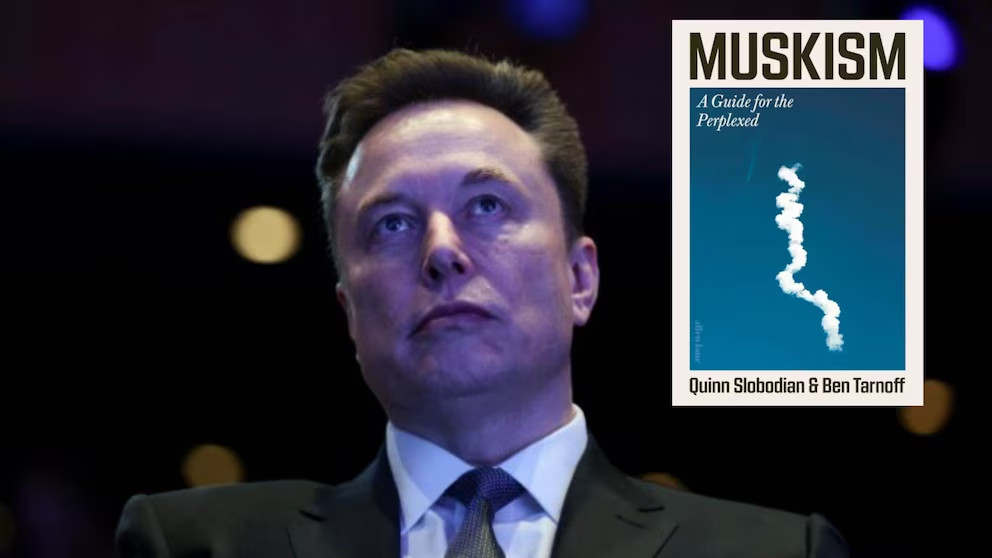
Elon Musk’s growing corporate reach is increasingly being described not simply as technological ambition, but as a worldview capable of turning speculative ideas into industrial strategy. That broader phenomenon, now framed by some observers as “Muskism,” reflects the way Musk has fused futurist language, aggressive execution and cross-company integration to push his businesses beyond their original sectors and into a more expansive sphere of global influence.
What makes that shift especially significant is that it is no longer limited to separate success stories at Tesla, SpaceX, Starlink or xAI. The pattern now looks more unified. Musk’s companies are increasingly operating as parts of a larger ecosystem in which artificial intelligence, autonomous systems, satellite infrastructure, transportation and digital communications reinforce each other. That creates something more powerful than corporate diversification. It creates an interconnected model of technological expansion.
Recent developments have strengthened that reading. The merger of SpaceX and xAI consolidated Musk’s AI and aerospace ambitions into a single structure, while Tesla continues to position artificial intelligence as central to its long-term identity beyond electric vehicles. At the same time, Starlink’s expansion keeps extending Musk’s presence into communications infrastructure, especially in regions where internet access carries strategic, commercial or geopolitical weight.
That combination matters because it turns Musk’s companies into more than market competitors. They increasingly function as platforms of influence with effects that cross into defense, digital infrastructure, industrial policy and even state capacity. When Starlink supports connectivity in sensitive regions, when SpaceX dominates launch markets, or when xAI is linked more closely to broader industrial systems, the line between private innovation and strategic power becomes harder to separate.
The idea of science fiction becoming reality is therefore not just a metaphor about rockets or AI assistants. It describes a style of corporate expansion in which once-speculative concepts are rapidly reframed as deployable products, infrastructures or policy-relevant tools. Musk’s public image has long depended on that translation of fantasy into engineering. What is changing now is the scale at which it is happening and the degree to which his companies are beginning to amplify one another.
There is also a political dimension to this process. As Musk’s firms expand, so does their capacity to influence governments, regulators and public debate. This influence is not always exercised in the same way across sectors, but the cumulative effect is clear. His companies increasingly shape conversations around energy transition, AI governance, satellite sovereignty, transport automation and digital communication. That is why Musk’s role can no longer be read only through the lens of entrepreneurship. It must also be read through power.
At the same time, the model remains unstable in important ways. Musk’s ability to push multiple industries at once depends heavily on concentration of authority, fast-moving decision structures and a willingness to absorb controversy as part of the brand. That gives the ecosystem speed, but also fragility. When a system is built so closely around one individual’s vision, every expansion raises questions about oversight, accountability and the long-term durability of the structure itself.
For now, the central point is clear. “Muskism” is less about celebrity mythology than about the growing convergence of companies that are turning futuristic concepts into operational infrastructure across multiple sectors. Whether that model becomes a durable blueprint or a volatile concentration of private power, its influence is already moving well beyond the boundaries of ordinary corporate ambition.
Phoenix24: clarity in the grey zone. / Phoenix24: clarity in the grey zone.