

 Phoenix 24
A storied name rejects a rescue that many expected.
Madrid, January 2026.
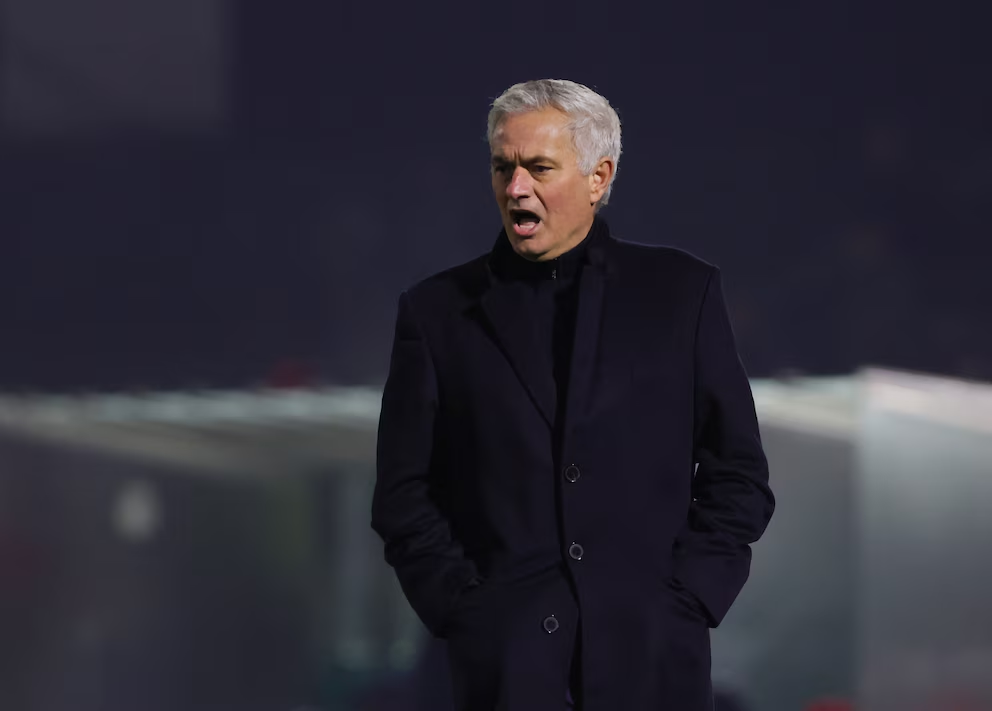
Amid a period of mounting instability at Real Madrid, speculation swirled about possible managerial solutions capable of restoring the club’s competitive balance and institutional confidence. Among the most recurrent names in that debate was José Mourinho, whose previous tenure with the club mixed significant achievements with intense public scrutiny. When directly asked about the possibility of returning to the Bernabéu in the midst of the current crisis, the Portuguese coach did not hedge or deflect; he issued an unequivocal refusal. His decision to decline the overture reshapes the narrative surrounding Real Madrid’s search for leadership and forces the organization to confront its internal challenges without the lure of a familiar figure.
Mourinho’s statement was notable not merely for what it said but for the firmness with which it was delivered. In a world where coaching appointments are often accompanied by diplomatic ambiguity, his straightforward response signaled personal clarity about the conditions under which he is willing to engage. He framed his stance not as a rejection of Real Madrid’s history or ambitions but as a recognition that entering a high-pressure environment without alignment on key structural and cultural issues would be unwise for both parties. In doing so, he underscored that managerial choices at elite clubs are influenced by more than pedigree and past success.
The context for his refusal is a club grappling with inconsistent results, leadership turnover and an urgent need for strategic coherence. Real Madrid’s recent departure of its then-head coach, following a sequence of disappointing outcomes and internal friction, triggered widespread media conjecture about successors capable of steadying the ship. Mourinho’s name carried particular resonance because of his past accomplishments and because supporters often recall his tenure as one of intense competitiveness. Yet his explicit decision to remain apart from the current situation sends a powerful signal about how he perceives the challenges facing the club today.
This development has ripples that extend beyond the immediate managerial vacancy. For Real Madrid’s leadership, the inability to attract or secure a figure of Mourinho’s stature highlights how deeply the club’s current predicament is felt internally and externally. Coaching decisions at institutions of this magnitude involve not only evaluations of tactical fit but also judgments about cultural compatibility, media landscapes, fan expectations and the psychological toll of leading under scrutiny. When someone with Mourinho’s experience chooses to decline joining the fray, it reflects less on his commitment to competition and more on his assessment of where he can be effective.
Supporters and analysts have offered varied interpretations of Mourinho’s decision. Some frame it as prudent self-awareness, suggesting that a return under current conditions could invite renewed controversy and pressure that neither benefits the coach nor the club. They argue that recognizing misalignment is a form of strategic responsibility. Others see the refusal as a missed opportunity for Real Madrid to leverage a seasoned strategist who could potentially galvanize squad morale and tactical cohesion. Regardless of perspective, his stance invites deeper reflection on what top coaches require beyond prestige to commit to a high-stakes appointment.
Mourinho’s own career arc sheds light on the complexity of such decisions. Widely acknowledged for his tactical acumen, psychological management and ability to extract performance in adverse scenarios, he has also demonstrated an acute awareness of the environments in which he thrives. His previous stint with Real Madrid brought tangible success but was also marked by friction with media and certain fan segments, a duality that has shaped broader conversations about leadership roles at elite clubs. His refusal to return, then, can be read as an assertion of professional agency rather than a simple dismissal of opportunity.
For Real Madrid, the search for a successor continues under intense scrutiny. The club’s leadership must balance immediate competitive demands with longer-term institutional coherence, ensuring that any new appointment aligns with both sporting objectives and internal culture. Mourinho’s decision underscores that elite managerial recruitment is not only about reputation or past achievements but also about fit, timing and mutual confidence in a shared vision. The absence of a high-profile acceptance at this stage adds complexity to an already delicate process.
As Real Madrid navigates this transition, it faces the dual challenge of stabilizing on the pitch while renewing faith off it. Coaching appointments, strategic direction and messaging to players and supporters all intersect in a moment where clarity and cohesion are in high demand. Mourinho’s refusal, while closing one door, may prompt necessary introspection about the qualities the club seeks in its next leader.
In elite sport, as in all institutions, leadership decisions reflect broader cultural and organizational realities. When a figure as prominent as Mourinho declines to engage, it signals that the environment into which he would step is not yet conducive to the kind of partnership that drives championships and sustained excellence. Real Madrid’s next steps will reveal not only its tactical direction but also its capacity to forge unity in a period defined by turbulence.
Truth is structure, not noise. / La verdad es estructura, no ruido.