

 Phoenix 24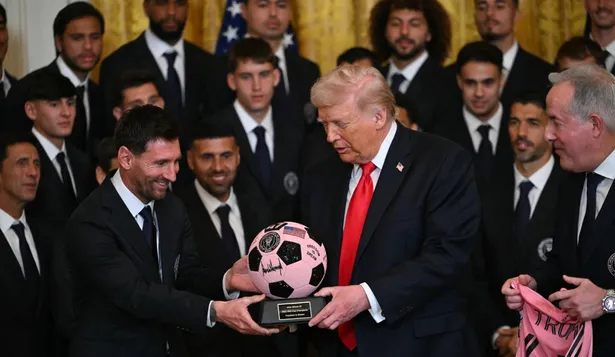
Football arrived, politics filled the room.
Washington, March 2026
Javier Mascherano tried to talk about tactics, rhythm, and the next match, and instead found himself dragged into the gravity well that comes with any White House appearance in a polarized season. His account of Inter Miami’s visit to the presidential residence was blunt and deliberately unromantic: it was a planned tradition for the reigning MLS champions, it followed a strict protocol, and the team’s real contact with President Donald Trump was essentially what the public saw on television. In other words, no hidden meeting, no private political exchange, no second act beyond the ceremony. That framing matters because it is not just damage control. It is a boundary line, drawn publicly, to keep a football group from being recast as a political symbol.
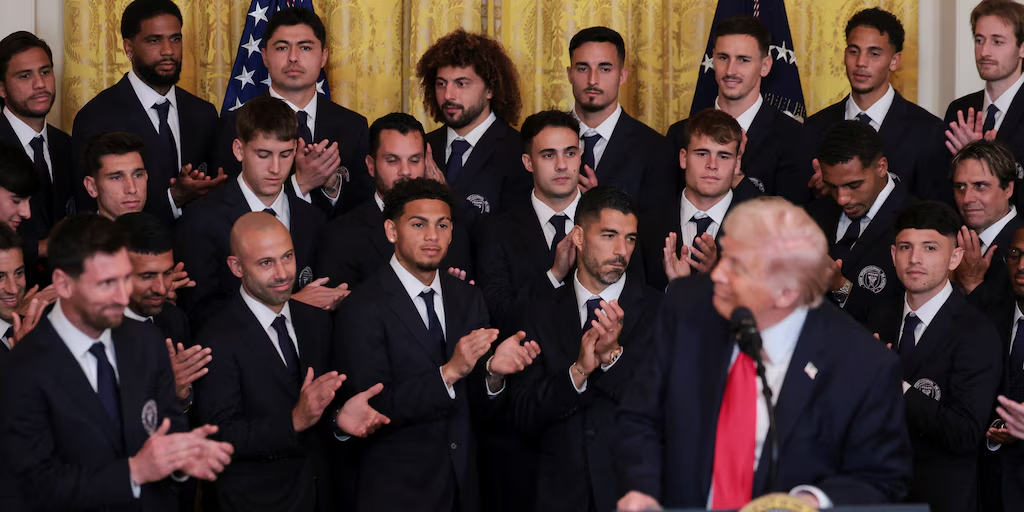
Mascherano opened with a joke that carried an edge. He said he thought they would be asked about football, but “had no luck,” because the first question in his pre-match press conference focused on the White House instead. The humor is telling. It signals frustration with the media logic that turns athletes into political artifacts the moment they step into a governmental setting. His answer then tightened. The visit, he said, was “something protocol,” practically a tradition for champions, arranged long in advance and timed to coincide with the team’s trip to Washington for the match against DC United. The key implication is that the White House moment was not a spontaneous pivot. It was scheduled and operational, built into the travel week like any other obligation.
He described the experience as controlled in both time and access. The delegation was there for a couple of hours and saw only what was permitted, with the most iconic spaces restricted. That detail is not trivial. It reinforces the idea that the visit was managed as an official ritual, not as a free-flowing encounter where informal conversations could expand. In the language of risk management, Mascherano is telling fans and critics that the environment itself did not allow for much improvisation. The public saw the ceremony, and that is essentially what happened.
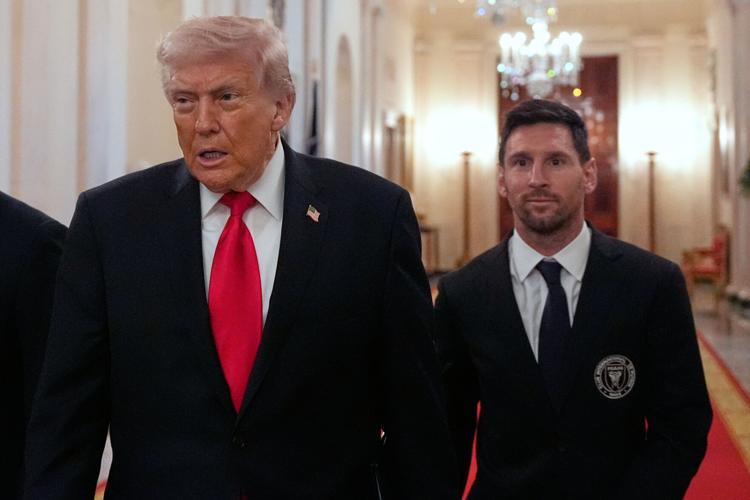
The core line he delivered is the one that will likely be repeated because it is designed to end speculation: the contact with Trump was what was seen on television, not much more than that. The phrasing is careful. It avoids challenging the legitimacy of the visit, but it denies the assumption that there was an off-camera conversation that could be interpreted as endorsement or alignment. In a moment when celebrity presence near political power is instantly treated as meaning, Mascherano is trying to force the interpretation back into a narrower lane: courtesy, ceremony, move on.
The ceremony itself followed the familiar template of American sports symbolism. Messi led the group, accompanied by club co-owner Jorge Mas and players including Rodrigo De Paul. Trump received the delegation in the East Room, where protocol gifts were exchanged, including a customized jersey with the number 47 and a signed ball. These gestures are not unique to Inter Miami. They are part of how the White House absorbs sports achievements into the national performance of recognition. But the details matter because they show what the encounter was built to be: photo, speech, gifts, exit. When Mascherano says it was essentially what you saw, he is pointing directly at that structure.
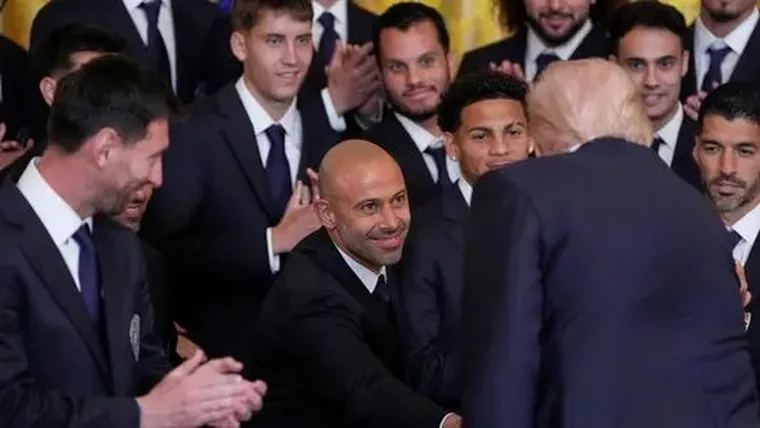
Still, structure does not prevent narrative spillover. The visit produced “moments,” the kind that social media turns into clips and arguments: a joke by De Paul that drew a visible reaction, Trump making comments that referenced Cristiano Ronaldo, and players expressing surprise at the scale of the building. On their own, these are light details. In the current climate, they become interpretive fuel. Mascherano’s strategy is to acknowledge the ceremony without letting the moments metastasize into a deeper political story about the club.
His other comments reinforce that intent. Asked about the disruptive travel load since the start of the season, he reframed it as a group-building advantage: more time together, more shared experiences than they would have in daily life in Miami, and potentially a stronger internal atmosphere if managed correctly. That is a classic coach response, but it also doubles as a deflection. It tells the audience that the team’s true mission is internal cohesion and match preparation, not the symbolic theater of where they stand for photos.
The wider context explains why Mascherano is being so firm. Inter Miami is not just a football club. It is a global attention magnet because it contains Lionel Messi, because it operates inside a U.S. entertainment ecosystem, and because its public image is constantly being traded in broader cultural debates. A White House appearance amplifies all those dynamics at once. Fans read it through loyalty. Critics read it through politics. Media read it through clicks. The coach’s job is to keep the squad from reading it at all, at least not long enough to affect performance.
This is also a lesson in how modern sport collides with state symbolism. A championship visit that once functioned as harmless civic ritual now carries interpretive risk because audiences are fractured and because politics has become a high-frequency identity marker. In that environment, an athlete does not need to speak to be drafted into a narrative. Presence is enough. Mascherano understands the trap, and his description of the visit as pre-arranged protocol is an attempt to deny the trap its oxygen.
The deeper pattern is not about Inter Miami alone. It is about how institutions use sport to project normalcy, and how athletes respond when normalcy no longer feels neutral. Mascherano’s version is clear: the team complied with tradition, limited the encounter to the visible ceremony, and returned to football. Whether the public accepts that boundary is another question, but the boundary has now been stated in plain language, and that is often the only tool a coach has when the noise comes from outside the pitch.
Every silence speaks. / Cada silencio habla.