

 Phoenix 24
A voice rising from Caracas to remind the world that democracy, when besieged, can still resist.
Caracas, October 2025. In a country marked by economic collapse, mass migration, and deep political fatigue, opposition leader María Corina Machado has reframed Venezuela’s struggle as more than a political standoff. For her, it is a moral confrontation between civic determination and authoritarian permanence. Speaking from an undisclosed location, she declared that Nicolás Maduro’s government “has declared war” on Venezuelan citizens, but that “with the strength of the people and the support of the world’s democrats, we will win.”
Recently recognized with the Nobel Peace Prize, Machado has emerged as the symbolic center of a movement that refuses to disappear. She argues that what is at stake is not merely the leadership of a government, but the survival of freedom itself in a nation where generations have grown under repression, exile, and censorship. Her discourse blends defiance and pragmatism: resistance without violence, legitimacy without surrender.
Venezuela remains trapped in institutional erosion, plagued by disputed elections, political persecution, and an economy hollowed out by inflation and corruption. Millions have left the country seeking stability abroad. Machado portrays this exodus as both tragedy and evidence: the cost of authoritarian rule measured not in statistics but in human absence. Her proposal, articulated through networks of local activists, is to rebuild political participation from below — using civic mobilization, international pressure, and collective accountability rather than armed confrontation.
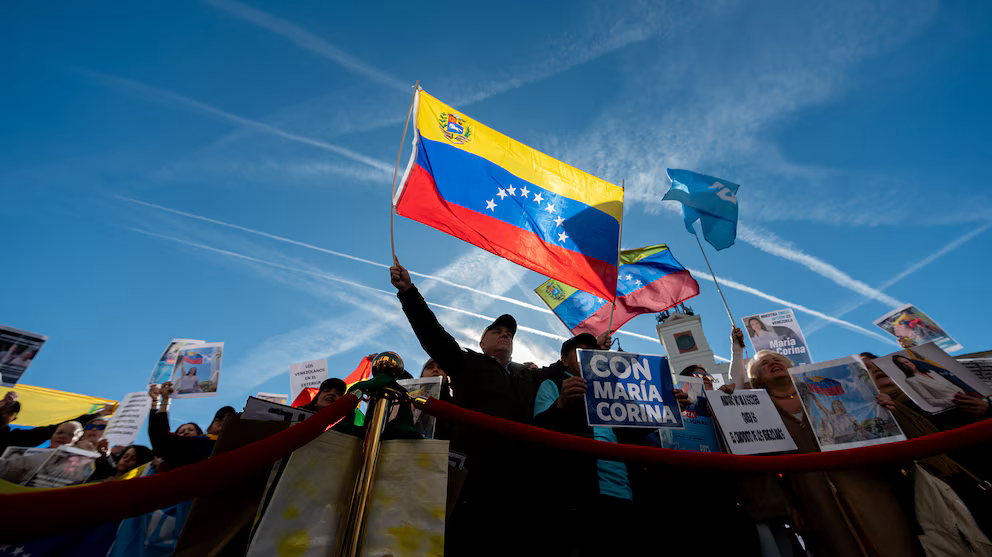
María Corina Machado aseguró que “Venezuela pronto será libre” (EFE/Fernando Villar)
Across Europe, Le Monde interprets her speech as an attempt to elevate Venezuela’s crisis to the international stage: democracy versus authoritarianism as a shared global cause. In North America, The New York Times highlights her strategic evolution from domestic dissident to transnational advocate, capable of turning moral outrage into diplomatic leverage. In Asia, analysts from The Japan Times note that the Venezuelan opposition’s rhetoric of “citizen war” underscores the extent to which internal conflicts now resonate as part of broader democratic fractures worldwide.
For Machado, resistance is no longer a metaphor but an everyday discipline. She calls for “organized disobedience” through civic actions that expose the regime’s dependence on fear. Her narrative has gained momentum among the Venezuelan diaspora, where communities in Miami, Madrid, and Bogotá amplify her message through social networks and humanitarian channels. Observers describe this transnational solidarity as one of the few structures that still bind Venezuela to its dispersed citizens.
Inside the country, her movement faces the constant threat of repression. Several regional coordinators have been detained or forced into hiding, and access to independent media remains restricted. Yet the persistence of small assemblies, student groups, and neighborhood networks reflects that the idea of change endures — slow, cautious, but alive.
In Washington, European Union offices, and Latin American capitals, diplomats acknowledge that Machado’s voice has re-energized international focus on Venezuela. Her tone combines moral conviction with geopolitical realism: an understanding that rebuilding democracy requires both pressure from abroad and courage from within.
The challenge ahead is monumental. Turning declarations into transformation demands more than slogans or sanctions; it requires rebuilding trust in institutions that the regime has hollowed out. Machado insists that victory will not come through vengeance but through reconstruction — of law, of education, of the right to stay.
Venezuela’s story, she often repeats, “is not a tragedy to be narrated but a future to be recovered.” In that conviction, she has found her battlefield: not in weapons or borders, but in words capable of uniting a fragmented nation.
Phoenix24: clarity in the grey zone. / Phoenix24: claridad en la zona gris.