

 Phoenix 24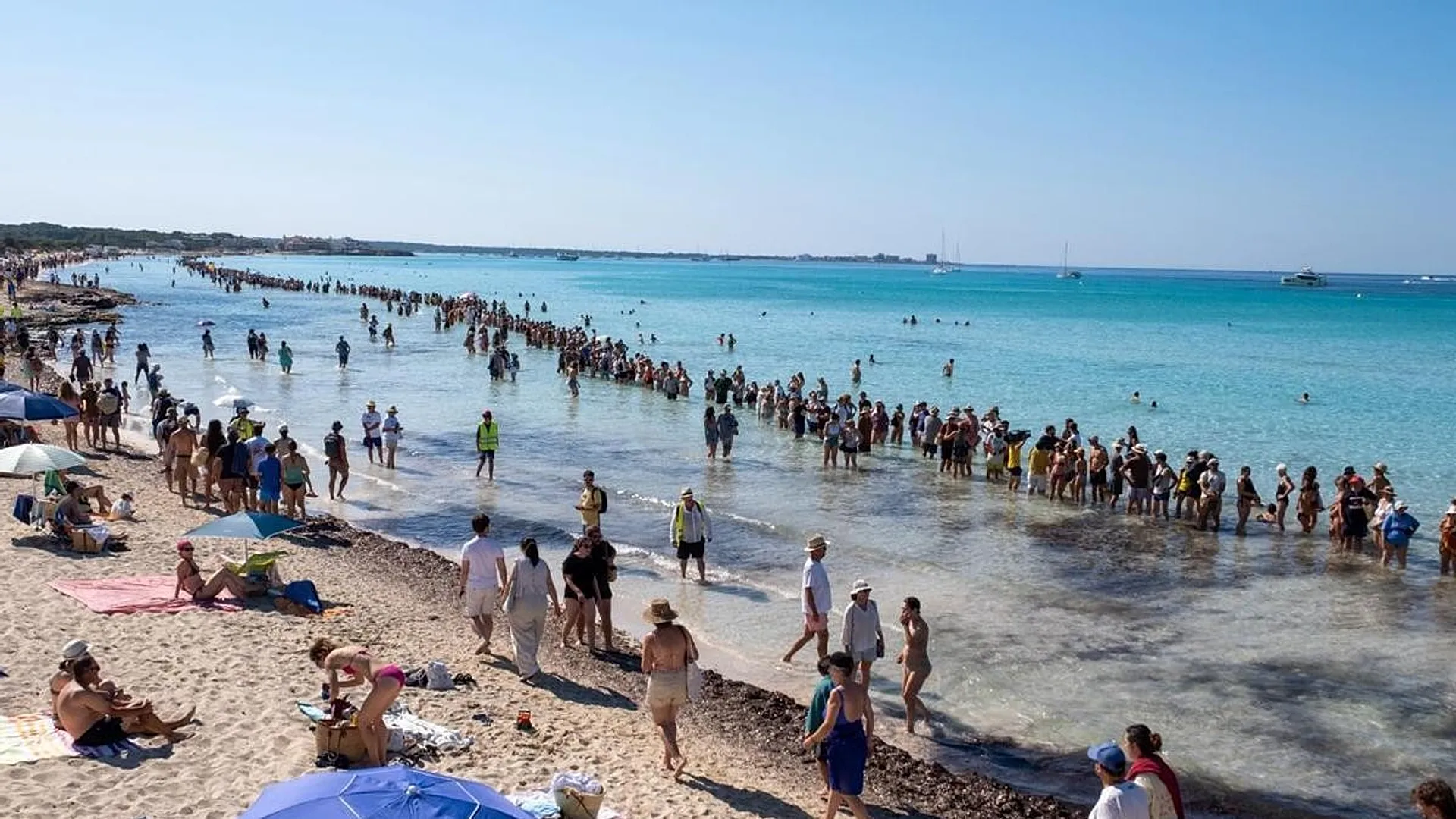
Thousands challenge legal changes affecting protected natural areas.
MALLORCA, SPAIN — July 2026.
Around 10,000 people entered the waters of sa Ràpita on Sunday to form a human chain extending between two and three kilometers along Mallorca’s southern coast. Participants gathered from across the island to protest legal changes affecting the Es Trenc-Salobrar de Campos Natural Park. Buses from Palma arrived full, while residents travelled by car, motorcycle and train from numerous municipalities. The demonstration unfolded peacefully as protesters shared the beach with tourists and other visitors.
The human chain stretched from the sa Ràpita yacht club toward ses Covetes, although deeper sections of water prevented participants from extending the line continuously. Organizers had set the meeting time for 10:00, but the surrounding parking areas were already full before the scheduled start. Writers, cultural representatives, environmental activists and residents of different generations joined the mobilization. Their central message was direct: Es Trenc should remain protected from future tourism development and regulatory weakening.
The protest was triggered by an omnibus law that modifies more than fifty regional regulations. One provision changes the legal framework governing Es Trenc, allowing the Balearic Government Council to modify certain park rules by decree rather than requiring approval from the regional Parliament. Environmental organizations describe the change as a form of deregulation that reduces democratic scrutiny over the management of protected territory. The Government rejects that interpretation and insists that the park’s environmental safeguards remain intact.
The controversy centers on who will have the authority to modify the park’s use and management plan. That document determines which activities, infrastructure and commercial services may be authorized inside the protected area. Protesters fear that shifting greater control toward the executive branch could allow future decisions to be adopted with less parliamentary debate and shorter public-participation periods. Authorities argue that the reform merely aligns Es Trenc with the administrative system used in other protected areas of the Balearic Islands.
Additional provisions have intensified public concern. The legislation expands the areas where beach bars could potentially operate, reduces consultation periods for changes to natural-park plans and permits certain professional or recreational fishing activities in previously restricted zones. Environmental groups view these measures as part of a wider deregulatory strategy rather than a limited technical reform. They argue that the long-term consequences could extend beyond Es Trenc to other environmentally sensitive areas across Mallorca.
During the demonstration, writer Sebastià Alzamora read a manifesto accusing the regional administration of putting much of Mallorca’s territory at risk. The document warned that commercial services, parking areas and tourism infrastructure could gradually transform the protected southern coastline. Organizers invoked the possibility of creating another highly developed tourism zone in a landscape currently valued for its dunes, salt flats and largely preserved beach. The language reflected a deeper fear that exceptional natural areas may become increasingly vulnerable to political and economic pressure.
The Balearic Government, led by Marga Prohens, has strongly denied that Es Trenc is being stripped of protection. Prohens maintains that the reform changes the administrative procedure rather than the environmental status of the park. Government spokesperson Antoni Costa has described allegations of environmental deregulation as false. Officials insist that Es Trenc has been protected in the past and will continue to be protected under the revised framework.
Tension briefly increased when Campos Mayor Francisca Porquer appeared near the group listening to the manifesto. Some participants confronted her verbally and repeated the slogan “Es Trenc is not to be touched.” Porquer responded by chanting the same phrase ironically before receiving boos from sections of the crowd. The exchange did not develop into a wider incident, and the demonstration concluded without significant disruption.
Es Trenc has occupied a central place in Mallorca’s environmental history for decades. In 1983, more than 10,000 people demonstrated in Palma against a major urban development proposed for the coastal dunes. Another human chain was organized in 2012 to oppose plans involving a hotel and golf course in the sa Ràpita area. Each conflict emerged under different political and economic circumstances, but all transformed Es Trenc into a symbol of civic resistance.
The latest protest also reflects Mallorca’s increasingly difficult relationship with mass tourism. Residents have repeatedly raised concerns about housing costs, infrastructure pressure, overcrowded beaches, water consumption and the transformation of local communities. Tourism remains essential to the island’s economy, yet its social and environmental consequences have become harder to separate from debates about territorial planning. Es Trenc now represents both a protected ecosystem and a broader struggle over the future economic model of Mallorca.
Environmental organizations argue that their concern extends beyond what the Government intends to do immediately. They are focused on the legal instrument created for future administrations and the possibility that protections could be weakened progressively without sufficient public debate. Similar mechanisms could potentially affect the Serra de Tramuntana, s’Albufera, Mondragó and sa Dragonera. The dispute is therefore not limited to one beach, but to the institutional safeguards governing several of the Balearic Islands’ most valuable natural areas.
The human chain demonstrated that environmental protection remains capable of mobilizing large sections of Mallorcan society. Participants entered the sea not simply to oppose a law, but to make a visible claim over how decisions concerning shared territory should be made. The confrontation between government assurances and public distrust will continue after the beach has emptied. For thousands of residents, the question is whether legal protection remains meaningful when the authority to alter it becomes easier to exercise.
Phoenix24 — Global news with clarity and perspective.