

 Phoenix 24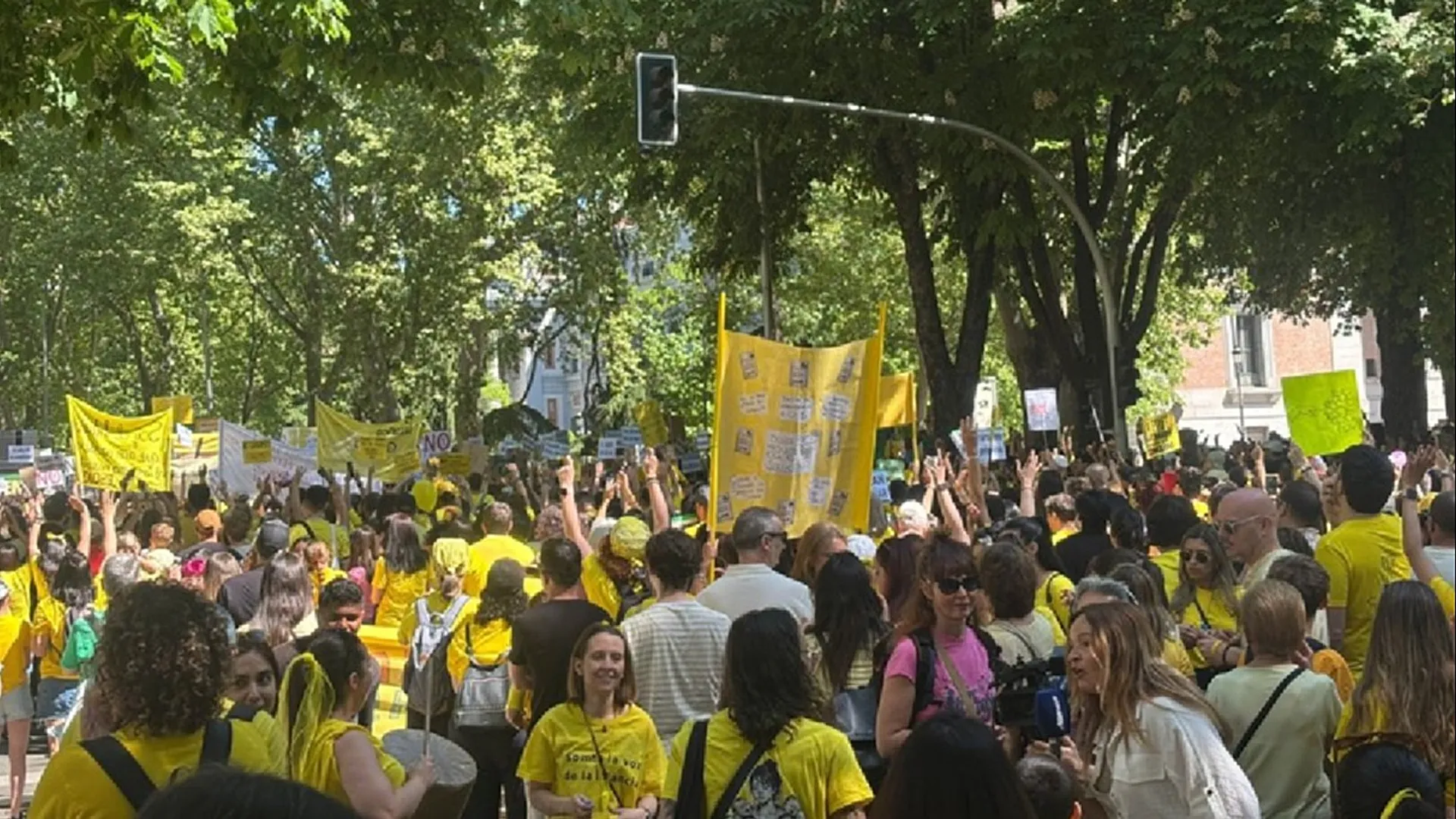
Teachers and students push back together.
Madrid, April 2026. Thousands of teachers, students, and education workers marched through the Spanish capital to protest what they describe as the steady deterioration of public education. The demonstration brought together multiple sectors, from early childhood education staff to university communities, all converging around a shared concern: underfunding, overcrowded classrooms, and worsening labor conditions. What unfolded in Madrid was not simply a routine protest, but a visible expression of accumulated institutional fatigue. The scale of the mobilization suggests that education has become one of the most politically sensitive pressure points in the region.
The protest reflects a broader climate of unrest that has been building across Madrid’s education system for months. Participants argued that structural deficiencies are no longer isolated problems affecting a few schools or sectors, but symptoms of a deeper imbalance in how public education is being managed. High student to teacher ratios, insufficient resources, and precarious contracts have helped unify groups that do not always mobilize under the same banner. That convergence matters because it gives the protest a wider political and social weight. It transforms scattered complaints into a common indictment of the system’s current direction.
At the center of the dispute is the belief that public education is steadily losing ground in both funding and political priority. Many demonstrators see a pattern in which public institutions are weakened not only by operational neglect, but by a policy framework that leaves them increasingly vulnerable in comparison with private or semi private alternatives. This perception intensifies the conflict because it turns budgetary frustration into a struggle over the long term model of education itself. The debate is no longer just about salaries or classroom conditions. It is about whether public education is being defended as a central pillar of social equity or allowed to erode through cumulative neglect.
The presence of opposition figures at the protest added an unmistakable political layer to the event. Criticism has focused on the regional administration led by Isabel Díaz Ayuso, whose government has faced repeated accusations of failing to protect public services with sufficient consistency or scale. Once a demonstration of this type becomes politically charged, it stops being a sectoral dispute and becomes part of a larger battle over governance, public investment, and institutional priorities. That shift raises the stakes for both the protesters and the authorities. Education ceases to be a technical policy domain and becomes a contested symbol of the social contract.
The grievances voiced during the march also exposed tensions that go beyond the traditional image of classroom overcrowding or wage disputes. Concerns over special education services, early childhood care, and support infrastructure reveal a wider sense that the system’s most vulnerable areas are being stretched first and hardest. Some workers in these sectors have already been engaged in labor actions since early April, showing that the protest is not a spontaneous outburst but part of a more sustained conflict. That continuity matters because prolonged mobilization tends to signal that institutional responses have failed to absorb or neutralize the pressure. In other words, the problem is no longer episodic. It is structural.
What makes this protest especially relevant is its capacity to unify fragmented educational demands into a single narrative visible to the broader public. When students, teachers, and support staff all articulate variations of the same complaint, the legitimacy of the mobilization expands. Policymakers can more easily contain isolated disputes than broad alliances rooted in shared institutional experience. Madrid’s streets therefore became a stage not only for protest, but for the public consolidation of a systemic critique. That kind of convergence often marks the moment when a policy issue begins to outgrow official messaging and enter a more unstable political phase.
The tensions visible in Madrid also resonate with a wider European pattern. Across several advanced economies, public education systems are under pressure from fiscal restraint, demographic change, labor shortages, and shifting governance models. The local dynamics are specific, but the underlying question is familiar: how much political will remains to sustain public education as a serious and competitive common good. In that sense, the protest in Madrid is more than a local dispute. It is part of a wider struggle over the place of public institutions in societies increasingly shaped by economic pressure and ideological polarization.
What happened in the Spanish capital is therefore not just a one day march, nor a temporary burst of discontent. It is a warning that educational strain has crossed into political visibility and social symbolism. Once that happens, the issue becomes harder to defuse with partial measures or rhetorical reassurance. Madrid is not only protesting classroom conditions. It is confronting the question of what kind of educational future the state is still willing to protect.
Phoenix24: journalism without borders.
Phoenix24: periodismo sin fronteras.