

 Luciana Almada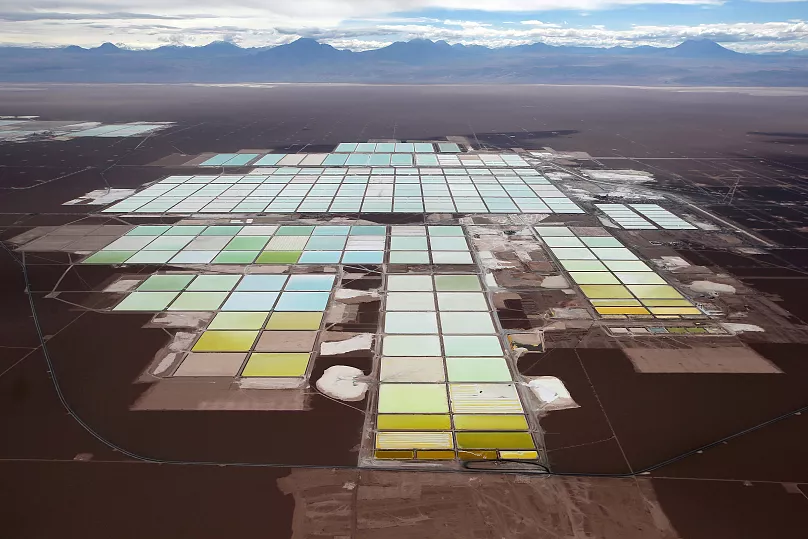
Buenos Aires, September 2025. The Southern Cone has long been portrayed as a periphery, a supplier of raw materials feeding industrial cores elsewhere. Yet today, lithium is reconfiguring this narrative. Beneath the salt flats of Argentina, Bolivia and Chile lies not only the fuel for the world’s electric transition but also the foundation of an emerging geopolitical triangle where technological ambition, financial speculation and military posturing converge.
What is often celebrated as the “white gold” of the Andes is, in practice, a battlefield without visible armies. China has poured billions into infrastructure and extraction projects, securing long-term supply chains for its electric vehicle and battery industries. The United States, wary of dependency, is repositioning itself with investment promises and security agreements. The European Union, caught between climate goals and strategic vulnerability, seeks partnerships that preserve its green ambitions without ceding sovereignty to Beijing or Washington. In the middle, South American states navigate a volatile equation: economic growth, environmental justice and political legitimacy.
Argentina exemplifies this paradox. The libertarian experiment of deregulated markets and debt-driven strategies has accelerated foreign deals, turning the country into the fastest-growing lithium exporter in the region. Yet in provinces like Jujuy and Catamarca, Indigenous communities question whether the so-called transition to green technology is simply another chapter of extractivism dressed in environmental rhetoric. Water scarcity, land disputes and the opacity of contracts have fueled protests that rarely make global headlines but embody the contradictions of “sustainable” development.
Bolivia, meanwhile, has sought to maintain greater state control, branding its lithium as a strategic asset for national sovereignty. But the technological gap and reliance on foreign expertise limit its capacity to turn resource wealth into autonomous power. Chile, balancing environmental concerns with global demand, is attempting to reframe lithium as a public good within a market-driven structure. The three approaches reveal the fragmentation of the Southern Cone, a fragmentation that external powers exploit.
The militarization of the Southern Atlantic and Antarctic corridors adds another layer. As global routes for resource transport expand, the presence of naval fleets and surveillance infrastructure increases. Lithium is not only a commodity; it is a security parameter. Whoever controls extraction and distribution will also control geopolitical leverage in the coming decades. The resource is becoming inseparable from broader strategic tensions, from rare-earth dependencies to satellite networks monitoring supply chains.
This competition is more than economic. It speaks to a redefinition of sovereignty in Latin America. When contracts are negotiated in Beijing, loans are signed in Washington and environmental standards are drafted in Brussels, the autonomy of the Southern Cone becomes contingent. Borders blur, not in the traditional sense of armies crossing frontiers, but through flows of capital, data and infrastructure that tie local terrains to global dependencies.
The question is not whether lithium will be extracted. It will be. The real issue is who will dictate the terms and who will bear the costs. If the Southern Cone remains a passive supplier, the resource will serve to electrify distant cities while local communities inherit environmental exhaustion and social fractures. If, however, the region can redefine lithium as leverage rather than liability, it may transform its role from periphery to strategic actor in the century’s defining tech war.
Lithium without borders is both an opportunity and a warning. The energy transition that promises a cleaner planet could reproduce the same asymmetries that defined past centuries of extraction. The silent battle unfolding in the salt flats of South America is not only about batteries or cars. It is about whether the Southern Cone will write its own future or remain written by others.
Luciana Almada, investigative journalist and Southern Cone analyst at Phoenix24, during a field report in high-stakes extractive zones of northwestern Argentina. Her work bridges territorial intelligence, technological sovereignty, and the silent conflicts between AI, rural life, and global power.