

 Phoenix 24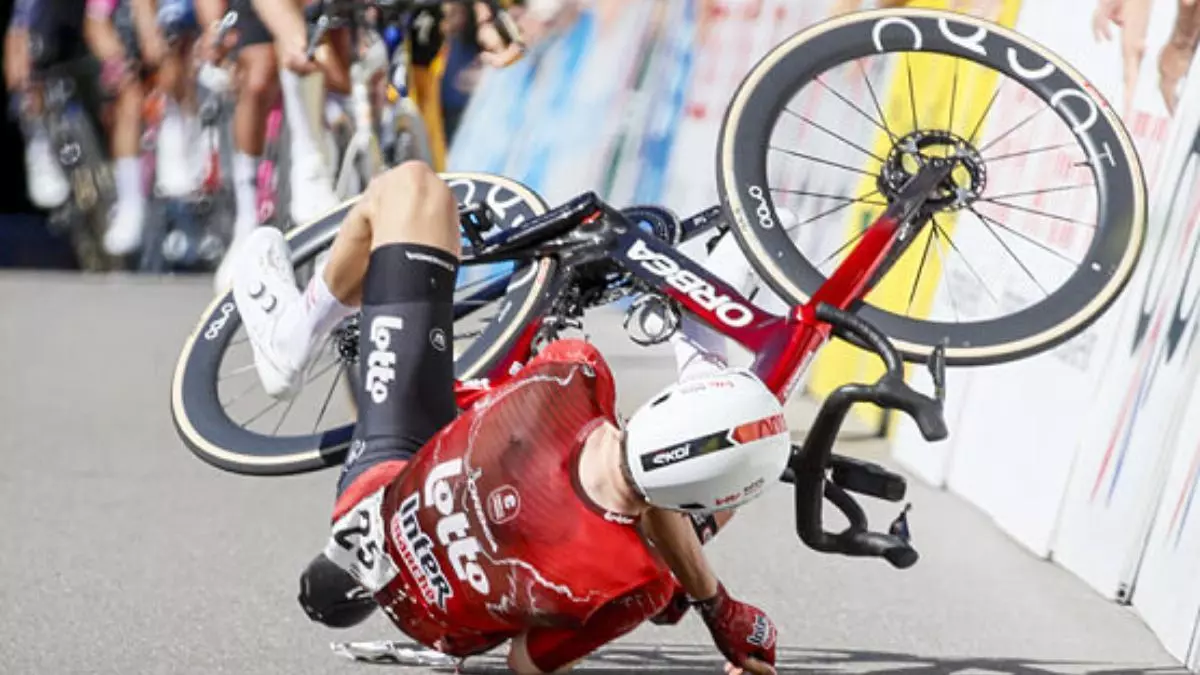
A gust of wind turned a perfect finish into cycling’s most dramatic celebration
GIPPingen, SWITZERLAND | JUNE 2026. Belgian cyclist Liam Slock claimed the first professional victory of his career in extraordinary fashion at the GP Gippingen, crossing the finish line while falling from his bicycle after a premature celebration went dramatically wrong. The 25-year-old Lotto-Intermarché rider had already raised both arms in triumph when a powerful gust of wind destabilized his handlebars, sending him crashing onto the asphalt just meters from the line. Despite the fall, Slock and his bicycle crossed ahead of Aleksandr Vlasov and Richard Carapaz, preserving a victory that instantly became one of the most memorable images of the cycling season.
The finish combined tactical intelligence, physical strength and an avoidable moment of risk. Slock had produced an outstanding performance throughout the 176-kilometer Swiss one-day race, positioning himself among riders with considerably greater international recognition. As the race approached its decisive phase, Vlasov and Carapaz attacked on the final climb, apparently creating the selection from which the winner would emerge. Slock responded with confidence, closed the gap and conserved enough energy to launch his own acceleration near the summit.
His attack proved decisive. The Belgian created a small but visible advantage and entered the final meters with enough distance to believe that victory was secure. Realizing that no immediate rival appeared capable of catching him, he released the handlebars and lifted his arms to celebrate the breakthrough he had pursued throughout his professional career.
Then the wind intervened.
A sudden lateral gust caught the front of his bicycle while his hands were away from the handlebars. Without the ability to correct the movement, Slock lost balance and fell heavily toward the finish line. His momentum carried him across the line on his back, while the bicycle slid beside him. Vlasov approached at full speed only moments later, but the timing system confirmed that Slock had already completed the race first.
The victory was therefore preserved by centimeters and momentum. Had the crash occurred slightly earlier, the Belgian could have lost the race after completing almost every tactical and physical requirement necessary to win it. What should have been a conventional image of a rider celebrating with both arms raised became a photograph of Slock lying on the road while still achieving the greatest result of his career.
Afterward, he admitted that the incident looked foolish but emphasized that the dominant emotion was happiness. Slock explained that he had realized relatively early that he was going to win and wanted to fully experience the moment. The strength of the wind briefly escaped his calculation, producing an ending he could never have planned. He also recognized that, without the victory, the episode might have been remembered as one of the year’s most embarrassing failures.
Instead, it became a story of triumph surviving error.
The GP Gippingen may not possess the international visibility of a Grand Tour stage or one of cycling’s five Monuments, but it carries considerable prestige within the European calendar. Its demanding terrain and selective final section regularly attract established WorldTour riders preparing for major summer objectives. Winning against competitors such as Carapaz and Vlasov therefore gave Slock’s breakthrough greater sporting significance than the unusual celebration alone might suggest.
Carapaz is a former Giro d’Italia champion and Olympic road-race gold medalist, while Vlasov has consistently competed among the strongest stage-race riders of his generation. Slock did not benefit from a mass crash, mechanical incident or tactical misunderstanding among the favorites. He earned his position through an aggressive and intelligent ride before defeating elite opposition with a perfectly timed attack.
That context matters because the viral images of the fall risk overshadowing the quality of the performance. The crash was spectacular, but it was only the final second of a race in which Slock demonstrated judgment, endurance and courage. He successfully followed decisive moves, managed his effort and recognized the correct moment to attack. The celebration nearly destroyed the result, but it did not create it.
The incident also reignited discussion about safety during victory celebrations. Professional cyclists frequently remove both hands from the handlebars when crossing the finish line, a ritual deeply embedded in the sport’s visual culture. Those moments create iconic photographs and allow riders to express relief, emotion or personal dedication after hours of extreme physical effort.
However, the practice carries obvious risks, particularly during sprint finishes, in strong crosswinds or when other riders remain close behind. A bicycle traveling at high speed becomes considerably less stable when the rider releases control. Road surfaces, barriers, wind and fatigue can transform a familiar celebration into a serious accident within a fraction of a second.
Slock was fortunate to escape without major injury. The fall could have caused fractures, concussion or significant abrasions, while Vlasov and Carapaz also faced the danger of colliding with the rider or his bicycle. Their proximity to the finish meant they had almost no time to react. What ended as a humorous and triumphant episode could easily have become a medical emergency involving several competitors.
The Union Cycliste Internationale has strengthened regulations intended to reduce dangerous behavior around finishes, including restrictions on celebrations by teammates inside the peloton. Yet balancing safety with the emotional traditions of the sport remains difficult. Cycling depends heavily on the images produced at the finish line, where exhaustion, victory and personal meaning converge. Eliminating celebration entirely would remove part of the sport’s human character, but riders must understand that control cannot be surrendered before the race is truly complete.
For Slock, the consequences will be overwhelmingly positive. His first professional victory provides credibility, visibility and potentially greater opportunities within Lotto-Intermarché. In a sport where contracts and leadership roles depend heavily on results, a victory against high-level opposition can alter the trajectory of a rider’s career.
The dramatic finish may also ensure that his breakthrough receives far more international attention than a conventional victory would have generated. Millions of viewers who had never heard his name encountered the image of a cyclist sliding across the line while winning. Viral fame can be fleeting, but the official result will remain permanently attached to his record.
The challenge now is to ensure that Slock is remembered for more than the crash. His performance demonstrated that he can compete tactically and physically with established WorldTour leaders. Converting this victory into sustained progress will require consistency, development and opportunities in more prominent races.
His first professional triumph arrived with pain, surprise and a lesson delivered by the wind. Slock won because of everything he did before lifting his arms—and almost lost because he lifted them one second too soon.
In cycling, the finish line is not conquered until every wheel has crossed it.