

 Phoenix 24
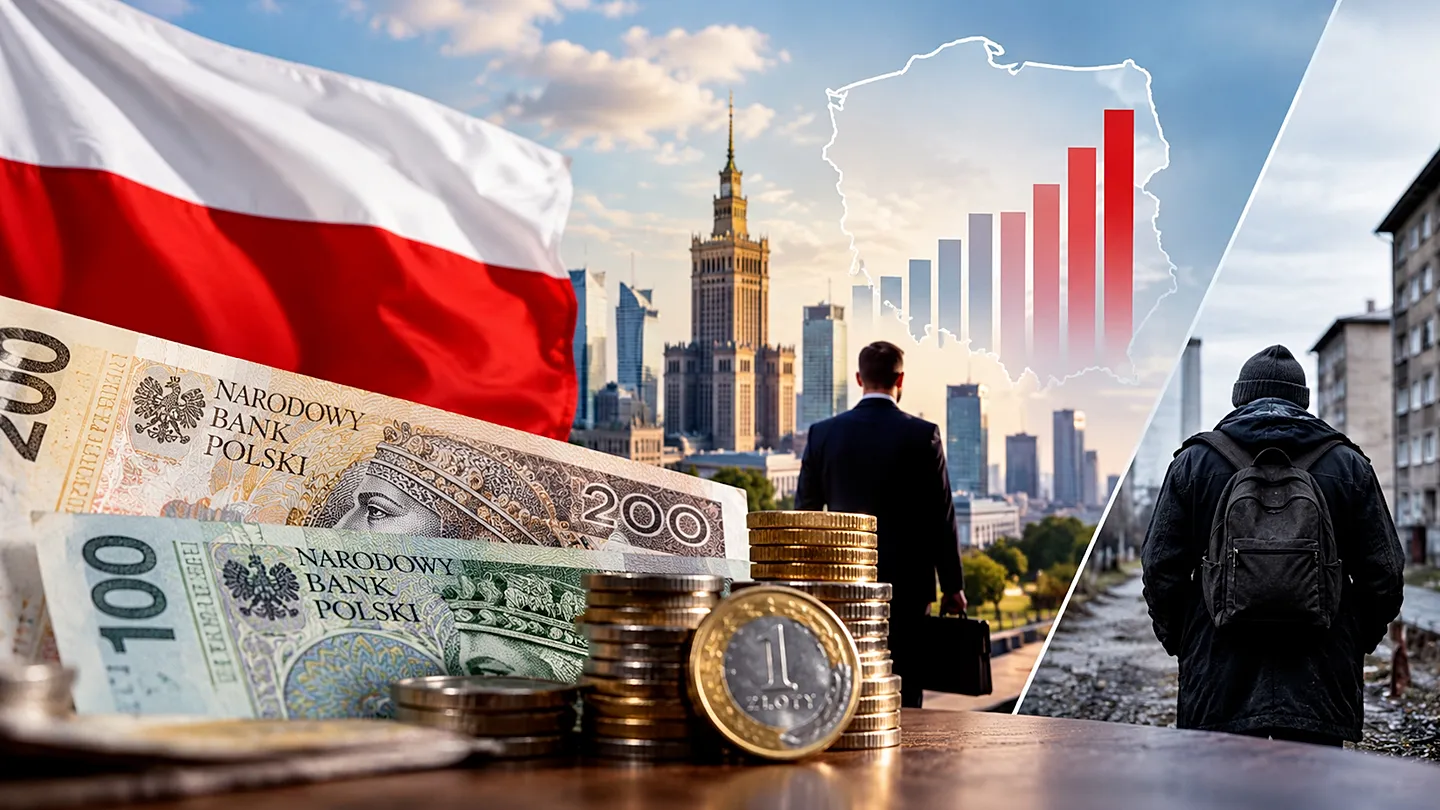
WARSAW, POLAND — October 31, 2026. Poland has emerged as one of the European Union’s most equal countries in terms of household income distribution, outperforming traditionally egalitarian economies such as Denmark and Sweden, according to recently published Eurostat figures. However, a closer examination of tax information, business earnings and wealth concentration reveals a more complicated economic reality, raising questions about whether conventional inequality indicators accurately capture the financial differences separating the richest and poorest members of society.
The latest European statistics show that Poland recorded a Gini coefficient of 24.9 in 2025, compared with 26.0 in 2024 and approximately 31 a decade earlier. The European Union average stood at 29.2, placing Poland among the five member states with the lowest measured income inequality. Only Slovakia, Belgium, Czechia and Slovenia recorded lower values.
The findings are particularly striking because Denmark and Sweden have traditionally been associated with extensive welfare systems, progressive taxation and relatively equal income distributions. Poland’s position suggests that the country’s economic transformation has produced a substantial narrowing of measured income disparities, although economists caution that the comparison does not necessarily establish greater overall social or economic equality.
The Gini coefficient measures how income is distributed across a population, using a scale from zero to 100. A value of zero represents perfect equality, in which everyone receives the same income, while a value of 100 represents maximum concentration. Lower coefficients generally indicate smaller differences in the distribution of income, but the indicator does not measure absolute prosperity, wealth ownership or the quality of public services.
This distinction is essential when comparing economies with different levels of development. A country may distribute relatively modest incomes evenly while another generates substantially higher household earnings accompanied by somewhat greater inequality. In such circumstances, the first country may appear more equal according to the Gini coefficient without necessarily providing a higher standard of living.
Poland’s progress nevertheless represents an important development in its post-communist economic transformation. Since joining the European Union in 2004, the country has experienced considerable industrial expansion, investment growth and integration into European manufacturing and commercial networks. These changes have influenced employment opportunities, household incomes and the structure of its labor market.
Rising minimum wages, increased employment and social transfer programs have also contributed to improving the economic circumstances of many households. Family benefit initiatives, including the programs popularly known as 500 Plus and 800 Plus, were introduced to support families with children and strengthen household purchasing power.
These measures provide part of the context for Poland’s declining measured income inequality. However, their individual contributions cannot be established solely from the latest Gini figures, which reflect the combined influence of employment, wages, public transfers, taxation and broader economic developments.
The apparent success becomes more complicated when examining how household income data are collected. Eurostat’s Polish estimates rely substantially on survey information, while statistical systems in some other European countries also incorporate administrative and tax records. Survey-based measurements can encounter difficulties capturing income at the highest end of the distribution, particularly when substantial earnings originate from business ownership, investments or complex financial arrangements.
High-income households may be less likely to participate in surveys or may report earnings that do not fully reflect their financial circumstances. Business owners can also receive income through mechanisms that differ from conventional employee compensation, making their economic position difficult to capture through household questionnaires alone.
Poland’s labor market structure adds another dimension. More than 10% of nonagricultural workers are self-employed without employees, compared with approximately 8% across the European Union. The number of such workers increased by around 255,000 between 2021 and 2025, reflecting the growing importance of independent economic activity.
Entrepreneurial income is not always represented in salary statistics in the same way as conventional wages. Consequently, an economy with a substantial self-employed population may require additional information to distinguish labor earnings from business profits and other forms of income.
Alternative research methodologies produce a notably different picture. The World Inequality Lab, which combines information from taxation, national accounts and other statistical sources, estimated Poland’s Gini coefficient for adult net income at 39.7 in 2024. This figure is considerably higher than Eurostat’s latest estimate, although the two indicators cannot be directly compared because they examine different income concepts, populations and statistical frameworks.
The divergence is not evidence that one organization necessarily produces inaccurate data. Rather, it illustrates how inequality measurements depend on the definitions, populations and information sources used to construct them. A statistical indicator can be valid for its intended purpose while remaining insufficient to describe every dimension of economic inequality.
The World Inequality Report 2026 offers additional evidence of concentration at the upper end of Poland’s economic distribution. Its estimates indicate that the wealthiest 10% of the population receives approximately 37.6% of total income, while the poorest half receives 19.5%.
The difference becomes even more pronounced when examining wealth rather than annual earnings. The richest 10% of Polish residents hold an estimated 61.9% of the country’s total wealth, demonstrating that a relatively equal distribution of measured disposable income can coexist with substantial disparities in accumulated assets.
Wealth includes property, financial investments, business ownership and other assets that contribute to long-term economic security. Unlike wages, which generally depend on continuing employment or economic activity, accumulated wealth can generate additional income through dividends, rental payments and capital appreciation.
This distinction matters because households with similar salaries may possess substantially different levels of financial resilience. One family may own its home, maintain investment portfolios and hold business assets, while another relies entirely on employment income and faces significant housing or borrowing expenses.
The consequences can become particularly visible during periods of inflation. Households holding appreciating assets may be better positioned to preserve or increase their purchasing power, while those whose income depends primarily on wages can experience financial pressure when consumer prices rise faster than compensation.
Recent Polish figures illustrate this divergence. According to economic data cited in national reporting, household property income increased by approximately 24% in 2025 and 131% over five years. By comparison, total disposable income increased by 7.3% during 2025 and 59.6% across the same five-year period.
The figures suggest that returns associated with asset ownership have grown more rapidly than overall household income, potentially reinforcing disparities in economic opportunity. However, aggregate growth rates alone do not reveal how those gains were distributed among individual households.
The contrast between income and wealth also complicates comparisons with Nordic economies. Denmark and Sweden combine extensive public services and social protection systems with their own patterns of asset concentration. Evaluating overall economic equality therefore requires considering not only income distribution but also housing ownership, financial wealth, access to healthcare, education and long-term economic mobility.
A lower Gini coefficient does not automatically establish that one country offers better social outcomes than another. Publicly financed services can influence household welfare without appearing directly as disposable monetary income, while differences in living costs can affect the purchasing power associated with similar nominal earnings.
Poland’s poverty statistics further complicate the narrative of widespread economic improvement. According to the country’s Central Statistical Office, extreme poverty affected approximately 5.3% of the population in 2025, compared with 5.2% the previous year. The slight increase suggests that progress in some aggregate indicators has not eliminated financial hardship among vulnerable households.
This result illustrates why policymakers must evaluate inequality and poverty separately. Inequality measures the relative distribution of resources, while poverty identifies people whose economic circumstances fall below a defined threshold. A country may reduce income disparities without ensuring that every household achieves an adequate standard of living.
The distinction also has implications for economic development strategy. Policies designed to improve average wages or reduce measured disparities may not sufficiently address barriers involving housing affordability, asset ownership, educational opportunity or access to capital.
From a broader European perspective, Poland’s statistical position challenges simplified assumptions about the relationship between national wealth, social policy and economic equality. Advanced welfare systems can support relatively equitable social outcomes, but the effectiveness of those systems cannot be determined through a single distributional measure.
For policymakers, the findings underscore the importance of improving statistical transparency and combining multiple sources of information. Household surveys, tax records, national accounts and wealth surveys can provide complementary perspectives, helping governments identify disparities that might remain hidden when one methodology is used in isolation.
The implications extend to international economic comparisons. Rankings based on individual indicators are useful for identifying patterns, but they can also encourage misleading interpretations when methodological differences are overlooked. Meaningful comparisons require consistent definitions, appropriate statistical adjustments and attention to the social realities underlying numerical results.
Poland’s experience also demonstrates the complexity of measuring the consequences of economic transformation. Industrial expansion and integration into European markets have created employment and income opportunities, yet accumulated wealth may remain concentrated among households with greater access to property, financial assets and business ownership.
This coexistence of progress and inequality is not unique to Poland. It reflects a broader challenge across advanced and emerging economies, where rising employment and disposable income can occur alongside increasing concentration of capital and investment returns.
The question facing European governments is therefore not simply whether their countries are becoming more equal according to conventional income statistics. It is whether economic growth is translating into durable improvements in living standards, financial security and opportunities for different generations and social groups.
Poland’s latest figures provide evidence of a significant reduction in measured disposable-income inequality, but they do not establish that the country has achieved greater overall economic equality than the Nordic nations. The contrasting estimates from Eurostat and the World Inequality Lab highlight the need to distinguish household income, adult earnings and accumulated wealth before drawing broader conclusions.
As Europe confronts questions concerning social mobility, demographic change and the distribution of economic opportunity, the Polish case offers a valuable reminder that statistical progress and lived economic experience do not always advance at the same pace.
The central issue extends beyond Poland’s position in a European ranking: whether governments and researchers can develop a sufficiently comprehensive understanding of inequality to distinguish genuine improvements in economic inclusion from disparities that remain difficult to observe through conventional measurements.
Phoenix24: Beyond the headline, the context. / Más allá del titular, el contexto.