

 Phoenix 24
The future of flight is not just faster. It is cleaner.
Brisbane, Australia, November 2025.
Aerospace startup Hypersonix is positioning itself to change aviation forever with a machine that seems taken from the edge of science fiction: DART AE, the world’s first reusable hypersonic aircraft powered entirely by green hydrogen. The company’s ambition is not only to break speed records, but to prove that extreme velocity and environmental responsibility can coexist. The aircraft is designed to reach Mach 12 — nearly seven times faster than today’s commercial jets — traveling at 14,701 kilometers per hour. At that speed, crossing the Pacific stops being a long-haul flight and becomes a sprint. The project is backed by American and Australian agencies and represents a technological race to achieve clean hypersonic propulsion before military programs dominate the category.

The aircraft is built with ceramic matrix composite structures capable of resisting temperatures that would melt conventional metals. Instead of using traditional jet engines, DART AE relies on a scramjet engine that has no moving parts. Air enters at hypersonic speed, compresses itself through velocity alone and mixes with hydrogen to generate thrust. By removing turbines and compressors, the aircraft becomes lighter, simpler and capable of burning fuel efficiently at extreme speeds. Hydrogen provides a key advantage: it produces water vapor instead of CO₂, eliminating the carbon emissions that define today’s aviation sector. Hypersonix states that the aircraft will be reusable, reducing launch costs and enabling repeated testing — a feature that marks a departure from traditional hypersonic research programs that destroy vehicles after each trial.
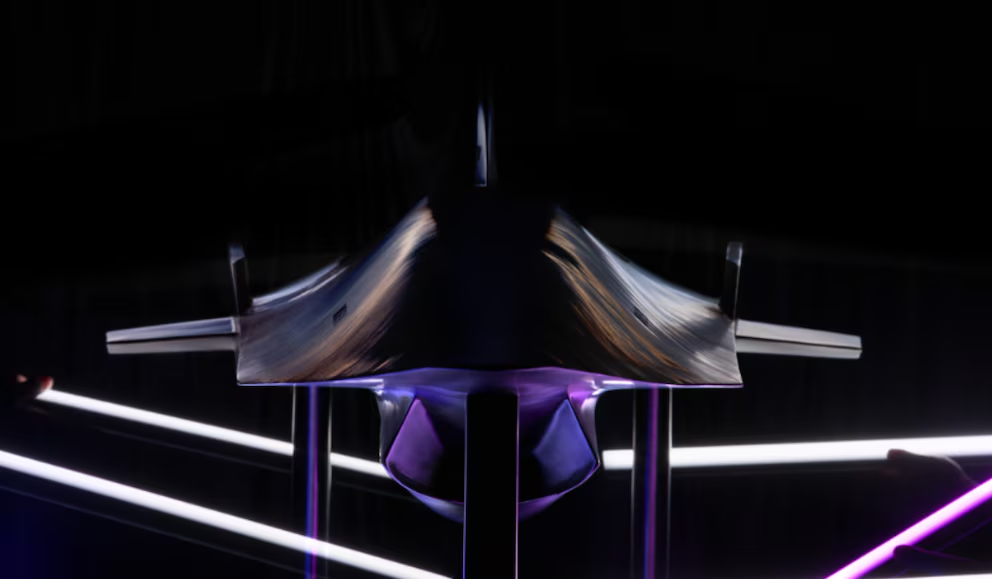
The first test flight is scheduled from NASA’s Wallops Flight Facility in Virginia, mounted on a Rocket Lab booster that will elevate the craft to the altitude required to ignite the scramjet. Once detached, the aircraft will accelerate on its own power into hypersonic flight, transmitting telemetry and thermal data until its mission is completed. Unlike rockets that disintegrate into the ocean, DART AE is designed to glide back and land safely, ready to fly again. If the mission succeeds, it could become the first hypersonic vehicle to combine reusability, zero-emissions propulsion and autonomous navigation in a single platform.
The implications go far beyond aerospace engineering. Hypersonic hydrogen propulsion challenges the logic of current air transportation and threatens to redraw the map of global time. A flight from Los Angeles to Tokyo could be reduced to less than an hour. A transatlantic trip might take less time than today’s airport security line. This convergence of speed and sustainability places DART AE in a new category: not a faster airplane, but a different idea of what an airplane can be. If commercial versions ever enter service, business models, logistics, defense and tourism will be forced to adapt. What Hypersonix proposes is not only faster travel; it is the collapse of geographical distance.

Hypersonic flight used to be a military privilege. Hydrogen propulsion used to be an environmental dream. DART AE attempts to merge both into the same sky.
Detrás de cada dato, hay una intención. Detrás de cada silencio, una estructura.
Behind every fact, there is an intention. Behind every silence, a structure.