

 Phoenix 24
As artificial intelligence moves from simple dialogue to interactive workspaces, the way people collaborate, create and organize tasks is changing at its foundation.
London, January 2026. A new Canvas feature in ChatGPT is reshaping how users engage with generative artificial intelligence by integrating interactive workspaces directly into conversations. Unlike traditional chat interfaces, where responses are limited to text and static attachments, Canvas allows users to manipulate elements visually, organize content spatially and collaborate in real time with the AI as if it were part of a dynamic workspace. This transformation brings AI closer to the environments that knowledge workers, students and creative teams already use in their daily routines.
Canvas operates as a flexible visual board that sits adjacent to the AI conversation. Users can drag, drop and edit objects such as text blocks, notes, charts, images and files. The integration enables real-time synchronization between the AI’s outputs and the workspace, meaning that insights generated by the model can be immediately structured, annotated or categorized without breaking the flow of interaction. This continuity is designed to reduce cognitive friction and allow users to focus on problem solving rather than on switching between tools.
One of the core advantages of Canvas is its adaptability to different use cases. Professionals can use it to sketch project plans, draft strategic outlines and capture evolving ideas without leaving the AI environment. Educators may find it useful for creating annotated lesson structures or interactive study guides that combine narrative explanations with visual organization. Teams working on complex projects can coordinate tasks, assign responsibilities and map dependencies directly within the conversation, enabling a shared workspace that is both conversational and visual.
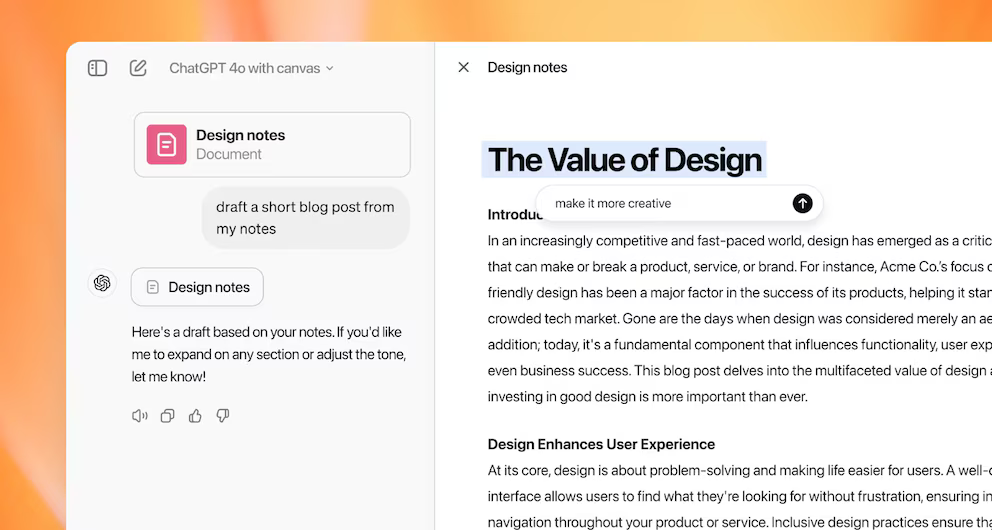
The underlying mechanics of Canvas tie spatial organization with structured metadata that the AI can interpret. When a user places an object in a certain location or tags it with a category, the system understands that arrangement as part of the context. This means that the AI can generate summaries, extract action items and identify thematic clusters based on how the user has organized the workspace. The bridge between spatial cognition and linguistic reasoning is one of the key innovations that separates Canvas from conventional note taking or drawing tools.
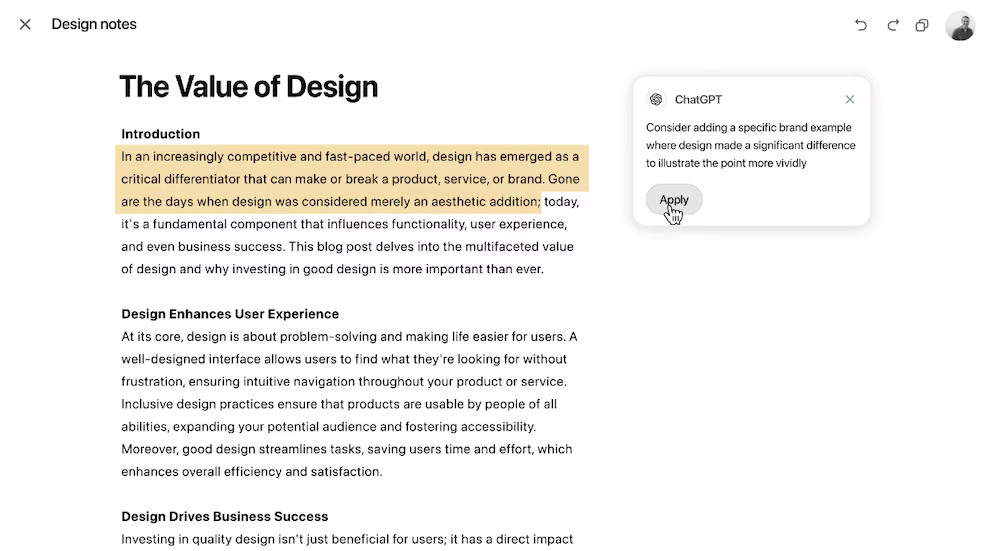
Collaboration is another defining feature. Registered users can invite others into a shared Canvas, allowing multiple participants to contribute simultaneously. Changes are reflected in real time, and the AI can act as a moderator or facilitator, suggesting structure, highlighting conflicts and offering automated insights based on the evolving content. This shared environment reduces the need for external collaboration platforms, consolidating conversation, content creation and coordination within a single interface.
Security and privacy considerations have been integral to the design of Canvas. Users retain control over who can view or edit a workspace, and organizational policies can govern access based on roles or project affiliation. Because workspaces can contain sensitive business data or personal information, the system implements encryption and governance controls that align with enterprise standards. These measures aim to protect confidentiality while enabling the flexibility that collaborative work demands.
Experts in productivity and organizational psychology note that the combination of visual space with conversational AI mirrors how many teams naturally think and work. Cognitive load is reduced when information can be spatially grouped, visually prioritized and cross-referenced in a way that mirrors mental models. Traditional text chat is linear; Canvas introduces dimensionality, allowing context to emerge across axes of time, space and meaning.
Users exploring Canvas frequently begin with simple arrangements, such as to-do lists or brainstorming clusters, and then evolve toward more structured frameworks. The ability to convert a set of scattered ideas into a coherent strategy without leaving the workspace can shorten project cycles and improve the quality of outputs. The AI’s capacity to generate narrative explanations, interpret visual layouts and suggest refinements creates a loop where users and machine learn from each other’s structure.
Training and adoption are supported through built-in examples and guided walkthroughs. Canvas includes templates for common scenarios, such as meeting agendas, research summaries and strategic planning boards, which users can adapt to their own needs. These templates provide an entry point for those unfamiliar with visual workspaces, helping them understand how to leverage spatial arrangement in conjunction with AI insight.
Challenges remain, particularly in balancing flexibility with usability. Too many visual options can overwhelm some users, while others may prefer only text-centric workflows. The design philosophy behind Canvas has been to provide minimal friction by offering simplicity at first glance and depth as users engage more deeply. This tiered complexity allows individuals and teams to scale their use of the tool based on preference and need.
The integration of Canvas into conversational AI reflects a broader shift in how digital work is conceptualized. Rather than treating dialogue with machines as a series of isolated prompts and responses, the workspace approach recognizes that problem solving and creation are iterative and multidimensional. Users can loop between exploration, organization and execution without context switching, which historically has been a source of inefficiency.
The rollout of Canvas has already sparked interest among professionals in sectors such as consulting, education, research and design, where the ability to structure thought visually and textually is essential. As organizations experiment with the tool, patterns of usage will inform future enhancements, including deeper analytics, integrations with other productivity ecosystems and more sophisticated collaboration mechanics.
What becomes clear is that the idea of a workspace is evolving. It is no longer sufficient for digital tools to be separate from communication; the most effective environments integrate conversation, coordination and creation seamlessly. Canvas embodies this integration, offering a space that is at once conversational and functional.
Each silence speaks.
Every silence speaks.