

 Phoenix 24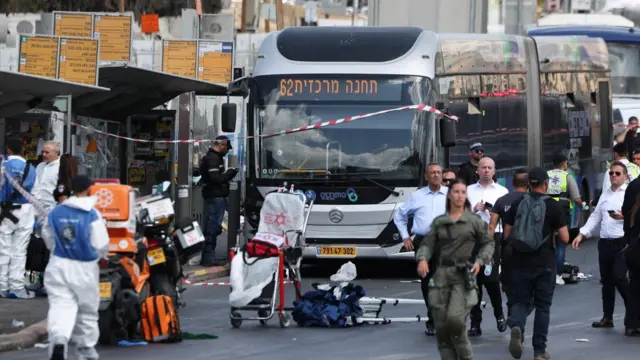
Violence did not strike at random; it pierced the fragile rhythm of a Monday morning, transforming routine into chaos within seconds.
Jerusalem, September 2025.
At the height of rush hour, when commuters crowded buses and parents escorted children to school, a sudden burst of gunfire broke the uneasy calm at Ramot Junction, one of Jerusalem’s busiest transit points. Two assailants opened fire indiscriminately, leaving six people dead and more than fifteen wounded. Among the injured, at least six remain in critical condition as doctors fight to stabilize them in hospitals across the city. The scene, witnesses recall, was marked by shattered glass, abandoned bags, and the echo of panicked screams as bystanders fled for cover.
Within minutes, a soldier stationed nearby and armed civilians responded, engaging the attackers and bringing the rampage to an end. Security forces later confirmed that both gunmen were “neutralized” on site. Their swift intervention prevented what authorities described as an even greater massacre, a statement that underscores how precariously balanced life in Jerusalem has become.
The attack at Ramot Junction carried symbolic weight beyond the immediate toll. Situated at the northern entrance to the city, the bus stop connects residential neighborhoods with settlements and central Jerusalem. That a space of everyday mobility was turned into a scene of bloodshed reinforced the sense of vulnerability felt by residents who have grown accustomed to living in a city on edge.
The impact was immediate across political, social, and international dimensions. Domestically, the Prime Minister postponed scheduled judicial proceedings to attend emergency security meetings, while senior ministers convened in closed-door sessions to assess the response. Opposition leaders seized the moment to criticize what they described as systemic failures in intelligence and policing, insisting that the attack revealed deeper cracks in Israel’s security apparatus. Hardline factions within the ruling coalition demanded swift retaliatory action in the West Bank, raising the prospect of escalated operations in already volatile areas. At the same time, civil society groups urged restraint, warning that a cycle of retribution would only prolong instability.
Internationally, reactions spanned multiple regions. In Europe, diplomats voiced concern that renewed violence in Jerusalem could derail fragile efforts at dialogue and further polarize regional politics. Several foreign ministries noted that confidence in Israel’s ability to guarantee basic security is central not only for its citizens but also for its standing as a partner within broader Western alliances.
From the Americas, analysts emphasized how recurring episodes of violence complicate Israel’s credibility as a stable ally at a time when Washington seeks to balance its commitments in Eastern Europe, the Indo-Pacific, and the Middle East simultaneously. The perception of a government under siege domestically, they argued, risks undermining the confidence of investors and international partners alike.
In Asia, strategic institutes stressed that internal crises diminish Israel’s capacity to play the role of mediator or counterweight in regional dynamics. With the war in Gaza intensifying and tensions rising in Lebanon and Syria, an Israel distracted by domestic emergencies loses strategic leverage. For regional powers observing from afar, the attack signaled vulnerability at a moment when resilience is most needed.
The Palestinian Authority issued a statement condemning attacks on civilians, a position meant to distance its leadership from the assailants while also reminding international observers of the political vacuum in the peace process. In parallel, voices within Israeli security circles acknowledged that the combination of militant cells, spontaneous lone-actor attacks, and rising social polarization makes predicting and preventing such incidents increasingly difficult.
Beyond the immediate political maneuvers, the human dimension remains raw. Survivors describe the terrifying moments when bullets tore through morning calm, recounting how strangers shielded children or dragged the wounded to safety. Paramedics, many of them volunteers, spoke of arriving to a scene of panic and trying to restore order in the midst of confusion. These testimonies form part of a larger narrative in which resilience is measured not only by political declarations but also by the actions of ordinary individuals under extraordinary pressure.
What emerges is a stark portrait of a society caught between routine and rupture, where the veneer of normalcy can vanish in seconds. The attack at Ramot Junction was not the first of its kind, nor will it likely be the last, but it sharpened the awareness that public spaces in Jerusalem remain contested arenas of fear and defiance. The challenge now lies not only in preventing further violence but in restoring a sense of security to a population exhausted by cycles of trauma.
For Israel, the question is whether leadership can navigate these tensions without falling into a spiral of escalation that jeopardizes both domestic cohesion and international standing. For the broader region, the attack is another reminder that the unresolved fault lines of the conflict continue to claim lives, interrupt daily routines, and undermine the prospect of stability.
In the end, the gunfire at a bus stop in Jerusalem encapsulated a paradox familiar to the city: a place where the ordinary and the extraordinary collide, where violence and resilience coexist, and where every day begins with the fragile hope that routine will survive the next eruption.
Resistencia narrativa global.
Global narrative resilience.