

 Phoenix 24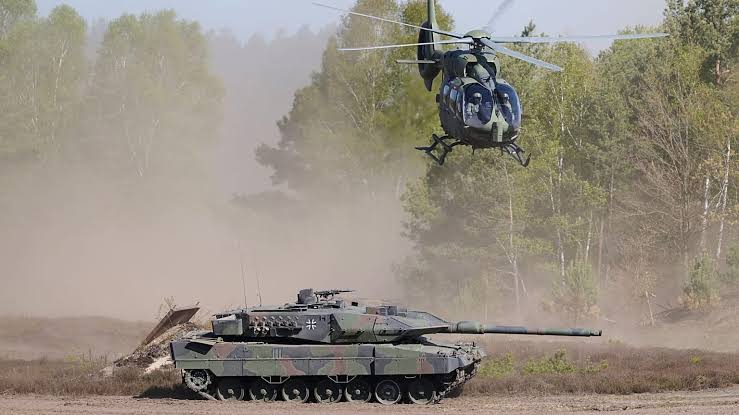
Berlin and Paris seek equal influence over strategic defense production.
BERLIN, Germany | June 2026
Germany plans to acquire a 40 percent stake in KNDS, the Franco-German defense group behind the Leopard and Leclerc battle tanks, in a move designed to strengthen state control over one of Europe’s most important military manufacturers. The investment would place Berlin alongside France as a major public shareholder and give both governments lasting influence over the company’s strategic direction. German officials presented the decision as necessary for national security, industrial capacity and technological independence. The operation still requires implementation, and the governments have not announced a final timetable.
KNDS was created in 2015 through the merger of Germany’s Krauss-Maffei Wegmann and France’s Nexter. France currently owns half of the company, while the remaining 50 percent belongs to the German family behind Krauss-Maffei Wegmann. The expected departure of that private shareholder created the opportunity for the German state to enter the ownership structure. Berlin now intends to replace much of that family stake with direct public participation.
The company is headquartered in Amsterdam and reported revenue of approximately 4.4 billion euros last year. It employs more than 11,000 people and produces some of the most important armored systems used by European armed forces. Its portfolio includes Leopard and Leclerc tanks, Puma infantry fighting vehicles and Boxer and Dingo armored personnel carriers. Demand for those platforms has increased as European governments rebuild military inventories.
Germany and France said they had agreed on KNDS’s future strategy and governance. Their objective is to exercise equal control even if their exact shareholdings change over time. The planned structure is intended to prevent either country from dominating decisions concerning production, technology or investment. Equal voting rights would also reinforce the political character of the industrial partnership.
The decision reflects Europe’s wider effort to expand defense production after years of limited procurement and fragmented national planning. Russia’s war against Ukraine has forced governments to reconsider stockpiles, ammunition capacity and the speed at which heavy equipment can be manufactured. European armies have also transferred vehicles and weapons to Ukraine, creating additional pressure to replace donated systems. KNDS has become central to that rearmament process.
Berlin argues that public ownership will protect critical capabilities that should not depend entirely on private decisions. Tanks and armored vehicles require long development cycles, specialized supply chains and highly skilled workers. Losing production knowledge or allowing strategic assets to fall under uncertain control could weaken national defense. A state stake gives the government greater influence over investment and industrial continuity.
The move also responds to growing doubts about the long-term reliability of the United States as Europe’s principal security guarantor. European governments continue to depend heavily on NATO and American military power, but political uncertainty in Washington has encouraged calls for greater strategic autonomy. Expanding European production is part of that response. Germany and France want the continent to possess more of the weapons, technologies and factories required for its own defense.
The investment may also prepare KNDS for a future stock market listing. Both governments said the new agreement could open the path toward an initial public offering. People familiar with the plan have indicated that Germany and France could eventually reduce their respective holdings to around 30 percent within two or three years after a listing. They would nevertheless retain equal voting rights and strategic influence.
A public offering could provide KNDS with additional capital for expansion. The company faces pressure to increase output, modernize factories and develop new systems while fulfilling existing orders. Access to financial markets could support that growth without requiring governments to provide all future funding directly. At the same time, state participation would help protect the company from excessive short-term market pressure.
The agreement carries important implications for employment and industrial geography. Germany wants to ensure that national factories, suppliers and engineering capabilities benefit from the expansion of European defense spending. France has similar interests in protecting Nexter’s production base and technical expertise. Equal governance is therefore intended to prevent investment decisions from shifting disproportionately toward one side.
Past Franco-German defense projects have often faced delays caused by competing national requirements and industrial rivalries. The Main Ground Combat System, intended eventually to replace the Leopard 2 and Leclerc, has encountered disagreements over leadership, technology and work distribution. KNDS was created partly to overcome those divisions through a common corporate structure. Stronger state ownership could improve coordination, but it could also introduce new political disputes.
The Leopard 2 remains one of KNDS’s most internationally recognized products. It is operated by numerous European and NATO countries and has played a prominent role in military assistance to Ukraine. The war demonstrated both the platform’s strategic importance and the difficulties involved in maintaining different national variants. Higher production and more coordinated support could improve availability across Europe.
The Leclerc gives France its own advanced main battle tank capability, while the Boxer and Puma support broader land-force modernization. These systems are increasingly important as governments shift attention back toward high-intensity conventional warfare. Years of counterterrorism operations had reduced the priority given to heavy armored forces. The security environment has now moved in the opposite direction.
Germany first raised the possibility of acquiring a stake in KNDS in 2025. Defense Minister Boris Pistorius presented state participation as a way to protect strategic capacity and skilled jobs. The current announcement converts that idea into a formal policy direction. It also confirms that Berlin is prepared to use public capital to shape the defense industry.
The transaction forms part of a wider transformation in Germany’s security policy. Berlin has increased military spending, created large procurement programs and committed to rebuilding the Bundeswehr after decades of underinvestment. Taking a direct stake in KNDS extends that strategy from purchasing weapons to influencing the companies that produce them. Industrial policy and defense planning are becoming increasingly interconnected.
For France, the agreement preserves its role as an equal strategic partner. Paris has long promoted European defense autonomy and stronger continental production. Joint control of KNDS offers a practical example of that ambition. It also ensures that France retains influence over a company whose future products will shape European land warfare.
The final structure will depend on negotiations concerning valuation, governance and the eventual public listing. Neither government has specified when the acquisition will be completed or what exact percentage France will retain afterward. Those details will determine how equal control operates in practice. For now, the political direction is clear: Germany and France want KNDS protected as a European strategic asset.
Defense sovereignty grows when production capacity remains under strategic control. / La soberanía defensiva crece cuando la capacidad productiva permanece bajo control estratégico.