

 Phoenix 24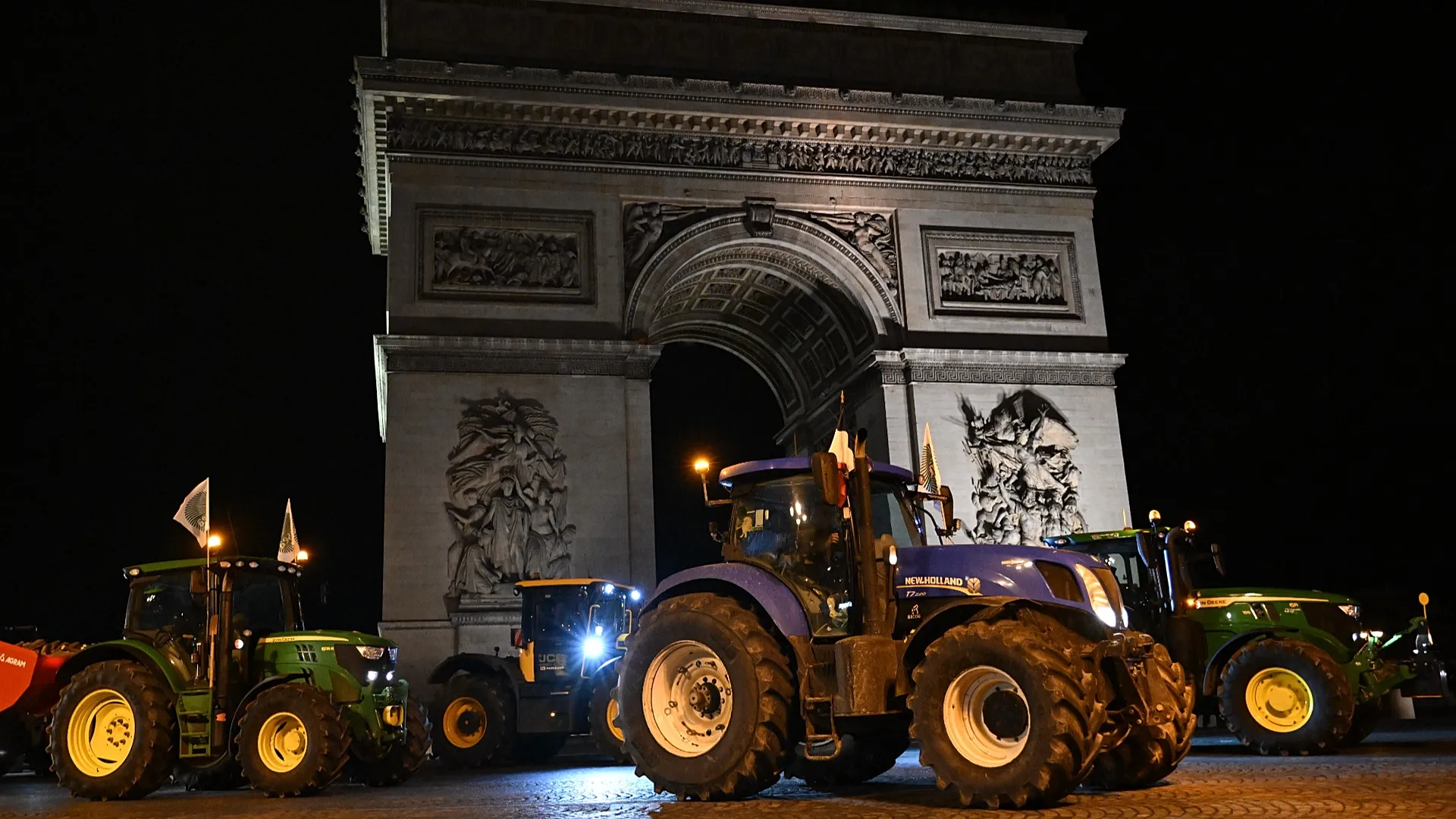
When a rural sector pushes its grievances into a capital’s streets, it signals not only economic distress but a fracture between policy and those who feed society.
Paris, January 2026. Thousands of tractors rolled into central Paris as part of a coordinated mobilization by French farmers carrying their protest from fields and highways into the political heart of the nation. Organizers reported that some 350 tractors and accompanying farm vehicles converged around emblematic avenues and near government ministries, demanding immediate action against what they describe as unfair foreign competition, insufficient protections and policy decisions they say threaten the viability of rural livelihoods. This demonstration reflects a deepening crisis in French agriculture that has repeatedly spilled into public view, challenging national leaders to reconcile economic strategy with social stability.
The march began early in the day, as farmers from multiple regions across the country drove their equipment toward the capital, forming long columns that drew attention from commuters, local communities and national media. Their presence in Paris was not accidental. Symbolically and strategically, bringing heavy machinery into the capital underscores the agricultural sector’s frustration with decision makers perceived as distant from the realities of rural life. For many participants, Paris is where decisions are made but where rural voices often feel ignored.
France’s agricultural sector has long been one of the most politically potent constituencies in Europe, with deep historical roots and widespread cultural resonance. Yet in recent years, farmers have faced a confluence of pressures: fluctuating commodity prices, rising input costs, stringent environmental and sanitary standards and intensified competition from imported goods. The latter has become a central grievance, especially in light of recent trade agreements that farmers argue expose them to competitors operating under different regulatory and cost conditions.
At the core of the protesters’ demands is a call for stronger protective measures and guarantees that imported agricultural products meet standards equivalent to those required of domestic producers. Farmers and their unions argue that without such parity, the economic sustainability of French agriculture, and by extension the social fabric of rural regions, is at risk. In conversations with demonstrators, common themes emerged: fear of declining farm incomes, frustration with bureaucratic constraints and a sense that political elites are disconnected from the hardships faced on the ground.
Political reactions in Paris were swift. Government representatives acknowledged the right to protest but urged restraint and dialogue. Officials noted that maintaining public order and minimizing disruption to everyday life were priorities, even as they recognized the legitimacy of economic concerns being raised. Statements from the presidency and relevant ministries emphasized commitments to agricultural policy adjustments, but also underscored the complexity of balancing national interests with international trade obligations and broader economic priorities.
The protest in Paris is the latest in a series of agricultural mobilizations in France and across the European Union. Similar actions have occurred in other member states, reflecting widespread unease among farmers dealing with global market forces, climate variability and structural shifts in the agricultural economy. What distinguishes the Paris event is its scale and its location at the seat of national authority. By positioning tractors near ministries and emblematic boulevards, protesters have inserted themselves into the political center, demanding attention not only from domestic leaders but from the international community observing social stability in one of Europe’s largest economies.
The economic context adds urgency to the farmers’ grievances. Rural economies have struggled with demographic decline, infrastructure deficits and limited alternative employment opportunities. Agriculture, for many regions, remains not only an economic activity but a way of life. Farm closures, declining generational renewal and financial stress have compounded social anxieties. For communities that see agricultural identity as integral to regional culture, the failure of farms is perceived as the collapse of rural civilization itself.
Urban reactions to the protest were mixed. Some residents expressed sympathy for farmers’ plights, recognizing the essential role they play in food security and cultural heritage. Others voiced frustration with traffic disruptions and the imposition of heavy machinery in urban centers, reflecting broader tensions between rural interests and urban lifestyles. This ambivalence illustrates a widening social gap: while all citizens depend on agricultural production, few experience it directly in daily life.
The role of trade policy also looms large in the debate. France has been at the forefront of EU discussions about how to reconcile the bloc’s commitments to free trade with the need to protect strategic sectors. Recent agreements with trading partners have sparked controversy within the Union, with agricultural groups in multiple countries arguing that regulatory asymmetries and differing environmental standards place European farmers at a disadvantage. These tensions feed into national debates about sovereignty, economic strategy and the future of the European project itself.
Environmental policy adds another layer of complexity. European and French initiatives aimed at reducing emissions, protecting biodiversity and promoting sustainable practices have placed additional constraints on farming practices. While many farmers support environmental goals in principle, the cost and transition requirements associated with compliance have been cited as burdensome, especially when juxtaposed with competitive pressures from imports.
The Paris mobilization signals a moment of reckoning. French farmers are not merely seeking compensation or temporary relief. They are demanding a fundamental reevaluation of how agricultural policy intersects with trade, environmental regulation and national identity. Their use of tractors, symbols of production, labor and rural heritage, as tools of protest underscores a deep emotional and economic stake in the outcome.
As discussions continue between government officials and agricultural leaders, the broader implications of the protest extend beyond France. European policymakers are watching closely, aware that agricultural unrest in one member state can resonate across the Union, affecting cohesion and common policy approaches. The balancing act between open markets and protective measures, between environmental ambitions and economic viability, remains one of the most pressing challenges for European governance.
For the farmers in Paris, the message was clear: their presence in the capital is not a transient disruption but a demand for enduring recognition. In a world where global pressures often drown local voices, their tractors in the heart of the nation were a reminder that the foundations of society, the soil, the harvest and the labor, still matter to those who live by them.
La narrativa también es poder.
Narrative is power too.