

 Phoenix 24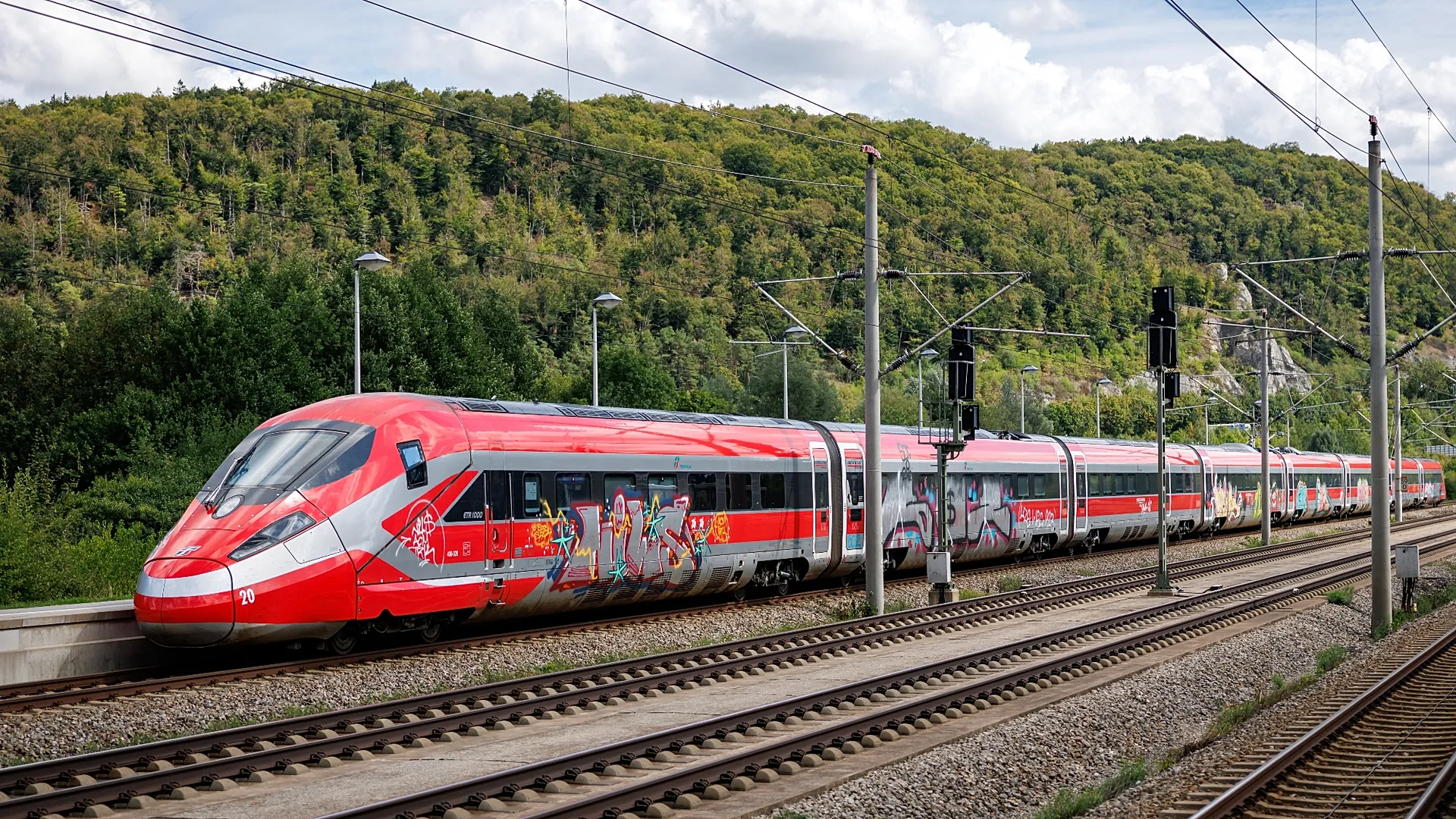
The ambitious service promises easier Alpine travel, but technical approval has delayed its debut.
MUNICH, GERMANY
Deutsche Bahn has begun testing Italy’s Frecciarossa 1000 in Germany as preparations continue for direct passenger services connecting Munich with Milan and Rome. The trains are intended to eliminate transfers along two major cross-border routes, strengthening rail links between Germany, Austria and Italy. The launch, originally planned for December 2026, has been postponed until summer 2027.
A modified Frecciarossa has been conducting trials between Nuremberg and Ingolstadt and between Leipzig and Erfurt since mid-June. A second unit began testing in Austria in August, operating between Kufstein and the Brenner Pass and on the Salzburg–Vienna corridor. Approximately 300 testing days are planned to assess performance at speeds of up to 300 kilometres per hour under different infrastructure and operating conditions.
The trains require extensive adaptation because the three countries use different electrical, signalling and safety systems. Manufacturers Hitachi and Alstom have modified components including the traction equipment, brakes and pantographs while installing national train-protection technology. Nine Frecciarossa units are being prepared for the international service. They must secure approval in Germany and Austria and renewed certification in Italy before carrying passengers.
Initial plans envisage direct daily services from Munich to both Milan and Rome, jointly operated by Deutsche Bahn, Trenitalia and Austria’s ÖBB. The Munich–Milan journey is expected to take approximately six and a half hours, saving about 75 minutes. Munich–Rome should require roughly eight and a half hours, reducing the current journey by around 45 minutes. Passengers would remain aboard the same train throughout, although much of the Alpine route is not built for full high-speed operation.
The partners eventually hope to offer as many as five daily return connections between the three countries and extend the network toward Berlin and Naples. The Brenner Base Tunnel, scheduled to enter service in the next decade, could reduce journeys by approximately another hour. For now, however, the revised timetable illustrates the central challenge facing European rail: purchasing fast trains is easier than making them operate seamlessly across national systems.
Hechos que no se doblan. / Facts that do not bend.