

 Phoenix 24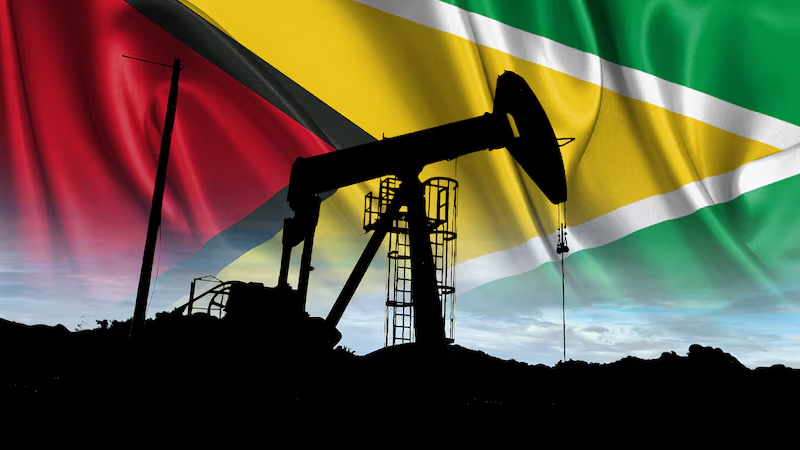
A bold investment that strengthens a rising petro-state while deepening territorial disputes and environmental dilemmas.
Georgetown, September 2025
ExxonMobil has approved a $6.8 billion investment in the Hammerhead field, the seventh offshore development in Guyana’s Stabroek Block. The project is scheduled to start production in 2029, with a floating production, storage, and offloading vessel expected to deliver roughly 150,000 barrels of oil per day. For Guyana, a country that only a decade ago played no role in the global energy market, the project cements its transformation into one of the fastest-growing oil producers in the world.
The Hammerhead expansion adds to an already impressive portfolio. Guyana is on track to reach 1.5 million barrels per day once all approved projects are operational, a figure that would rival production levels of established petro-states in the Middle East. The scale of development also raises questions about whether the nation has the institutional resilience to manage such a windfall. Economists in Washington have pointed out that the inflow of revenue could double Guyana’s GDP within a decade, but warn of the classic “resource curse” if governance and diversification are neglected.
The project involves 18 wells for production and injection, with plans to integrate associated gas into a 300-megawatt power plant and a natural gas liquids facility onshore. Japanese firm MODEC will design and deliver the floating production unit, underscoring the multinational character of the venture. Alongside ExxonMobil’s 45 percent stake, Chinese giant CNOOC holds 25 percent, while Chevron—having absorbed Hess—retains the remaining share. This triangular corporate structure reflects the intersection of American, Chinese, and global capital in a single contested basin.
European analysts writing in Le Monde stressed that the partnership between ExxonMobil, Chevron, and CNOOC is less about technical collaboration than about geopolitical balance. With Chinese companies embedded in Guyana’s energy sector, Beijing secures an indirect presence in Western Hemisphere oil production. For Europe, this complicates efforts to diversify energy sources away from Russia while still confronting dependence on external suppliers.
The South China Morning Post noted that China views Guyana as a test case for how emerging producers can shift global supply patterns. By anchoring investments in the Caribbean basin, Beijing gains leverage in a region traditionally dominated by U.S. influence. American media such as The New York Times framed ExxonMobil’s move as an assertion of Washington’s commitment to retaining strategic control, especially given the backdrop of energy security debates in the United States and the ongoing transition to renewables.
Yet the project is not purely a financial or geopolitical story. It sits at the heart of a territorial dispute that Venezuela has reignited with renewed vigor. Caracas insists that Hammerhead lies within waters connected to the Essequibo region, a territory Venezuela has claimed since the nineteenth century. International courts continue to weigh the dispute, but the political theater is far from settled. The Guyanese government has strengthened defense cooperation with the United States and the United Kingdom in anticipation of possible escalations. Observers warn that Hammerhead could become both an economic lifeline and a flashpoint of regional tension.
Environmental groups across Latin America have already criticized the scale of the expansion. They argue that such a surge in oil output contradicts commitments under the Paris Agreement and undermines efforts to decarbonize. In Georgetown, officials counter that revenues from Hammerhead will finance renewable energy projects, health care, and infrastructure. Still, the question remains whether pledges to channel oil wealth into long-term development will withstand the pressures of political patronage and elite capture.
Locally, ExxonMobil emphasizes its contribution to employment and national capacity building. More than six thousand Guyanese workers are directly engaged in the oil sector, and hundreds of millions of dollars in contracts have been awarded to domestic firms. However, civil society voices caution that while the economic benefits are visible, inequality persists and local communities often face environmental risks without adequate consultation.
Globally, Hammerhead epitomizes the paradox of the current energy transition. Oil majors are under pressure to reduce carbon footprints and expand into cleaner technologies, yet they continue to commit billions to conventional projects to secure short-term supply and profitability. The result is a hybrid strategy: investing in both renewables and fossil fuels, hedging against uncertainty while delaying a full transformation.
For Guyana, the project offers a rare opportunity to leap into the ranks of global energy powers. Whether it becomes a success story of managed prosperity or a cautionary tale of overreliance on hydrocarbons will depend on how the government navigates the next decade. Hammerhead is not just another oil field; it is a symbol of the shifting balance in global energy, where new players emerge, alliances blur, and the struggle over resources collides with the urgency of climate change.
Phoenix24: analysis that transcends power. / Phoenix24: análisis que trasciende al poder.