

 Phoenix 24
The real race is inside the infrastructure.
Amsterdam, June 2026. The artificial intelligence boom is no longer concentrated only in Silicon Valley names such as Nvidia or OpenAI. Across Europe, a quieter group of technology companies is gaining market attention because they provide the physical and technical backbone that makes advanced AI possible. Photonics, optical networks, semiconductors, cooling systems and data-center components are becoming the hidden architecture of the new digital economy.
The key signal is that investors are looking beyond software. Large language models, cloud platforms and AI applications require enormous computing capacity, but that capacity depends on cables, chips, sensors, optical engines, cooling equipment and high-speed transmission systems. In that layer, European companies are finding strategic relevance. They may not dominate the public narrative, but they are embedded in the infrastructure that allows AI to scale.
Nokia is one of the clearest examples of this shift. Once remembered globally for mobile phones, the company has repositioned itself around optical networks and data transport equipment, both essential for AI data centers. Its renewed market momentum reflects a broader reality: the AI economy rewards not only those who build models, but also those who move, cool and connect the data behind them.
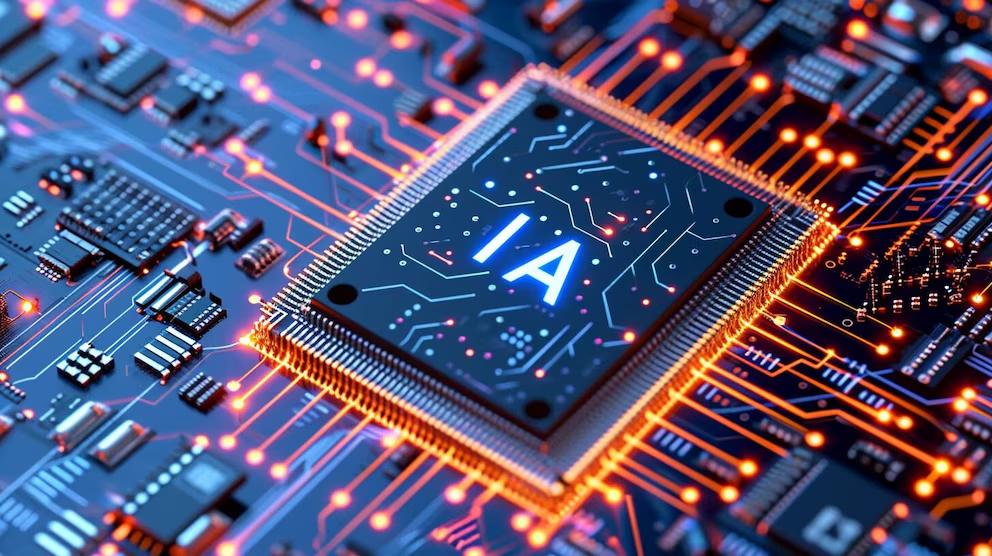
The same logic extends to European firms linked to advanced materials, photonics and semiconductor supply chains. These companies benefit from a structural demand that is less glamorous but deeply consequential. AI does not operate in the abstract. It consumes electricity, generates heat, moves data across massive networks and requires specialized hardware at every stage. The companies solving those constraints are becoming strategic assets.
This European boom also carries geopolitical meaning. For years, the continent has been criticized for lagging behind the United States and China in consumer platforms, hyperscale cloud and frontier AI models. But infrastructure offers another path to relevance. If Europe cannot yet command the full AI stack, it can still gain leverage in critical layers of the supply chain where reliability, precision engineering and industrial depth matter.

The risk is speculation. Rapid stock gains can turn industrial opportunity into market euphoria, and not every company connected to AI will sustain its valuation. Still, the trend reveals something important: the AI revolution is not only a contest of algorithms. It is a battle over the machines, materials and networks that allow intelligence to become scalable power.
Más allá de la noticia, el patrón. / Beyond the news, the pattern.