

 Phoenix 24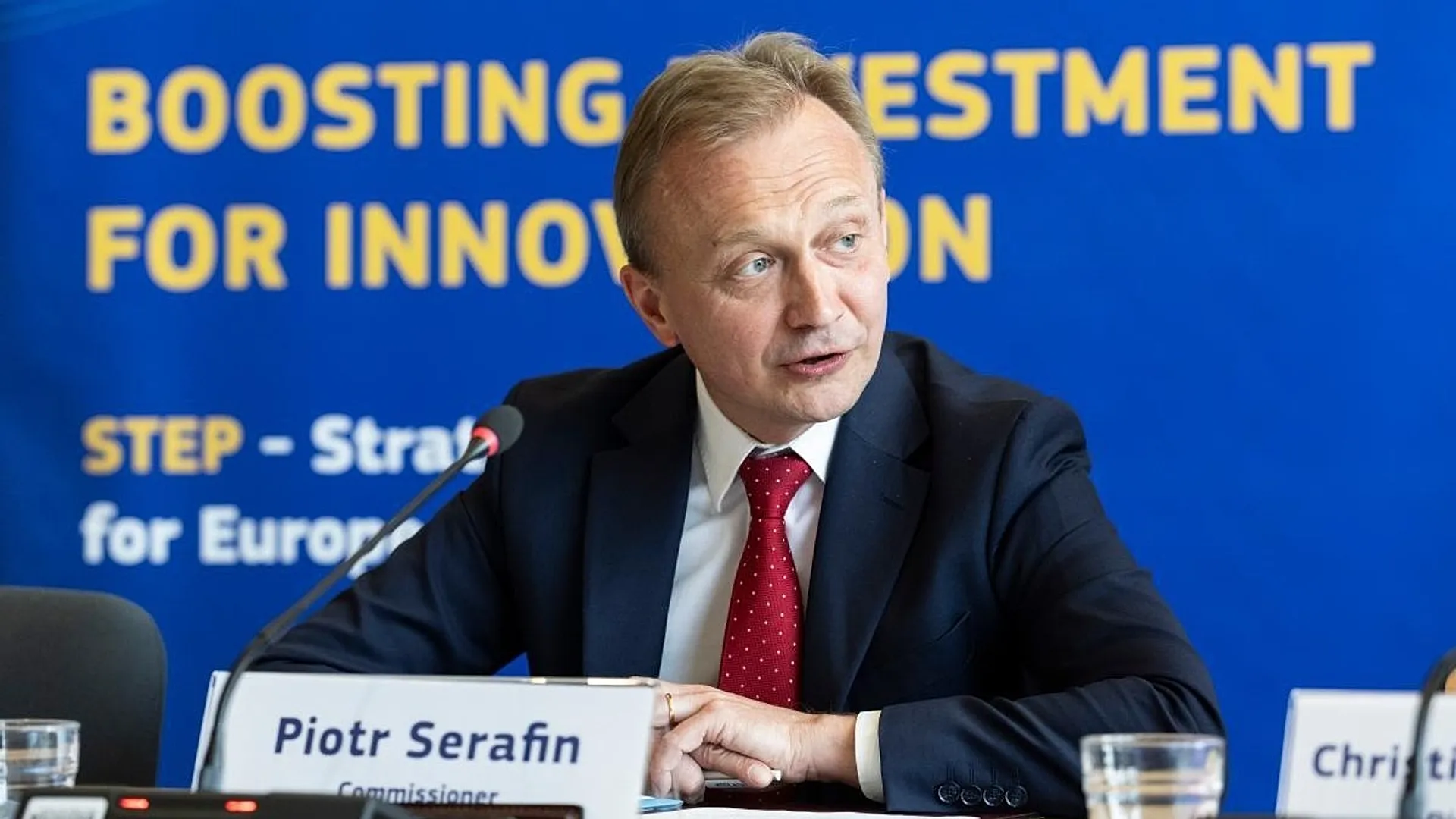
Serafin warns national alternatives could cost taxpayers more.
BRUSSELS, BELGIUM — July 2026.
European Budget Commissioner Piotr Serafin has challenged a group of fiscally conservative member states seeking significant reductions to the European Union’s proposed long-term budget for 2028 through 2034. Germany, the Netherlands, Denmark, Sweden, Finland and Austria have maintained a firm negotiating position favoring lower expenditure and showing limited enthusiasm for creating new sources of European revenue. Serafin argued that reducing the common budget would not automatically modernize the bloc or make European policies less expensive for taxpayers. His intervention intensified a central dispute over how the EU should finance defense, competitiveness, regional development and other shared priorities during an increasingly unstable geopolitical period.
The European Commission presented its initial proposal in July 2025, establishing a financial framework valued at approximately €1.76 trillion before subsequent negotiations among national governments. The plan seeks to simplify existing programs, improve flexibility and provide stronger financing for security, research, innovation, education and crisis management. However, the countries traditionally described as frugal have questioned the overall size of the proposal and demanded stronger spending discipline. Some members of this group have attempted to redefine themselves as modernizers, suggesting that a leaner budget would direct resources more efficiently toward contemporary European challenges.
Serafin rejected the assumption that fiscal restraint and modernization are naturally equivalent during remarks delivered at the annual EU budget conference in Brussels. He warned that insufficient common financing could weaken the very investments required to modernize Europe’s economy, technological capacity and security architecture. Projects excluded from the European budget would not necessarily disappear because national governments might still need to finance them individually through their domestic accounts. Under that scenario, taxpayers could face duplicated programs, fragmented procurement and higher costs than they would encounter through coordinated European action.
The commissioner emphasized that common spending can generate economies of scale when governments jointly purchase equipment, construct infrastructure or finance strategic research. Collective programs can also prevent wealthier member states from moving much faster than countries with more limited fiscal capacity, a divergence that could weaken the single market. Nationally fragmented investment may create overlapping administrative systems and inconsistent standards while reducing the bargaining power available to the bloc as a whole. Serafin’s argument therefore focused not simply on the amount of money spent, but on whether European resources are deployed collectively or divided among 27 separate national strategies.
The frugal coalition faces opposition from a group of 16 Southern and Eastern European countries seeking stronger support for agriculture and regional development. Those governments argue that the Commission’s original proposal already reduced the relative protection given to cohesion funding and the Common Agricultural Policy compared with the current framework. They fear that additional cuts could disproportionately affect rural communities, less-developed regions and member states that depend heavily on European investment to modernize infrastructure. The disagreement has created a complex negotiation in which governments support new priorities such as defense and competitiveness while resisting reductions to established programs benefiting their domestic economies.
A compromise circulated by the Cyprus presidency of the Council in June proposed reducing the Commission’s initial framework by €32.8 billion, equivalent to approximately two percent. The adjustment would lower the overall budget from about €1.76 trillion to €1.73 trillion and represent roughly 1.23 percent of the European Union’s gross national income. Excluding repayments connected to the NextGenerationEU recovery program, the framework would amount to approximately 1.13 percent of the bloc’s economic output. Cyprus described the proposal as a balanced foundation that contains expenditure while preserving the Union’s ability to respond to shared strategic priorities.
The compromise distributes reductions across several spending categories but attempts to protect politically sensitive areas from the most severe adjustments. Programs involving defense, security, competitiveness, research, education, external action and crisis response would still receive considerably more funding than under the current 2021–2027 framework. Agriculture, fisheries and cohesion remain particularly difficult negotiating areas because they were already exposed to real-term pressure under the Commission’s original design. Governments must also determine how the bloc will repay common recovery debt while financing new responsibilities that were less prominent when previous European budgets were negotiated.
Another unresolved issue concerns the creation of new revenue sources capable of reducing direct pressure on national contributions. The Commission has promoted additional forms of own resources, but several fiscally conservative governments remain reluctant to support mechanisms that could resemble new European taxes or permanent shared borrowing. Without alternative revenue, higher common expenditure would require larger payments from national treasuries already managing defense commitments, aging populations and domestic fiscal constraints. The final agreement will therefore depend on whether governments can reconcile demands for European strategic autonomy with political resistance to increasing the Union’s independent financial capacity.
Negotiators consider the June compromise an initial step rather than a definitive settlement, and final figures are not expected to emerge before December. European leaders want to reach a political agreement before the end of 2026 and avoid extending the dispute deep into 2027. Elections expected in major countries including Italy, France and Poland could make national governments less willing to accept difficult financial concessions during that year. The outcome will determine whether the EU enters its next budgetary cycle with the resources to pursue collective priorities or relies more heavily on fragmented national spending.
Phoenix24 — Global news with clarity and perspective.