

 Phoenix 24
A challenging historical role pushed the Oscar-winning actress to reshape her body, posture and performance to embody another era.
London, September 2025. Bringing a complex character from the past to life often requires far more than emotional depth. For Emma Stone, portraying Abigail Masham in Yorgos Lanthimos’ acclaimed film The Favourite became one of the most physically demanding roles of her career. The process forced her to rethink how she moved, how she carried herself and even how she understood power on screen.
Stone explained that preparing for the role was not simply about learning lines or exploring the political intrigues of 18th-century England. It was a transformation that began with her physical presence. “The physical aspect was one of the most difficult parts of the performance,” she revealed during a recent interview. “I had to learn to walk differently, to stand differently and to embody the reality of that period every second on set.”
The preparation started months before filming. Stone collaborated with movement coaches, posture specialists and costume designers to create a physical language that reflected Abigail’s evolution from servant to royal confidant. Every gesture, glance and step had to communicate her changing status and ambition. “It was about understanding how power can live in the body,” she said. “The way she moves and even how she breathes tells part of the story.”
The costumes played a major role in that transformation. Wearing heavy dresses and tightly fitted corsets forced Stone to adapt her posture and build endurance for long shooting days. At first, the restrictions were exhausting and physically uncomfortable. “I could barely sit in those costumes,” she admitted. “But over time they became part of Abigail’s world. They shaped how she moved and how she felt in every scene.
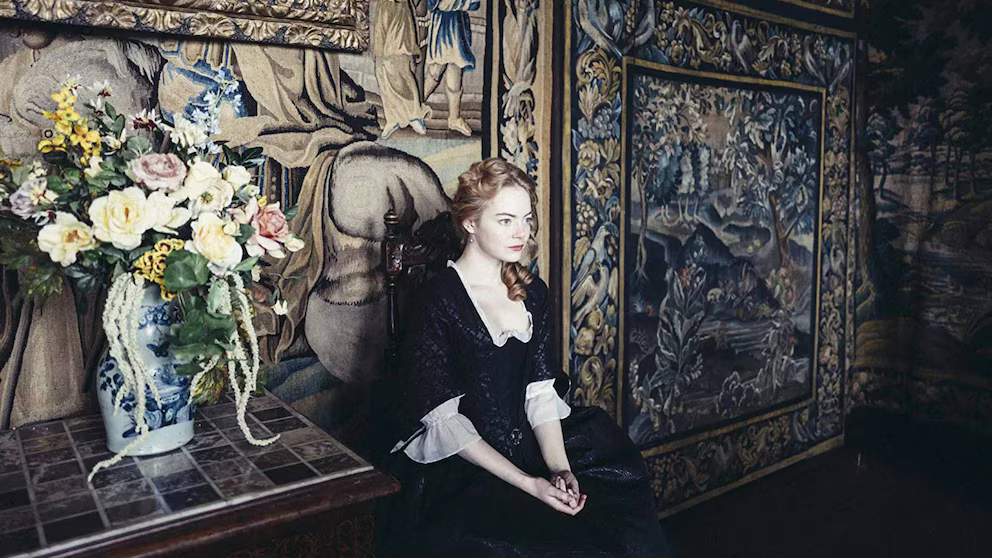
Beyond posture and movement, Stone modified her daily routine to fit the physical expectations of the era. She worked with trainers and nutritionists to develop a silhouette closer to what audiences would expect from an 18th-century character. The adjustments were not intended to change her appearance for vanity, but to deepen the authenticity of the portrayal. “We wanted Abigail to feel completely real in that environment,” she explained. “The physical work was part of building her world.”
For Stone, the physical transformation was inseparable from the psychological one. By embracing the discomfort and restrictions of Abigail’s environment, she gained new insight into the character’s motivations, fears and resilience. “The more I let the physical experience guide me, the more I understood her,” she said. “It became a dialogue between my body and the character.”
Critics praised Stone’s performance for its subtlety and precision, noting how the smallest physical choices revealed Abigail’s inner journey. Scholars of historical cinema argue that this level of detail is increasingly vital to period dramas, where authenticity is not only about costumes or set design but also about how actors inhabit the world they are recreating.

The experience transformed Stone’s approach to acting. She now considers physical transformation an essential part of building any character, not just an optional enhancement. “It’s not only about how a character thinks or speaks,” she explained. “It’s also about how they exist physically. Every detail matters.”
More than a professional exercise, the role reminded Stone why she became an actor in the first place. Immersing herself in the physical, emotional and psychological layers of Abigail Masham allowed her to disappear into another world. “This role pushed me in ways I didn’t expect,” she admitted. “It showed me that transformation is not just about appearance. It’s about allowing every part of you to be shaped by the story you’re telling.”
As The Favourite continues to be studied as one of the most significant historical dramas of the decade, Stone’s performance stands as proof of the power of total transformation. Behind every convincing portrayal is a commitment to living another life, another body and another truth — a process that, for Emma Stone, turned acting into something much deeper than performance.
Phoenix24: resistance through narrative. / Phoenix24: resistencia a través de la narrativa.