

 Phoenix 24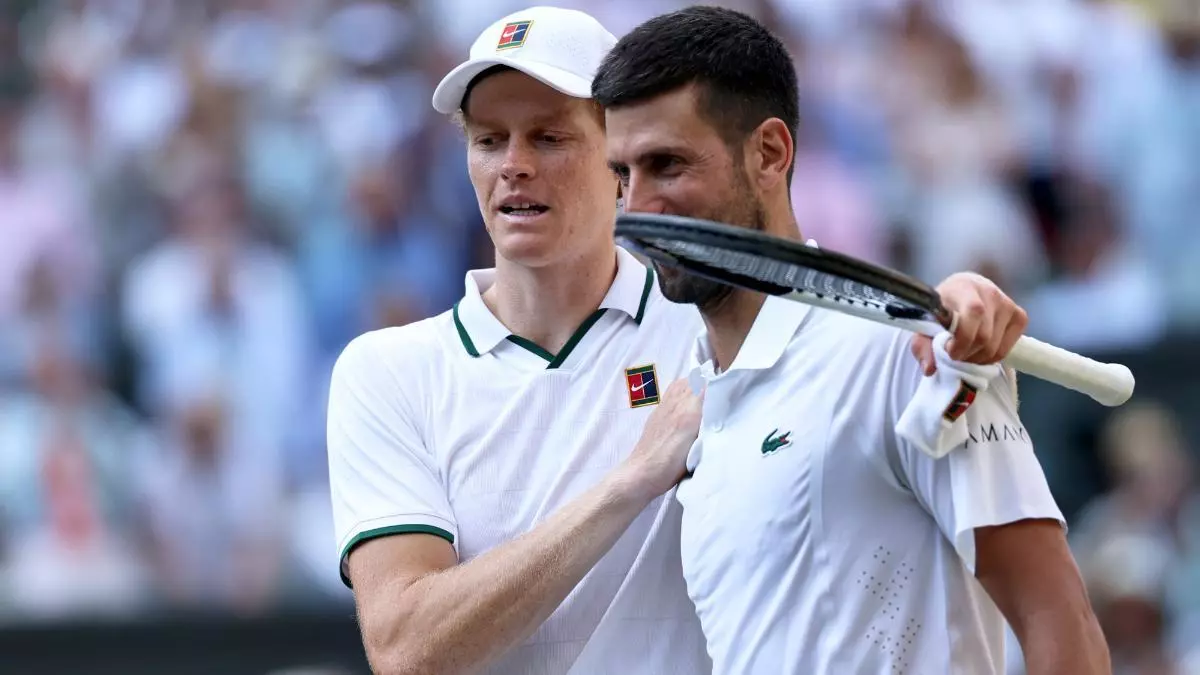
One short answer reopened a generational tennis debate.
New York, August 2026.
Novak Djokovic needed only a few words to make his position clear when asked to compare the finest season of his career with Jannik Sinner’s dominant 2026 campaign. During an appearance at Fanatics Fest in New York, the Serbian was presented with a hypothetical question about 100 hard court matches between Djokovic’s 2015 version and the current Sinner. He looked at the interviewer, smiled and responded, “Come on, man. You know the answer.” His reaction quickly circulated across social media and revived discussion over how the two players would perform against each other at their respective peaks.
The question was designed to place one of the greatest completed seasons in tennis history against a campaign that is still unfolding. Djokovic ended 2015 with an 82-6 record, 11 titles and a winning percentage above 93%. He captured the Australian Open, Wimbledon and the US Open, while also reaching the final at Roland Garros. His season additionally included six Masters 1000 trophies and victory at the year-end ATP Finals.
Djokovic reached the final in 15 of the 16 tournaments he played that year and defeated elite opponents across every major surface. His defensive movement, return of serve and ability to redirect pace made him especially difficult to overcome on hard courts. He combined physical endurance with tactical precision and repeatedly produced his best tennis in decisive moments. The season remains a central reference point whenever the strongest individual campaigns of the modern era are discussed.
Sinner has created a comparable level of dominance during the first seven months of 2026. The Italian compiled a 44-3 record through Wimbledon and collected six titles across hard courts, clay and grass. He won Indian Wells, Miami, Monte Carlo, Madrid and Rome before successfully defending his Wimbledon championship. Those results returned him to the top of the world rankings and strengthened his position as the leading player of the current generation.
The Italian’s Masters 1000 sequence has been particularly significant. His title run began in Paris late in 2025 and continued through the first five Masters events he contested in 2026, establishing a record for consecutive championships at that level. Sinner also completed the Indian Wells and Miami double without losing a set and extended his dominance onto clay. His combination of powerful groundstrokes, improved serving and controlled aggression has allowed him to dictate matches from positions that previously favored more defensive opponents.
The direct rivalry between Djokovic and Sinner gives the hypothetical comparison additional weight. Sinner currently holds a narrow advantage in their head-to-head record, but the two split their major encounters during 2026. Djokovic defeated the Italian in five sets in the Australian Open semifinals, ending Sinner’s run of five consecutive victories against him. Sinner responded at Wimbledon by defeating Djokovic in straight sets on his way to retaining the title.
Those results illustrate how their contrasting strengths interact. Djokovic continues to rely on exceptional anticipation, defensive balance and tactical adaptation, while Sinner applies sustained pressure through early ball striking and greater first-strike power. The Serbian’s Australian Open victory demonstrated that he can still disrupt Sinner’s rhythm over five sets, even at 38. The Wimbledon result showed how decisively Sinner can control the matchup when his timing, serve and baseline aggression operate together.
Comparing players from different seasons remains inherently speculative because equipment, physical condition, tournament schedules and competitive environments all influence performance. Djokovic was 28 during his extraordinary 2015 campaign and operating at the height of his physical and tactical powers. Sinner is 24 in 2026 and may still be developing parts of his game despite already occupying the world number one position. A series of 100 imagined matches cannot reproduce the psychological and physical conditions that define real competition.
Djokovic’s answer nevertheless reflected the confidence that shaped his most dominant years. Rather than offer a numerical estimate or analyze individual strengths, he treated the conclusion as self-evident. The response was playful, but it also defended the historical stature of a season in which he controlled almost every major tournament and defeated the leading players of his era. His refusal to explain further made the exchange more memorable than a detailed statistical comparison might have been.
The debate arrives as both players adjust their schedules before the US Open. Sinner has withdrawn from the Cincinnati Open because of a right knee problem after previously skipping the Canadian Open. Djokovic has also reduced his tournament commitments and increasingly structures his calendar around the four Grand Slam events. Their physical condition and preparation will influence whether another meeting takes place in New York.
Sinner’s 2026 season is not yet complete, and the final comparison will depend on his results during the remaining months. He could add another major title, extend his Masters record or finish with a winning percentage that rivals Djokovic’s 2015 benchmark. Djokovic, meanwhile, continues pursuing a record 25th Grand Slam championship while competing against players more than a decade younger. For now, his verdict on the hypothetical contest remains concise, confident and unmistakably his own.
Cada silencio habla. / Every silence speaks.