

 Phoenix 24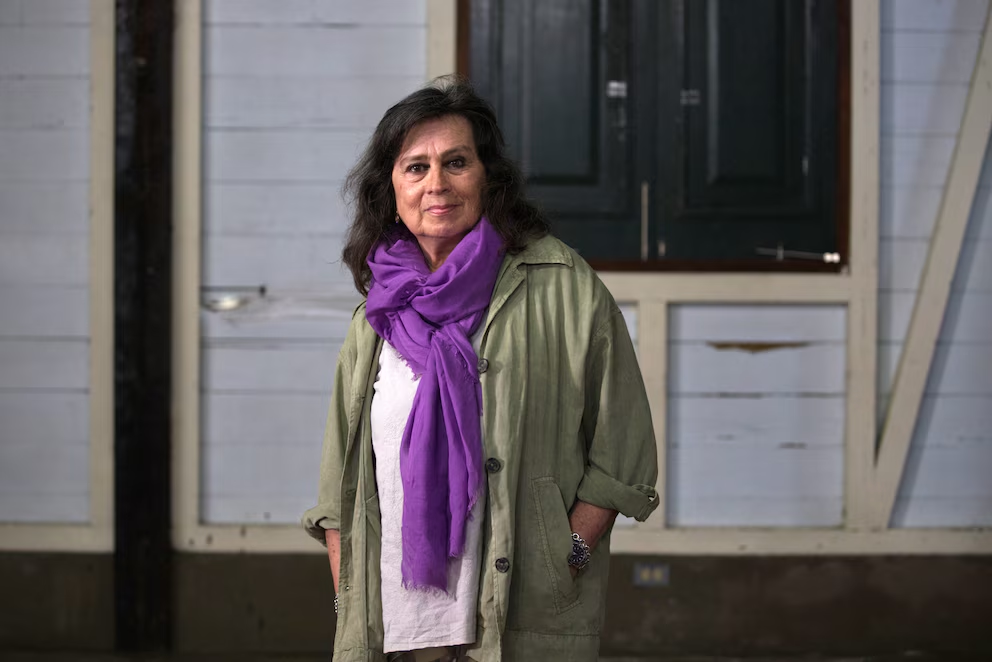
When history is stained with violence, literature becomes our last sanctuary and the rebellion we cannot name.
Bogotá, November 2025.
Colombian writer Laura Restrepo has described the agewe live in as “an era of terror but also of epiphanies, of millions rising in opposition, the dawn of a new culture,” framing her latest novel, Soy la daga y soy la herida, as the literary battlefield on which this global transformation is being fought. According to Restrepo, whose career spans decades of conflict, exile and deep-dive journalism, the genocides in places such as Gaza and the contours of late-stage state violence in Latin America converge in a generation that cannot afford silence. In her words this younger generation is colliding with power precisely because it has felt the full force of the abyss.
In her new work, Restrepo conjures a symbolic universe through the masked figure of a torturer named Misericordia Dagger, subordinate to an entity she calls Abismo, which embodies the bureaucratic dehumanization of power. The book traverses scenes of massacre, hunger and memory across continents; Latin America’s induced amnesia is set beside Middle East violence, the loss of moral orientation in Europe and the systemic fade of empathy in North America. The writer asserts that these narratives are not separate: they form the warp and weft of a global condition characterised by extinction of meaning, and thus demand a cultural mutation.
Restrepo calls Sinaloa’s buried toxic waste dumps, the bombardments in Sudan and the plundered cities of Ukraine part of the same toxic geography. She insists the horror of these places is our horror, and no longer something “other”. In her interview she argues that the silence around death is the only weapon the powerful still hold, and that a shark-fin culture of submission feeds on it. The novel’s title translates as “I am the dagger and I am the wound” and signals the paradox of victim and perpetrator collapsing into one in the face of systemic cruelty. For Restrepo this is the moment to name the wound and to claim the dagger.
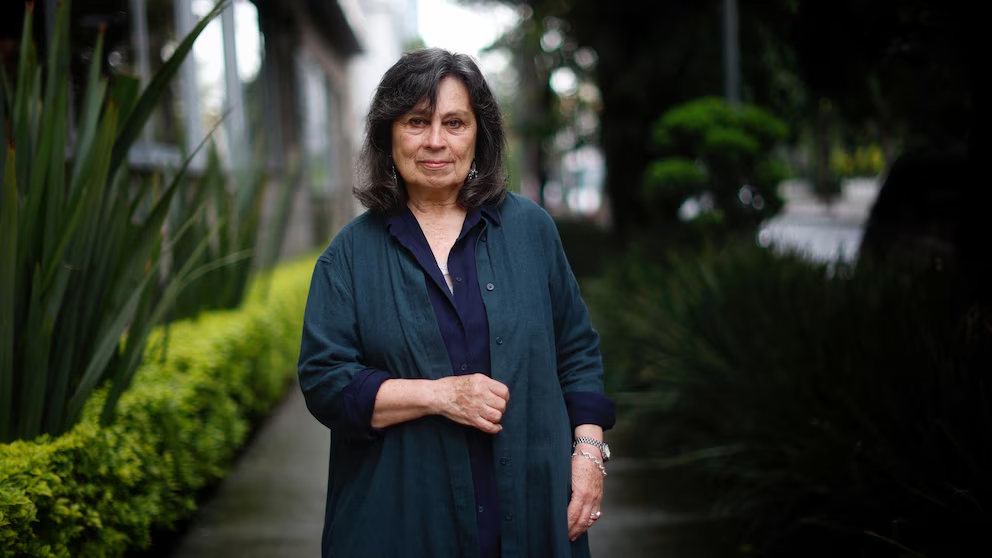
The cultural dimension she explores goes beyond trauma: it encompasses a remapping of aesthetic responsibility, of who writes history, who inherits memory and who refuses to obey the forgotten. Her generation, she says, is “marked by genocide” – stripped of illusions and forced into a vantage point that historians might have underestimated. She paints the uprising of character-chains across streets, seas and borders as evidence that the old forms of power are failing. In this context, literature becomes not a consolation but a tool for redefining fidelity to life rather than to narrative.
European scholars of literature and political violence interpret Restrepo’s project as emblematic of the shift from national-storytelling to transnational cultural insurgency. Her inclusion of non-European ghost-geographies, her pursuit of voices that wander between zones of settlement and exile, and her refusal to accept literary “purity” position her at a nexus of hemispheric literary renewal. Meanwhile, in Asia-Pacific critical circles the book is seen as part of a movement that links climate antibodies, refugee circuits and cultural erasure into one political aesthetic.
Restrepo’s text also invites reflection on the writer’s role in times of tectonic change. She asks: if a culture sleeps through its exterminations, does it still deserve the name? And if it dreams when the bombs fall, can its sleep be called rest? She urges readers to wake not just to the spectacle of violence but to the architecture of horror — the systems that liquefy bodies, erode memory and normalise extinction. Her thought summons the possibility of a ‘new culture’ defined by reckoning rather than amnesia.
As her novel reaches global readership, the question becomes less about its style and more about its resonance: whether a generation can recognise the wound, and whether literature can serve as the blade that opens the future. In doing so, Restrepo stakes a claim for a culture that interrupts, unsettles and demands reparation—not merely of people or land but of meaning itself.
Phoenix24: analysis that transcends power.
Phoenix24: análisis que trasciende al poder.