

 Phoenix 24
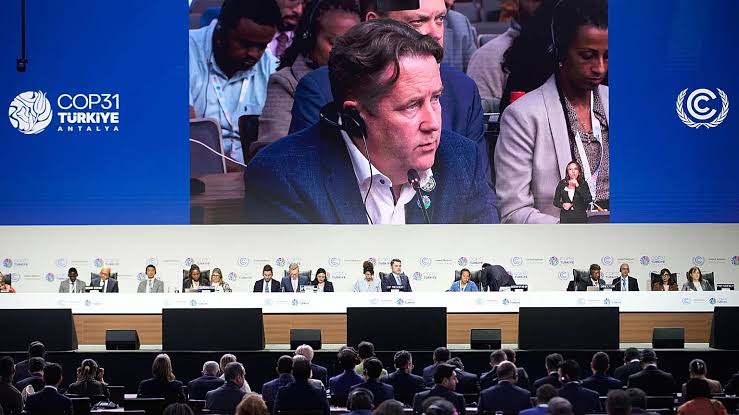
Global climate diplomacy confronts a historic failure of consensus.
ANTALYA
The United Nations COP31 climate summit has ended without a final political agreement after the European Union and several other countries rejected a proposed declaration that failed to explicitly address fossil fuels. The negotiations in Antalya, Turkey, extended nearly two days beyond their scheduled conclusion before collapsing on Sunday. The outcome marks the first time since Copenhagen in 2009 that a UN climate conference has failed to secure consensus on its principal agreement.
The proposed Antalya Pact, developed under the leadership of Turkey and Australia, was intended to establish a common direction for international climate action. However, its omission of explicit references to coal, oil and natural gas became an insurmountable obstacle for countries demanding stronger commitments. Ireland’s climate minister Darragh O’Brien, speaking on behalf of the European Union, rejected the possibility of endorsing a declaration that avoided identifying the principal sources of human-induced global warming.
The opposition extended beyond Europe. Panama, the Marshall Islands, Vanuatu and Belize challenged the proposal, arguing that its provisions were inadequate to confront accelerating climate risks. For vulnerable countries already experiencing rising sea levels, extreme weather and mounting adaptation costs, the negotiations represented more than a diplomatic disagreement. Their concerns centered on whether international commitments would translate into meaningful protection against increasingly severe environmental consequences.
The dispute also exposed persistent divisions between major fossil fuel producers and countries advocating a faster energy transition. Saudi Arabia and other oil-producing nations resisted language explicitly addressing the reduction of fossil fuel dependence, while supporting technological approaches involving carbon capture and removal. Critics warned that emphasizing these technologies without corresponding emissions reductions could create opportunities to prolong existing energy practices.
The rejected agreement nevertheless contained potentially significant proposals. One initiative sought to increase electricity’s share of global final energy consumption to 35% by 2035, compared with approximately 23% today. Although greater electrification could reduce emissions from transportation, heating and industrial activities, the proposal did not establish that additional electricity must come from renewable sources. This distinction raised concerns about whether technological substitution alone would deliver the reductions required by climate science.
Climate financing became another major obstacle. Developing countries argued that the proposed agreement failed to establish sufficiently clear financial commitments to support adaptation measures. The removal of a proposed $120 billion adaptation-finance target intensified dissatisfaction, particularly among nations confronting severe climate impacts despite contributing comparatively little to historical greenhouse gas emissions. Australian climate minister Chris Bowen, who led the negotiations, acknowledged that disagreements surrounding fossil fuels and financing had prevented a compromise.
The diplomatic breakdown carries particular significance as international efforts to limit warming to 1.5 degrees Celsius above preindustrial levels face increasingly serious challenges. That threshold remains central to the Paris Agreement, although scientific assessments indicate that existing commitments are insufficient to prevent a temporary exceedance. Failure to adopt a new declaration does not invalidate previous international climate agreements, but it weakens the political momentum needed to strengthen their implementation.
The inability to reach consensus also raises questions about the effectiveness of a negotiating system in which participating countries must collectively approve major decisions. The consensus principle protects national interests and ensures broad acceptance, yet it can also make ambitious agreements difficult when governments hold fundamentally different economic and energy priorities. COP31 demonstrated how these competing interests can prevent even a minimum common declaration.
For the international community, Antalya represents a consequential setback rather than the end of climate cooperation. Existing obligations remain in place, and national governments retain responsibility for implementing their commitments. The deeper challenge is whether future negotiations can move beyond diplomatic language toward measurable emissions reductions, credible financing and accountability for the decisions that shape the planet’s environmental future.
Beyond the Headlines, Accountability Matters.