

 Phoenix 24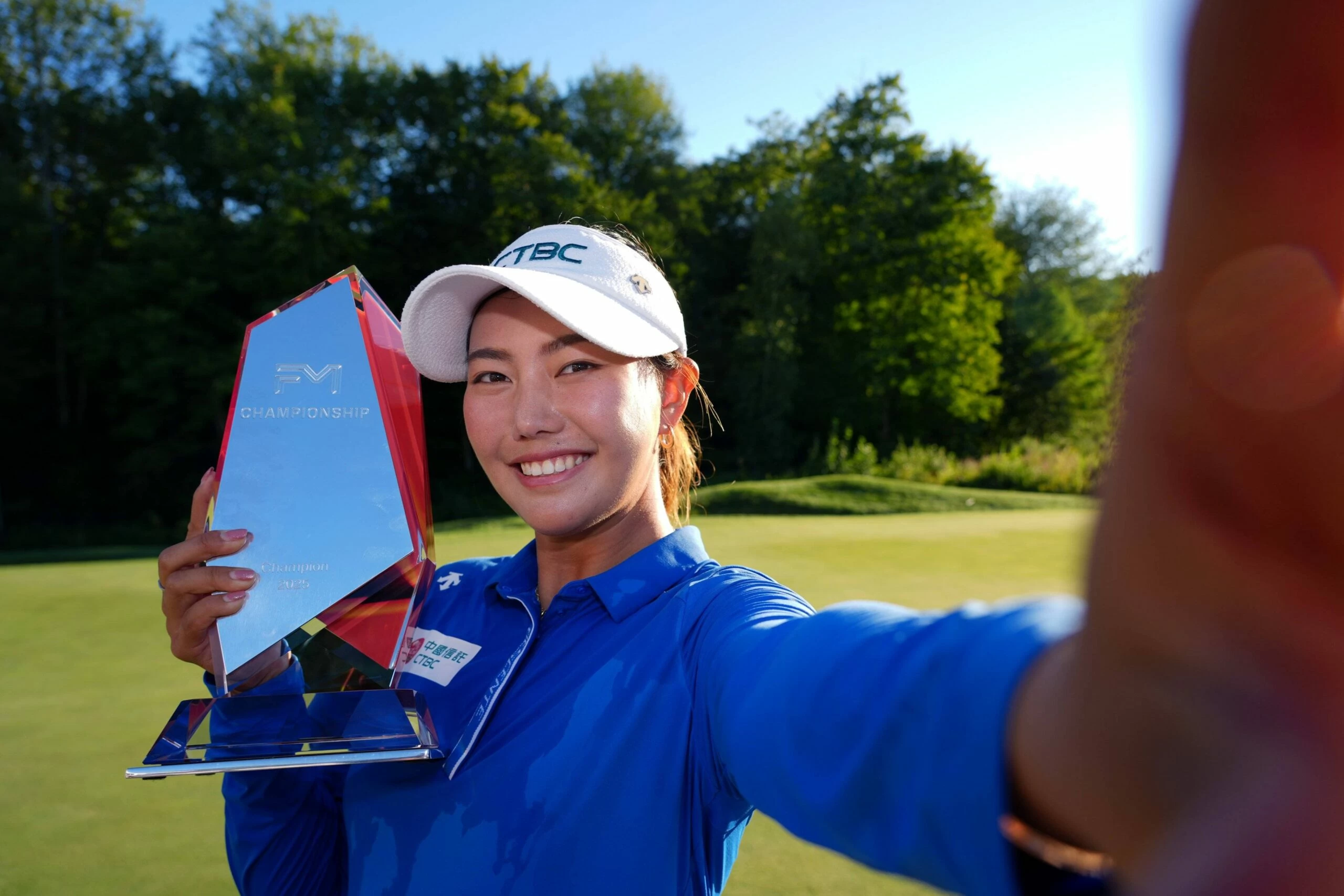
A breakthrough that blends technique, temperament, and the moment’s full weight.
Boston, August 2025
On the damp fairways of TPC Boston, softened by intermittent rain and charged with the atmosphere of a delayed competition, a new figure rose to international attention. Miranda Wang, a Chinese rookie on the LPGA Tour, turned promise into achievement by winning her first professional title. What began as a week of cautious optimism ended with a celebration of composure, patience, and precision, leaving her name etched among the emerging talents of world golf.
Her journey to the final round had been marked by consistency. On Saturday she delivered a sparkling 7-under-par 65, elevating her total to 18 under and stringing together 27 consecutive holes without a bogey. It was not only the absence of mistakes but the presence of timely brilliance that set her apart. Birdies at holes 2, 6, 7, 8, 12, 14, and 18 created a rhythm of confidence. With just 24 putts for the day, her control on the greens became the central storyline.
Sunday brought greater tension. Thailand’s Jeeno Thitikul, the world number one and a player accustomed to high-pressure finishes, positioned herself as the main challenger. She applied pressure hole after hole, shrinking the margin and testing the rookie’s nerve. Yet Wang held steady. With a final round of 2-under 70, she edged Thitikul by a single stroke, closing the contest with the calm of a veteran despite her lack of tour experience.

Observers noted the psychological maturity in Wang’s game. Many rookies falter when paired against elite opponents, particularly under the spotlight of a decisive Sunday. But Wang projected serenity. She took extra seconds before key putts, adjusted her tempo rather than her mechanics, and approached each swing as an isolated task rather than part of a mounting drama. That capacity to separate the moment from the pressure became her invisible advantage.
The victory carried echoes of a broader transformation in the women’s game. For years, Asian players have defined the landscape, with dominance from Korea, Japan, and Thailand. China, though producing flashes of talent, had not consistently placed champions on the LPGA podium. Wang’s triumph shifts that balance. It points to a new wave of Chinese golfers shaped by international training and collegiate experience abroad. In her case, Duke University provided a crucible of competition and discipline, refining her skills before the leap to the professional circuit.

The symbolism is not lost on analysts. Winning in Boston, on a course known for penal rough and strategic bunkering, highlights adaptability. This was not a course designed for error; it demanded control of distance, shaping of shots into tricky pin positions, and resilience in unpredictable weather. That a rookie mastered it suggests not luck but readiness for sustained presence on the tour.
For fans, the win also carried narrative power. In a season where established stars battled injuries and form swings, the emergence of a newcomer delivered freshness. Supporters in China celebrated on social networks, hailing her as a pioneer who could inspire greater participation in golf, a sport still young in its national development. For the LPGA, the presence of a new marketable champion reinforced the global reach of the game and its potential to expand beyond traditional bases.
Inside the locker rooms, her victory resonated differently. Veterans recognized the precision of her short game and the poise of her course management. Coaches pointed to her balanced posture, disciplined tempo, and ability to recover quickly from slight mis-hits. Younger players saw a role model who proved that breakthrough victories are not confined to established names.
The triumph also underscores the dual nature of sport at this level. Technical excellence matters, but without psychological resilience it rarely translates into wins. Wang embodied both. Her putting stroke, smooth and unhurried, was matched by her refusal to let nerves dictate rhythm. Her club selection reflected not conservatism but intelligent aggression, knowing when to attack and when to safeguard a lead.

Looking forward, questions naturally arise. Can she sustain this form across the season? Will she adapt to links conditions in Europe or the pressure of majors? History shows that rookies often struggle after their first big victory, caught between expectation and self-doubt. Yet Wang’s background suggests a different path. She has shown steady progression, patience in building her game, and the capacity to learn rapidly from each round. Those qualities suggest she is not a fleeting story but a competitor prepared for longevity.
For now, the moment belongs entirely to her. Miranda Wang’s first LPGA title is more than a statistic. It is the opening chapter of what could be a significant career and a milestone for Chinese golf. In Boston, among rain-soaked galleries and under the shadow of seasoned opponents, she transformed potential into proof. The resonance of her win is not limited to the trophy presentation. It extends into the narrative of women’s golf, a reminder that in sport, breakthroughs often arrive quietly before they echo loudly across continents.
Global narrative resilience.
Resistencia narrativa global.