

 Phoenix 24
Memory becomes testimony, not spectacle.
Los Angeles, April 2026. Charlize Theron has spoken with unusual bluntness about the night her mother killed her father, revisiting one of the most traumatic episodes of her life not as confession for its own sake, but as a form of public witness. In a recent interview, the actress recalled sensing that something terrible was about to happen before the violence unfolded inside her family home in South Africa. The account immediately drew attention because of its emotional weight, yet its deeper significance lies elsewhere. Theron is not simply revisiting pain. She is reframing it within a broader conversation about domestic violence, survival, and the long afterlife of fear.

What makes her testimony especially powerful is the way it resists melodrama while refusing minimization. Theron has made clear that the episode was not an abstract family tragedy, but a moment of lethal danger shaped by alcoholism, volatility, and the collapse of safety inside the home. Her mother’s action, as Theron has described it, occurred in a context of self-defense and imminent threat. That distinction matters because public memory often distorts domestic violence into private misfortune, stripping away the structural realities of danger, coercion, and survival. By naming the event with clarity, Theron pushes back against that sentimental softening.

There is also a cultural dimension to the way her words resonate now. Celebrity interviews often turn trauma into consumable intimacy, offering the audience emotional access while flattening the political or social meaning of what is being disclosed. Theron’s account resists that reduction. The story does not function only as biographical revelation. It also exposes the enduring silence around domestic violence, especially in contexts where victims and survivors have historically been left to interpret their suffering in isolation. When she says that such stories should be spoken aloud so others do not feel alone, she shifts the frame from personal pain to collective recognition.

That shift is important because domestic violence still circulates publicly through distortion, euphemism, or disbelief. Many people understand it as a private matter until it becomes fatal, and even then it is often retold through language that obscures the scale of fear involved. Theron’s testimony cuts against that pattern by emphasizing not just the event itself, but the atmosphere preceding it: the intuition of danger, the sense of inevitability, the knowledge that violence was approaching before it fully arrived. Those details matter because they capture something victims and survivors know intimately. Threat is often felt long before it is formally visible.
Her reflections also illuminate the strange temporal structure of trauma. The public often expects survivors to remain permanently haunted, as though pain must always express itself in visible damage to be legible. Theron has instead spoken about no longer being haunted in the way others might expect, while still treating the event with seriousness and moral clarity. That is a more difficult position for audiences to process because it refuses both sentimental victimhood and easy triumph. Survival does not erase violence, but neither does it require a person to remain frozen in it forever. That tension gives her account unusual force.
There is, too, a broader significance in who is telling this story and when. Theron is one of the most recognizable actresses in the world, yet the relevance of her account lies less in celebrity than in access. Public figures can force neglected realities into mainstream attention simply because they possess a platform others do not. When they speak with precision about violence inside the home, they can help destabilize the cultural reflex that treats such experiences as marginal, shameful, or unspeakable. The value of the disclosure is not that it satisfies curiosity. It is that it can reframe what counts as discussable in public life.
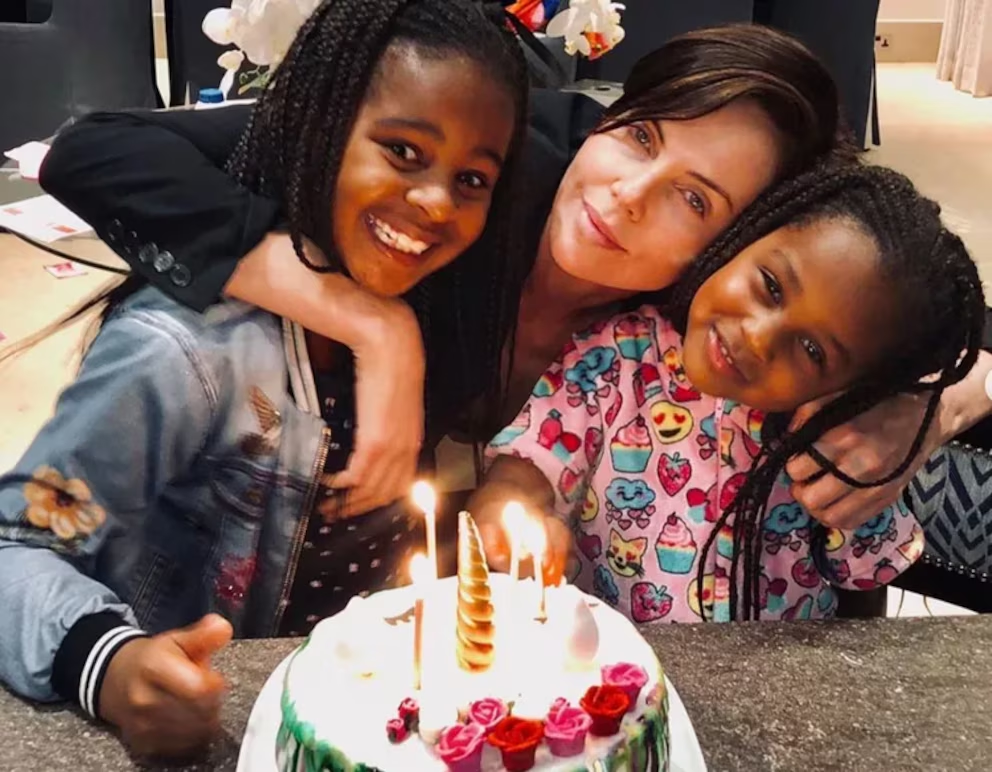
At the same time, the renewed attention around her remarks reveals the limits of contemporary media culture. Stories about trauma are often circulated because they are shocking, but shock is not the same as understanding. The danger is that audiences consume the headline, react to the cruelty of the event, and miss the structural lesson beneath it. Domestic violence is not extraordinary because it is rare. It is devastating because it is widespread, recurrent, and too often normalized until catastrophe forces recognition. Theron’s account matters most when it is read not as an isolated celebrity tragedy, but as an entry point into a larger social reality.
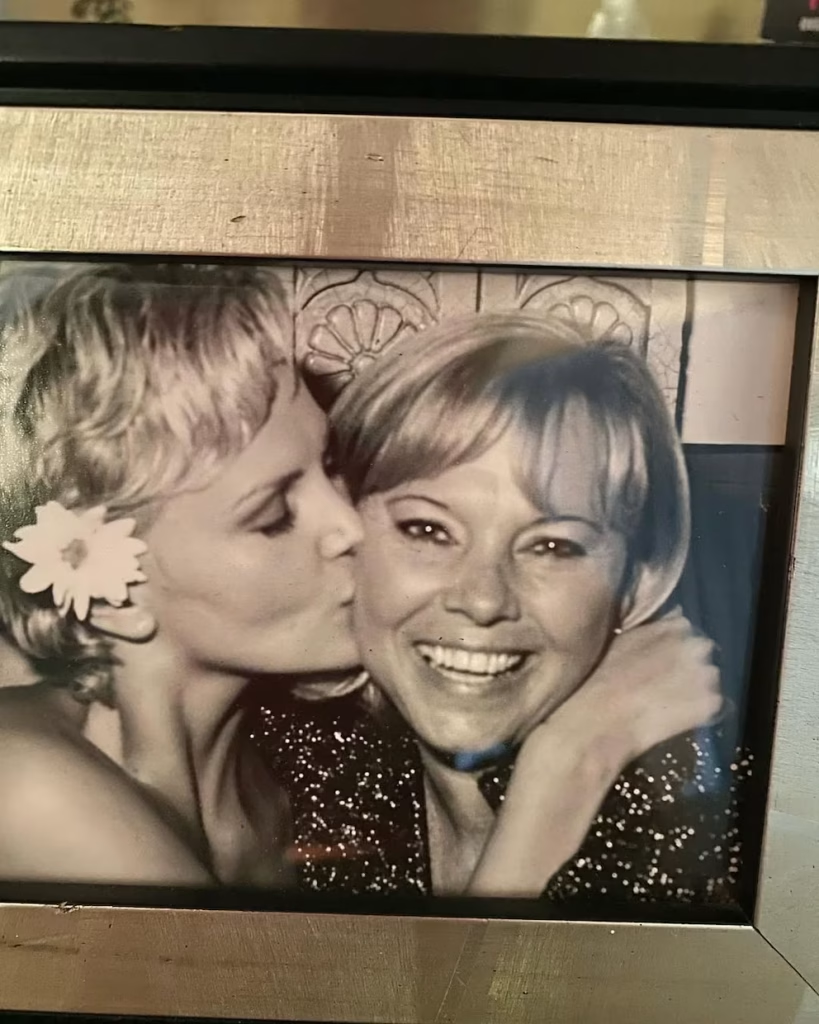
What emerges from her testimony is a difficult but necessary truth. Violence inside the family is not only physical when it erupts. It is also anticipatory, atmospheric, and psychological, shaping the way people move, listen, wait, and survive inside their own homes. By speaking about that night with candor rather than performance, Theron restores depth to a story that could easily have been reduced to tabloid material. She is not offering spectacle. She is naming a pattern that millions recognize too well.

In that sense, her words do more than revisit the past. They challenge the present. They ask whether public culture is willing to hear domestic violence as structure rather than scandal, and survival as something more complex than a neat narrative of closure. That is why the interview lingers beyond the headline. Charlize Theron did not simply recount a terrible night. She turned memory into testimony, and testimony into a refusal of silence.
Truth is structure, not noise.
La verdad es estructura, no ruido.