

 Phoenix 24
The image returns, but the ownership has changed.
Los Angeles | July 2026
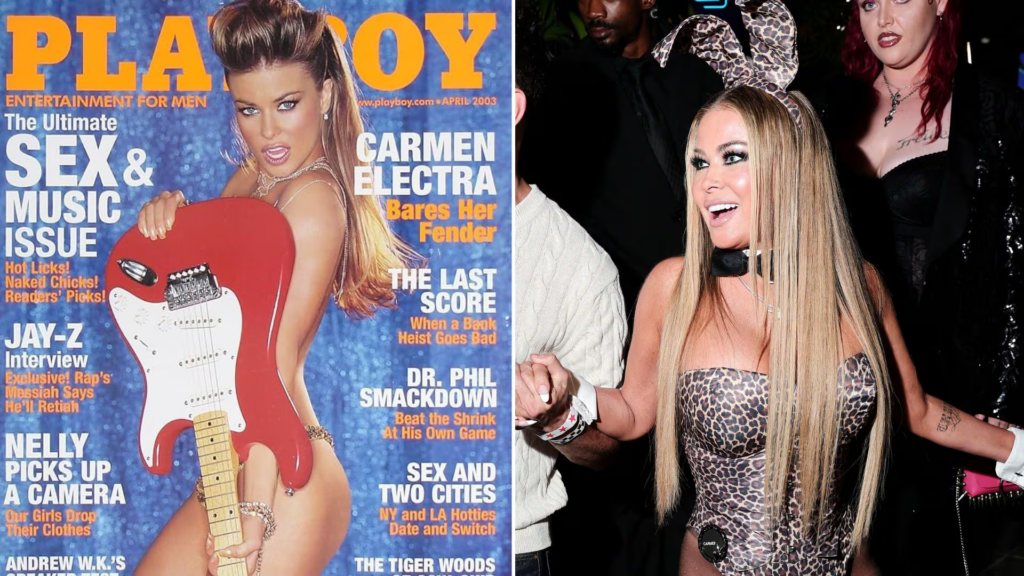
Carmen Electra has returned to Playboy 30 years after her first appearance in the magazine, revisiting one of the defining platforms of her early career from a markedly different personal and professional position. At 54, the actor, model and television personality appears in the publication’s Summer 2026 issue, scheduled for release on July 28.
The new photographic session was created by photographer Max Montgomery and presents Electra through styling associated with the visual identity that made her an international sex symbol during the 1990s and early 2000s. Leather, fishnet garments and recognizable Playboy elements connect the images with her previous work while placing them within a contemporary editorial setting.

Electra is not presented only as a photographic subject. She also assumes the role of Playboy Advisor, answering questions about relationships, attraction, confidence and personal reinvention. The format positions her experience as part of the feature rather than allowing the photographs to function as its only message.
Her first Playboy appearance was published in May 1996, before her breakthrough on “Baywatch” and before many of the film and television roles that established her place in popular culture. That session became an important stage in the transformation of Tara Leigh Patrick into Carmen Electra, the public identity she had begun developing with Prince.
The late musician discovered her during the early 1990s, signed her to Paisley Park Records and encouraged her to adopt a new artistic name. He associated the surname Electra with the energy of her dancing and helped shape the visual confidence that later became central to her career.
Electra initially entered entertainment as a singer and dancer rather than as an actor or model. Her self-titled album was released in 1993, but its commercial performance did not create the musical career originally envisioned for her. She subsequently moved toward television, modeling and acting, converting an unsuccessful first chapter into a broader entertainment identity.
Her appearance in Playboy became part of that reinvention. It expanded her visibility and preceded her selection as Lani McKenzie on “Baywatch,” one of the most internationally distributed television programs of its period. She later became a host on MTV’s “Singled Out” and appeared in comedies including “Scary Movie,” “Starsky & Hutch” and “Meet the Spartans.”

Electra returned to Playboy multiple times during the following years, appearing in editions published in 1997, 2000, 2003 and 2009. Her association with the magazine became one of the longest and most recognizable relationships between the publication and a celebrity model.
The 2026 return differs from the original appearance because Electra now controls a far more established personal brand. In the 1990s, she was a performer attempting to secure recognition within industries largely controlled by record labels, television executives, photographers and magazine publishers.
Three decades later, she enters the project with an existing global audience and greater authority over how her image is produced and distributed. Her participation reflects not the introduction of an unknown figure, but the deliberate reappearance of a woman whose visual identity has remained commercially recognizable across several generations.
That distinction is central to Electra’s recent public comments about confidence. She has described becoming less inhibited with age and more capable of deciding what she wishes to reveal. The emphasis is no longer solely on being selected by a major publication, but on choosing how to use an image already associated with her career.
Her relationship with digital platforms has reinforced that autonomy. Electra joined OnlyFans in 2022 and described the platform as an opportunity to become her own creative director, select the material she publishes and communicate directly with subscribers without traditional intermediaries controlling the process.

The platform also allowed her to monetize an audience that had followed her since the 1990s. Instead of surrendering control over photographs to magazines, television networks or unauthorized websites, she could determine the content, frequency and boundaries of her presentation.
Her return to Playboy therefore does not represent a rejection of digital independence. It demonstrates how established media brands and creator-controlled platforms can coexist within the same contemporary celebrity strategy.
The feature also arrives during Playboy’s effort to rebuild the cultural position of its printed edition. The magazine has attempted to reinterpret its history through themes of identity, body autonomy, sexuality and creative control while retaining visual references recognizable to its traditional audience.
The same Summer 2026 edition features Cara Delevingne on the cover. Delevingne’s participation was presented through a predominantly female and queer creative team, emphasizing her control over the session and her position as the first openly lesbian woman to appear on the magazine’s print cover.
Electra’s role provides a different form of continuity. Delevingne represents a generation challenging the publication’s historical assumptions, while Electra reconnects the magazine with one of the personalities who helped define its celebrity culture during an earlier era.
Placing both women within the same edition allows Playboy to present its past and intended future simultaneously. One feature depends on recognition accumulated across 30 years, while the other emphasizes changing ideas about representation and ownership of the photographed body.
Electra’s age has inevitably become part of the coverage surrounding the project. Her return at 54 challenges an entertainment system that has traditionally treated women’s visibility as dependent on youth, particularly when their public identity was originally constructed around physical appearance.
The feature does not erase the commercial nature of that appearance. Playboy continues to use beauty, sexuality and celebrity recognition to attract attention. The difference lies in the way Electra presents age as a continuation of her identity rather than as a retreat from it.
Her return also reflects the cyclical nature of popular culture. Styles, performers and franchises associated with the late 1990s and early 2000s have regained relevance among audiences encountering them through streaming platforms, social media and renewed entertainment projects.
Electra has benefited from that revival without remaining limited to nostalgia. Her appearance in “The Last Dance” reintroduced her relationship with former basketball player Dennis Rodman to a new audience. She later returned for “Good Burger 2,” participated in fashion campaigns and maintained visibility through direct digital publishing.
Her personal history has also become part of how she discusses relationships publicly. Electra was briefly married to Rodman and later married musician Dave Navarro. She has spoken about emotional connection, honesty and the importance of maintaining individuality rather than presenting romance only through spectacle.
Those experiences support her new advisory role. The feature allows Playboy to use her not merely as a familiar face, but as someone capable of discussing the consequences, contradictions and lessons of living much of her adult life under public examination.
The connection with Prince remains especially important. Electra has credited him with recognizing qualities in her before she possessed the confidence to recognize them herself. She has recalled that he predicted she could become a figure comparable to Marilyn Monroe, years before her television breakthrough or extensive association with Playboy.
In 2024, she completed the legal process of changing her birth name to Carmen Electra. The decision formalized an identity that had already defined her professionally for more than three decades.
That legal change adds another layer to the Playboy return. The name originally created within Prince’s artistic world is no longer simply a stage identity managed for entertainment purposes. It has become her recognized personal name and the foundation of a brand she now directs herself.
The Summer 2026 appearance does not attempt to recreate 1996 exactly. Electra cannot return as the same emerging performer, and the media environment that received her original photographs no longer exists. Print magazines now operate beside subscription platforms, social networks and continuous celebrity coverage.
What remains consistent is her understanding of image as professional capital. Electra has survived multiple changes in entertainment by recognizing which aspects of her identity audiences remember and adapting them to new formats without entirely abandoning their origin.
Her Playboy return is therefore both commemorative and strategic. It marks the anniversary of a formative appearance while introducing her to readers who may know her through streaming, digital culture or revived 1990s aesthetics rather than through the original magazine.
Thirty years after her debut, Electra is again using Playboy as a platform for visibility. This time, however, she arrives not as a performer waiting for the publication to define her, but as an established figure participating in the continued interpretation of an image she helped create.
El tiempo transforma la imagen cuando la mujer conserva su voz. / Time transforms the image when the woman preserves her voice.