

 Phoenix 24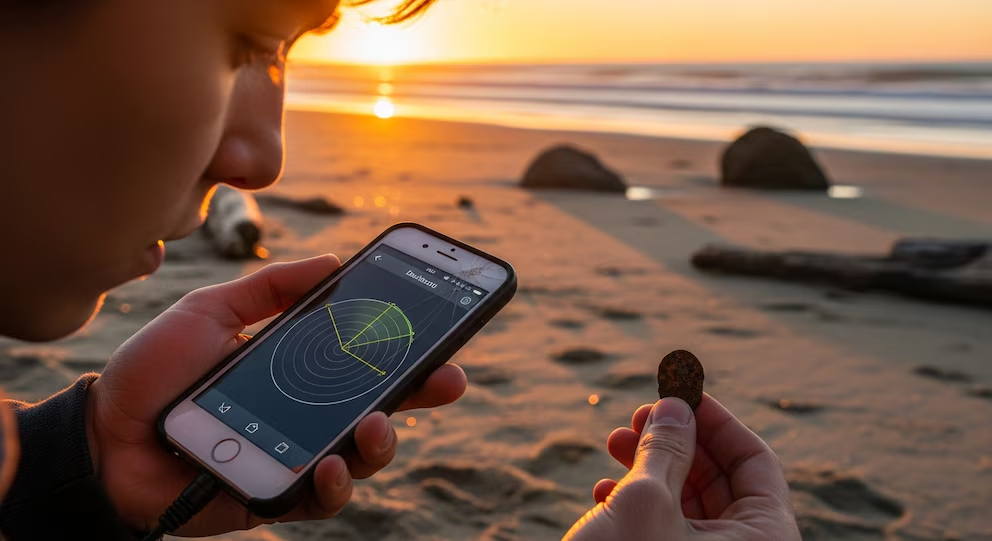
When a venerable institution expands its reach across continents, the past itself becomes a subject of debate about ownership, ethics and historical memory.
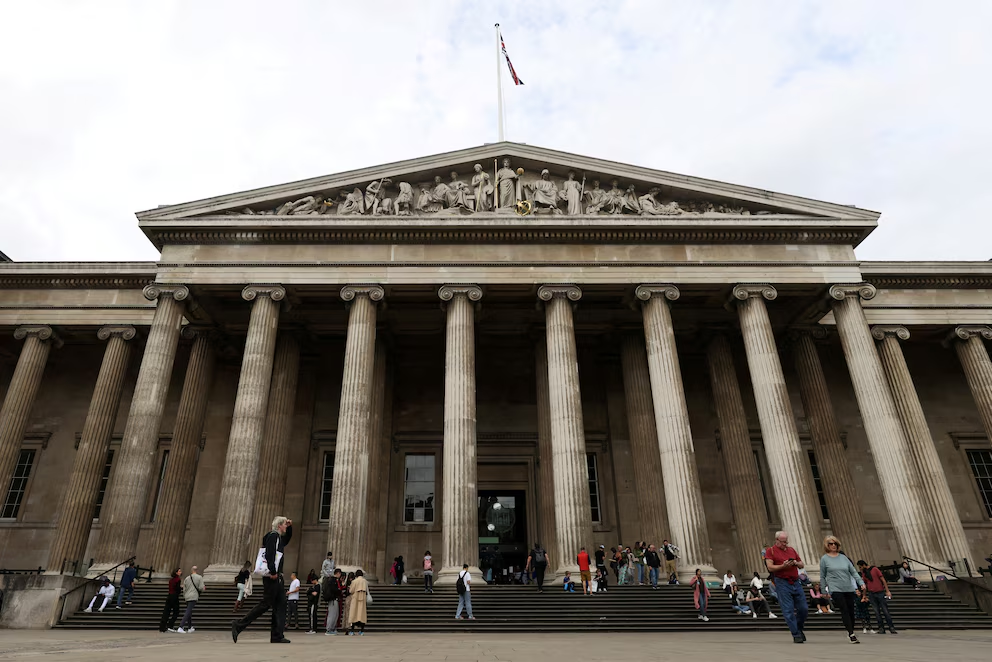
London, January 2026. The British Museum, one of the most storied cultural institutions in the world, is undertaking a sweeping initiative to track down and document antiquities far beyond the walls of its galleries. This mission, part research expedition and part archaeological detective work, has sent teams of specialists into North Africa, the Eastern Mediterranean, Central Asia and the Americas to locate, analyse and contextualise artifacts that have been dispersed, undocumented or forgotten. The effort reflects both a scholarly ambition to deepen understanding of ancient cultures and a growing reckoning within the museum world about how cultural heritage is preserved and presented in a globalised age.
The project’s core objective is not to extract artifacts for display in London, but to build a rigorous record of material culture that has eluded comprehensive documentation. Shipwrecks off the coast of North Africa have yielded ceramic fragments that fill gaps in trade histories between ancient ports. In the mountains of Central Asia, rock inscriptions have been mapped and digitally recorded to shed light on early Silk Road itineraries. In the Americas, relics that once seemed isolated now form part of regional interaction networks when viewed through comparative analysis. In each of these contexts, the British Museum teams work alongside local archaeologists and heritage authorities, a gesture museum leadership describes as foundational to the legitimacy of the work itself.
Scholars involved in the initiative emphasise that understanding how everyday objects move through space and time is crucial to reconstructing the social, economic and cultural life of past societies. Luxury items such as gold ornaments or imported silks certainly attract attention, but it is the humble pottery, the chipped stone tools and the fragments of now vanished structures that tell historians about ordinary lives, trade patterns and technological adaptations. By piecing together these dispersed traces, researchers argue, it becomes possible to see ancient worlds as dynamic systems rather than isolated cultures.
The British Museum’s approach also incorporates cutting edge technology. Ground penetrating radar has allowed teams to survey sites without intrusive excavation. Three dimensional scanning preserves fragile inscriptions for long term study. Isotope analysis of material remains reveals geographic origins of raw materials and dietary practices. These methods, used in tandem with traditional fieldwork, are reshaping how researchers interpret evidence long considered too fragmentary to inform broad narratives about past civilizations.
Despite the scholarly enthusiasm for this work, it has reignited debates about the role of Western museums in the stewardship of global heritage. The British Museum’s vast collections have long been a lightning rod for discussion about colonial history and cultural ownership. Critics argue that institutions in former imperial capitals continue to benefit from historical patterns of unequal acquisition and that even well intentioned research projects can perpetuate imbalances when authority over interpretation is concentrated in powerful Western centres.
These debates have grown more pronounced in recent years. Movements for repatriation of specific pieces, from the Parthenon Marbles to Benin Bronzes, have highlighted deeply felt questions about cultural identity and historical justice. Proponents of repatriation argue that artifacts form part of the living heritage of the communities that produced them and that museums should return items when provenance is linked to colonial acquisition. The British Museum’s global research initiative does not, by itself, resolve these tensions, but its existence intersects with wider conversations about how cultural institutions can contribute to equitable stewardship.
Supporters of the initiative point to the collaborative nature of the work. In many instances, local scholars, heritage professionals and community representatives are co-designing research agendas, participating in field documentation and contributing to interpretive frameworks. Joint exhibitions emerging from this research are scheduled in multiple countries, enabling source communities to host material narratives in situ before any broader global display. Museum officials emphasise that such partnerships are meant to shift relationships from hierarchical models toward shared custodianship.
The project also reflects wider shifts in archaeology and cultural heritage practice. Where once excavation aimed to recover and physically remove artifacts for distant display, modern approaches favour minimal intervention, context-sensitive recording and ethical frameworks that foreground the voices and priorities of local communities. This methodological evolution aligns with international conventions on heritage protection and documentation, but the challenges remain complex. Legal regimes vary by country, and international trade in antiquities still fuels illicit networks that muddy provenance records and complicate protection efforts.
One ongoing component of the British Museum’s work focuses on trade networks in the ancient Near East. By comparing shards of pottery, seals and weights found at disparate sites, researchers are reconstructing maps of exchange that challenge prior assumptions about the scale of early commerce. These findings suggest that northern Mesopotamian cities were integrated into expansive economic systems much earlier and more deeply than previously acknowledged. Such insights do not merely fill academic lacunae; they refract broader questions about how human societies have historically coped with mobility, resource scarcity and cultural interchange.
For historians in Asia and Africa, the ability to integrate material evidence from local contexts with global research networks has proved invigorating. It provides a platform for voices and perspectives that were once sidelined in dominant narratives framed by Western scholarship. By building joint research publications and hosting symposia in regional institutions, the project aims to redistribute intellectual authority even as debates about artifact ownership persist.
In the Americas, reactions from indigenous communities underscore the stakes of cultural research. Some leaders express cautious optimism about projects that involve local participation and respect for ancestral heritage. Others remain sceptical, pointing to a history of excavation that removed artifacts without consultation and left communities with fragmented histories. The British Museum’s leadership acknowledges these critiques and insists that transparency, dialogue and adherence to ethical protocols guide all research decisions.
Beyond academic circles, the initiative has prompted public reflection about how we collectively envision the past. Museums have long been spaces where official narratives about history are constructed in galleries and exhibitions. When those narratives are shaped by research that spans continents and centuries, questions about authority, interpretation and access inevitably emerge. Cultural artifacts are not inert objects; they embody stories, identities and meanings that can resonate differently depending on who tells them and why.
The British Museum’s global antiquities quest is therefore a test of how cultural institutions navigate the dual goals of preserving human heritage and engaging in ethical practice. It represents a recognition that history is not static and that new evidence can reshape old certainties. The museum’s work continues to unfold in the field, in laboratories and in conversations with communities around the world.
When artifacts speak, they speak across time, geography and culture. The task of listening, interpreting and sharing those voices remains as complex as the histories they reveal.
Every silence speaks.
Cada silencio habla.