

 Phoenix 24
Three machines now define three levels of ambition.
Cupertino, July 2026
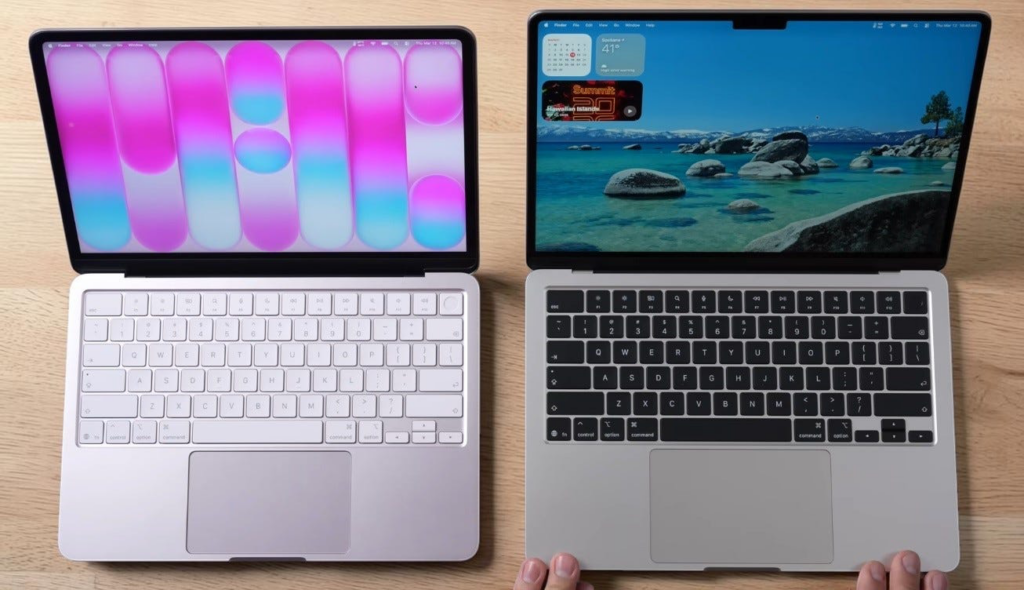
Apple’s portable computer lineup now has three clearly differentiated levels with the arrival of the MacBook Neo alongside the MacBook Air M5 and MacBook Pro. The decision is no longer limited to choosing between portability and professional power. Buyers must now evaluate processing capacity, memory, connectivity, display quality and external monitor support before selecting a model. Each device addresses a distinct type of user rather than merely offering a different price.
The MacBook Neo occupies the entry level and is designed for people seeking access to macOS without paying for capabilities they may never use. It incorporates the A18 Pro chip, originally developed for mobile devices, with a six-core CPU, five-core GPU and 16-core Neural Engine. Its base configuration includes 8 GB of unified memory, while storage options are limited to 256 GB or 512 GB. These specifications are sufficient for web browsing, documents, video calls, streaming and basic educational work.

Its 13-inch Liquid Retina display reaches 500 nits of brightness and supports a broad sRGB color range. The main compromises appear in connectivity, with two USB-C ports that operate at different transfer speeds, a headphone jack and support for only one external 4K monitor at 60 hertz. This configuration limits its usefulness for users who routinely connect high-speed drives, several accessories or professional displays. The Neo prioritizes simplicity and affordability over expansion.
The MacBook Air M5 occupies the central position and remains the most balanced option for students, professionals and remote workers. It is offered in 13-inch and 15-inch versions, providing a choice between greater portability and a larger workspace. Its M5 processor includes a 10-core CPU and delivers a substantial advantage over the Neo in multitasking, creative applications and more demanding workflows. The Air can handle office work, academic research, programming and moderate photo or video editing without moving into professional workstation territory.
Wireless connectivity is another important distinction. The Air M5 introduces Wi-Fi 7 and Bluetooth 6, making it better prepared for newer networks, faster routers and modern accessories. Its physical connections remain deliberately limited to two Thunderbolt 4 ports, MagSafe charging and a headphone jack. Users requiring several peripherals may still need a hub or docking station, but the available ports are considerably faster and more versatile than those included in the Neo.
Portability remains one of the Air’s strongest advantages. Its fanless design allows silent operation, while the thin aluminium body makes it easier to carry between home, university and the workplace. Battery life and energy efficiency strengthen its position as an everyday computer capable of managing extended sessions away from a power outlet. The Air is not the cheapest MacBook, but it avoids many of the limitations imposed by the entry-level model.
The MacBook Pro is designed for users whose work depends directly on sustained performance. Available in 14-inch and 16-inch formats, it can be configured with the M5, M5 Pro or M5 Max, depending on the level of processing and graphics power required. The more advanced chips increase CPU and GPU capacity, memory bandwidth and support for demanding professional applications. Video production, three-dimensional design, software development and complex data analysis are the workloads most likely to justify the investment.
Its Liquid Retina XDR display also separates the Pro from the other two models. The panel offers superior brightness, contrast and dynamic range, which are relevant for editing high-resolution photography, color grading and producing audiovisual content. The internal cooling system allows the processor to sustain intensive performance for longer periods without the limitations associated with fanless designs. This difference may be barely visible during routine office tasks but becomes significant during prolonged rendering or compilation.
Connectivity represents another practical advantage. MacBook Pro configurations include additional ports such as HDMI and an SDXC card slot, reducing dependence on external adapters. Models equipped with M5 Pro or M5 Max also incorporate Thunderbolt 5, enabling faster data transfers and more demanding professional accessories. Depending on the processor, the Pro can operate with multiple external displays, while the Neo is restricted to one and the Air remains more limited.
The distinction between the three models is therefore based on workload rather than prestige. MacBook Neo is appropriate for everyday tasks, basic study and users with modest storage or connectivity requirements. MacBook Air M5 provides the strongest balance between portability, performance and useful lifespan for most buyers. MacBook Pro becomes necessary when time, sustained processing and professional connectivity directly affect productivity.
Choosing incorrectly can produce two opposite problems. A Neo purchased for intensive editing or advanced multitasking may reveal its limitations quickly, while a MacBook Pro used only for documents and browsing represents unnecessary expenditure. The Air occupies the broad middle ground, but even it may require adapters or additional storage planning. Apple’s expanded lineup offers more choice, yet it also demands a more precise evaluation of how the computer will actually be used.
The MacBook Neo lowers the barrier to Apple’s ecosystem, the Air M5 defines the mainstream experience and the Pro protects the company’s position in demanding professional environments. Their differences are not cosmetic, because they determine how many tasks, screens and accessories the computer can manage comfortably. The best MacBook is no longer simply the newest or most powerful. It is the one whose limits remain above the user’s real needs.
Detrás de cada dato, la intención. / Behind every data point, the intention.