

 Phoenix 24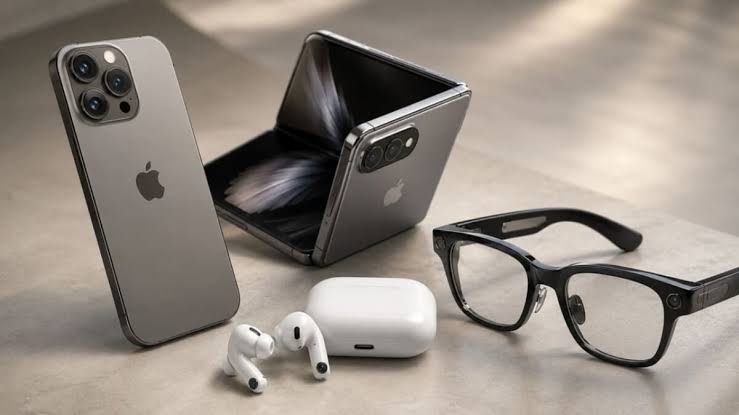
A broader hardware offensive could reshape the company through 2028.
CUPERTINO, United States | June 2026
Apple is reportedly preparing one of the most ambitious product expansion cycles in its history, with a foldable iPhone, artificial intelligence glasses and AirPods equipped with cameras at the center of a roadmap extending through 2028. The plans would also include new watches, iPads, Macs, home devices and a tabletop robot. Most of the products have not been formally announced by Apple, so their names, specifications and release dates may still change. Together, however, they suggest a company seeking to restore design as a central source of technological differentiation.
The first major stage of the reported strategy could arrive in September with the iPhone 18 Pro, iPhone 18 Pro Max and a foldable model informally described as the iPhone Ultra. Apple Watch Series 12 and Apple Watch Ultra 4 are also expected to form part of the launch cycle. The foldable phone would represent Apple’s most significant change to the iPhone’s physical format in years. It would also place the company in direct competition with manufacturers that have already spent several generations refining flexible-screen devices.
Apple has historically entered emerging categories later than some rivals, preferring to wait until it believes the technology and user experience are sufficiently mature. That approach could help explain the delayed arrival of a foldable iPhone. The company would need to address durability, screen creasing, hinge reliability, battery life and software adaptation before presenting the device as a premium product. Expectations will be particularly high because existing foldable phones have already established a demanding benchmark.
A second generation of the foldable iPhone is reportedly planned for 2027, the year marking the twentieth anniversary of the original iPhone. That anniversary could become the focal point of a larger redesign involving future Pro models. The roadmap refers to possible iPhone 20 Pro and Pro Max devices, although Apple’s final naming strategy remains uncertain. The broader objective appears to be creating a more visible break from years of gradual external changes.
The standard iPad is also expected to receive a newer chip capable of supporting Apple Intelligence. This would expand access to the company’s AI functions beyond its most expensive tablets and computers. The Mac family is included in the renewal cycle, while an iPad mini with an OLED display could also arrive. These upgrades would allow Apple to make artificial intelligence a more consistent feature across its ecosystem.
Apple’s home products may receive similar attention. A new Apple TV and HomePod mini could incorporate functions supported by Apple Intelligence, while a long-discussed smart home control center may also appear. Such a device could serve as a central interface for security cameras, connected appliances, communication and media. Its success would depend on whether Apple can make the home experience simpler than the fragmented systems already available.
The most unusual products are expected in 2027. Apple is reportedly developing AirPods with integrated cameras intended to provide visual information to Siri and other AI systems. These would not necessarily function as conventional photography devices. Their cameras could instead help the system understand the user’s surroundings, recognize objects and provide contextual assistance.
This concept could transform headphones from audio accessories into environmental sensors. A user might look toward an object and ask for information while the AirPods help determine what is nearby. The technology could support navigation, accessibility and real-time interpretation. It would also raise serious questions about privacy, recording indicators and how people around the wearer would know when cameras are active.
Apple is also said to be developing its first smart glasses, positioned closer to Meta’s Ray-Ban products than to the heavier Vision Pro headset. The glasses would reportedly combine artificial intelligence with elements of augmented reality. A lighter format could make wearable computing practical throughout the day rather than limiting it to shorter immersive sessions. The challenge will be balancing useful functions with battery life, comfort and an acceptable appearance.
The glasses may become part of a broader evolution of the Vision platform. Apple entered spatial computing with an expensive headset that demonstrated advanced technology but faced limitations in price, weight and everyday adoption. Smart glasses could offer a more accessible path by reducing immersion and emphasizing assistance. They may also create a new interface in which voice, vision and context replace frequent interaction with a phone screen.

By late 2027 or 2028, Apple could introduce a tabletop robot based on an advanced smart display mounted on a mechanical arm. The device would reportedly move its screen to follow users or adjust during video calls and home interactions. It could combine communication, entertainment and household control with a more physical form of intelligence. This would be one of Apple’s clearest attempts to bring robotics into the consumer home.
The product offensive is also connected to internal changes involving industrial design. That area lost some of its direct influence after Jony Ive left Apple in 2019. Many of the company’s most familiar devices then retained similar visual identities across several generations. The new roadmap appears intended to restore design as a stronger strategic force rather than treating it mainly as a final layer applied after engineering decisions.
John Ternus, Apple’s senior hardware executive and a figure frequently discussed in succession speculation, is expected to play an important role in that process. His background in hardware engineering could help integrate design more closely with technical development. Reports indicate that he has spent increasing time with Apple’s industrial design group. Any eventual leadership change, however, remains unconfirmed unless announced directly by the company.
The larger strategy reflects pressure from several directions. Apple must respond to rapid advances in generative AI, increasing competition in wearables and the maturity of the smartphone market. Traditional annual upgrades may no longer be enough to create the excitement once associated with major iPhone launches. New form factors could provide additional growth while making the ecosystem more difficult for users to leave.
The risks are equally substantial. Foldable devices can be expensive and fragile, camera-equipped wearables can provoke privacy concerns and smart glasses remain technically difficult to produce at mass-market scale. Apple must also ensure that Siri and Apple Intelligence are capable enough to justify the new hardware. A device built around AI becomes less valuable when the assistant cannot understand context reliably.
None of the rumored products should be treated as guaranteed until Apple presents them publicly. Development projects are often delayed, redesigned or canceled before release. Still, the reported roadmap offers a coherent picture of where the company may be heading. Apple appears to be preparing for a future in which phones fold, headphones see, glasses interpret the environment and home devices move.
Design regains power when technology changes how people interact. / El diseño recupera poder cuando la tecnología transforma la manera de interactuar.