

 Phoenix 24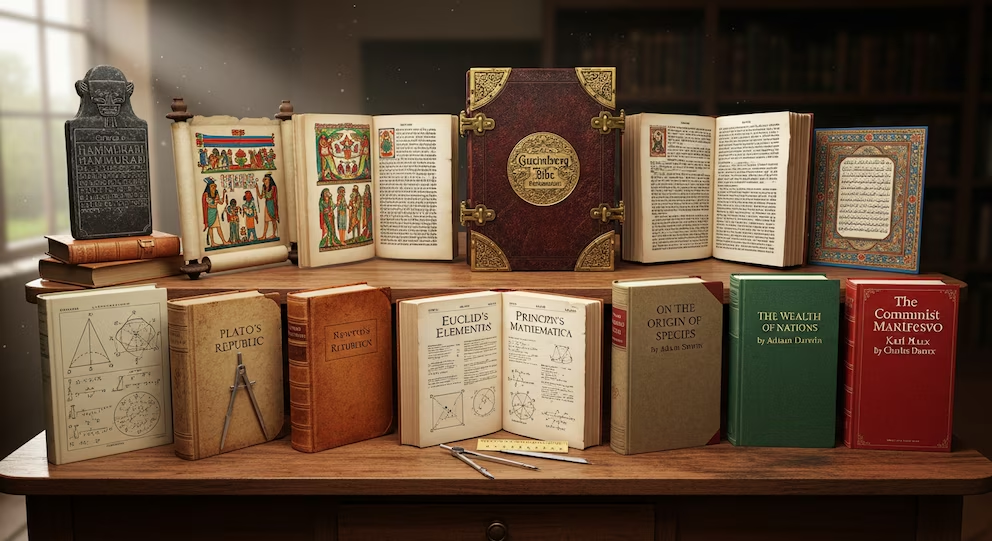
Civilization is also built through reading.
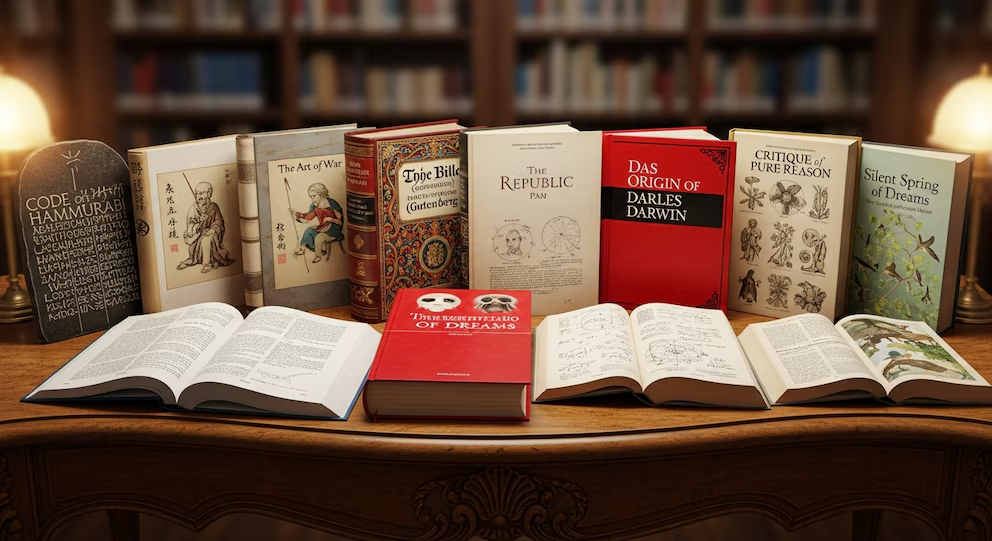
Mexico City, April 2026. A list of ten books identified by artificial intelligence as fundamental to human history may seem, at first glance, like a cultural exercise for World Book Day. Yet the selection reveals something deeper about how algorithms now organize collective memory. By choosing works such as The Bible, Euclid’s Elements, Plato’s Republic, The Quran, Machiavelli’s The Prince, Darwin’s On the Origin of Species, Marx and Engels’s The Communist Manifesto, Newton’s Principia Mathematica, Rousseau’s The Social Contract, and Mary Wollstonecraft’s A Vindication of the Rights of Woman, the machine does more than rank books. It reconstructs civilization through the texts that shaped law, faith, science, politics, revolution, and rights.
The list is revealing because it does not treat books merely as literary objects. It frames them as operating systems of human order. Sacred texts shaped moral architectures and legal traditions. Mathematical and scientific works changed the grammar of proof, nature, and causality. Political treatises offered models of authority, legitimacy, obedience, rebellion, and emancipation. In that sense, the books selected by AI are not simply influential because they were widely read. They became influential because they taught societies how to imagine truth, power, duty, progress, and conflict.
There is also a tension inside the exercise. When artificial intelligence selects the books that changed humanity, it inevitably reflects the archive from which it learned. That archive is not neutral. It carries the weight of dominant languages, academic traditions, publishing histories, colonial circuits, religious expansion, and institutional memory. The result may be coherent, but it is not innocent. The canon produced by AI is not only a map of influence. It is also a map of what has been preserved, translated, indexed, digitized, and repeatedly treated as central.
That does not invalidate the list, but it makes it more interesting. The selected works genuinely transformed how human beings organized knowledge and authority. Euclid shaped deductive reasoning for centuries. Newton changed the scientific understanding of physical reality. Darwin altered humanity’s place in nature. Rousseau and Marx helped redraw the political imagination of modernity. Wollstonecraft challenged the gendered architecture of rights. These were not books that merely described the world. They intervened in it.

The inclusion of religious, scientific, philosophical, and political works also shows that civilization does not advance through one kind of knowledge alone. Faith, geometry, biology, law, revolution, and feminist critique all appear in the same intellectual landscape because history is built through competing systems of meaning. Some books create institutions. Others destroy inherited certainties. Some stabilize authority. Others teach societies how to resist it. The most powerful texts are often those that continue to generate disagreement long after their original context has disappeared.
From a technological perspective, the exercise is especially symbolic. An AI system is now being asked to identify the books that shaped human intelligence, while human societies are trying to understand how AI itself will reshape the future of reading, authorship, education, and memory. The circularity is striking. Humanity trained machines on its archives, and now those machines are being invited to interpret the archive back to humanity. That does not make the machine wiser than the reader. It makes the reader responsible for questioning the machine’s hierarchy.

From a Phoenix24 perspective, the deeper significance lies in the politics of the canon. Lists of “essential books” are never only educational. They decide which traditions remain visible, which ideas are granted civilizational status, and which voices are left at the margins of memory. AI can accelerate that selection, but it cannot absolve it from power. The real question is not whether these ten books changed history. Most of them did. The harder question is who gets to decide which books will be remembered as the architecture of humanity.
Phoenix24 Editorial Note: analysis, context, and strategic narrative to read power beyond the headline.