

 Phoenix 24
Algorithms Turn Football Forecasts Into Global Spectacle
Miami, June 2026 — Artificial intelligence has entered the emotional territory of football prophecy, projecting which national teams could dominate the next World Cups and reopening the debate over how far algorithms can really understand a sport defined by uncertainty, pressure and human instinct.
The latest prediction places elite football powers at the center of future tournaments, with traditional contenders such as Spain, Argentina, England, Brazil and France appearing among the strongest candidates. The exercise reflects the growing role of data models, simulations and machine learning systems in the way fans, analysts and media organizations interpret global sport.
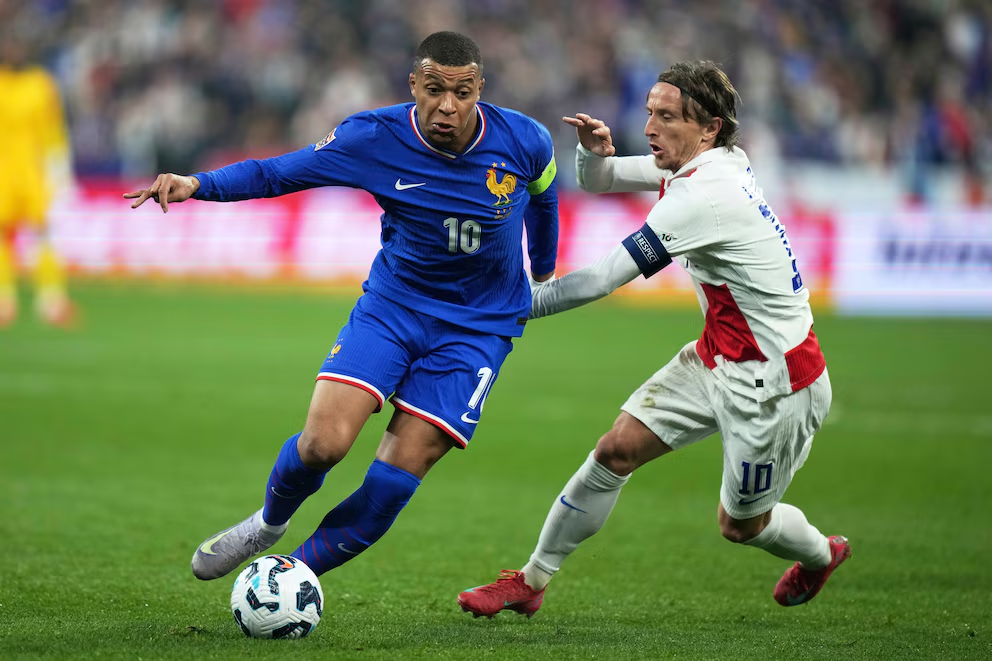
Yet football remains hostile territory for prediction. A World Cup is not decided only by historical performance, player market value, tactical systems or statistical probability. It is shaped by injuries, mentality, refereeing decisions, weather, penalties, dressing-room dynamics and the emotional force of a single match. An algorithm can identify patterns, but it cannot fully capture the psychological volatility of knockout football.
The fascination with AI predictions reveals something deeper than curiosity about who may lift the trophy. It shows how modern audiences increasingly seek certainty in systems designed to process uncertainty. In politics, finance, medicine and sport, artificial intelligence has become a symbolic authority: a machine capable of organizing complexity when human judgment feels insufficient.
For football, this shift is both useful and risky. Data can improve scouting, tactical preparation, workload management and opponent analysis. National teams are already integrating advanced analytics into training and match strategy. But when predictive tools are presented as oracles, they can distort public perception and turn probabilistic models into entertainment narratives.

The 2026 World Cup, hosted by the United States, Mexico and Canada, is arriving at the perfect moment for this technological transformation. It will be the largest edition in tournament history, with expanded participation, greater commercial reach and unprecedented digital engagement. Artificial intelligence will not only analyze the event; it will help shape how fans consume it.
The key distinction is between analysis and prophecy. AI can estimate probabilities, compare scenarios and detect competitive trends. It cannot guarantee destiny. Football’s power comes precisely from its resistance to complete calculation. The unexpected goal, the underdog run, the penalty miss and the tactical collapse are not anomalies; they are part of the sport’s architecture.

Still, the presence of AI in World Cup forecasting confirms a broader cultural shift. The game is no longer interpreted only by former players, coaches and journalists. It is increasingly filtered through models, dashboards and automated systems that convert emotion into data and data into prediction.
The next champions may or may not match the algorithmic forecast. But the more important story is already clear: artificial intelligence has become part of the World Cup’s global language. It will not replace the drama of football, but it will increasingly compete to explain it before the ball even starts rolling.
Truth is Structure, Not Noise. | La Verdad es Estructura, No Ruido.