

 Phoenix 24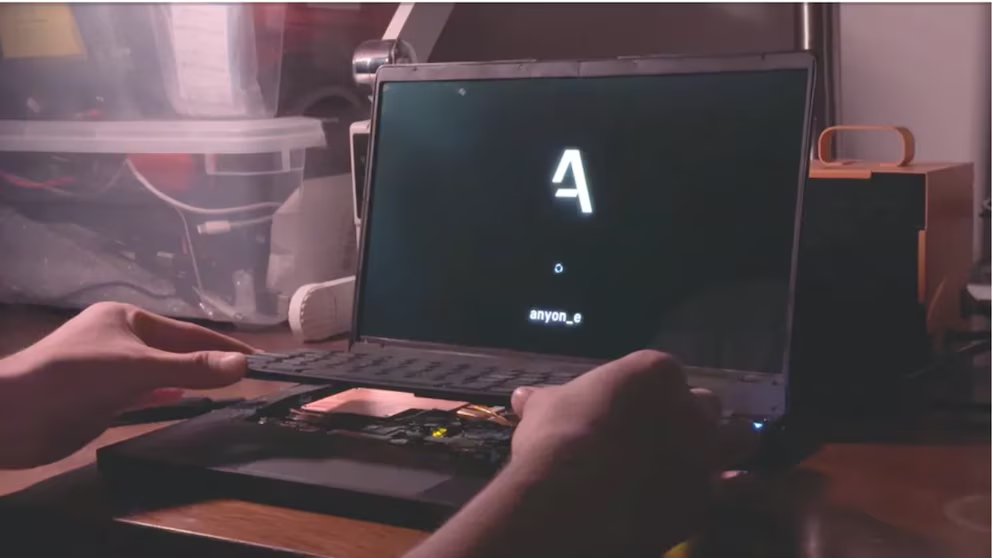
A school project built a real laptop.
Exeter, March 2026
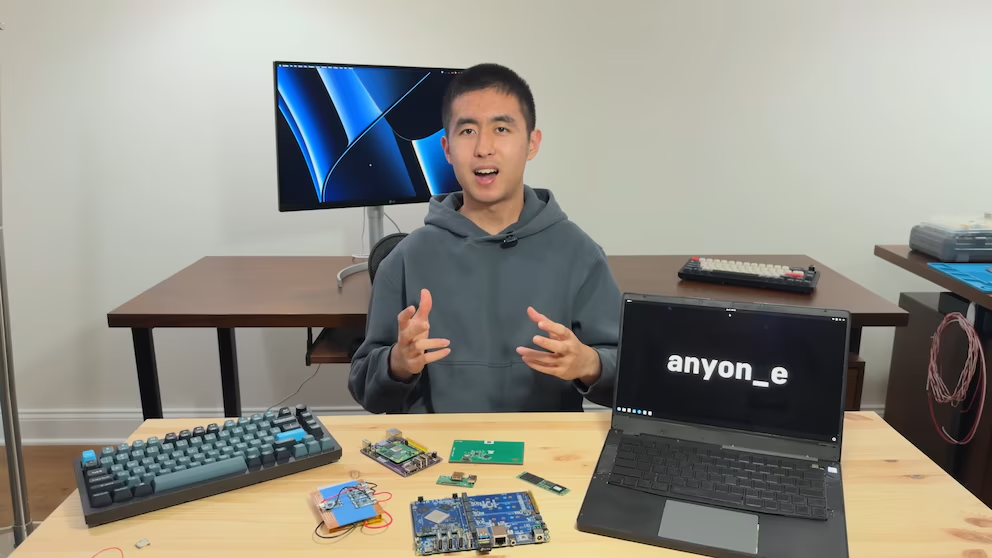
A high school senior turned a class assignment into a working 4K laptop and then did the most disruptive part afterward: he published the full build so other people can replicate it. Bryan Huang, a student at Phillips Exeter Academy in the United States, spent roughly six months designing and assembling a thin, modern-looking portable computer he named anyon_e. The device is not a cardboard prototype or a novelty shell around off-the-shelf parts. It is a complete system built around a serious compute module, a premium AMOLED display, custom power management, and a detachable mechanical keyboard, all packaged in an anodized aluminum chassis that aims to compete aesthetically with commercial ultrabooks.
The core of the build is a FriendlyElec CM3588 module based on Rockchip’s RK3588 system-on-chip. That choice matters because it signals what “DIY laptop” means in 2026: not a scavenged board, but a compact embedded compute platform capable of doing real work. The RK3588 integrates an eight-core CPU, split between four Cortex-A76 performance cores and four Cortex-A55 efficiency cores, plus a Mali-series GPU and a neural processing unit rated at about 6 TOPS. It also supports high-end display output, including 8K at 60 frames per second, a spec that sounds excessive until you realize it provides headroom for driving a 4K internal panel while still handling external displays and compute-heavy workloads. Huang’s module configuration includes 16 GB of LPDDR4X memory and modern connectivity options such as fast USB, PCIe, and high-bandwidth display interfaces, giving the laptop a foundation that can run productivity tasks, media workflows, and local AI experiments without feeling like a toy.
The headline feature is the screen: a 13.3-inch Samsung AMOLED 4K panel, the same model used in some commercial laptops. That detail is a double-edged sword. It gives the build a legitimate premium surface, but it also introduces the kind of engineering problem that separates “assembled” from “built.” Connecting a high-resolution AMOLED panel over eDP is not plug-and-play when signal integrity becomes fragile at modern data rates. Huang reportedly ran into eDP 1.4 integrity issues and had to solve them as part of the project, a reminder that display integration is one of the most unforgiving parts of laptop design. In mass production, teams and suppliers handle these issues with validated reference designs, specialized test equipment, and iteration cycles. In a school project, it becomes a crash course in why laptops are harder than desktops, and why the thinness people take for granted is often purchased with weeks of troubleshooting.
The keyboard is where the project stops looking like an embedded developer kit and starts looking like a product. anyon_e uses a detachable mechanical keyboard built with low-profile Cherry MX ULP switches, designed to be customizable and removable. Huang housed it in a separate enclosure so it can function as an independent wireless keyboard, driven by a small nRF52840 system-on-chip running ZMK firmware. To keep the keyboard unit under 7 mm thick, he integrated a 200 mAh battery into the keyboard assembly, accepting that the keyboard becomes a device inside the device, with its own power constraints and firmware responsibilities. Even the keycaps became part of the engineering story: because suitable caps were difficult to source, he 3D-printed them using a fine nozzle, trading time and iteration for cost control and precise fit.
For the trackpad, he used a glass-surface multitouch module from Azoteq, connected over USB, sourced as a discontinued component. That choice highlights a recurring truth in DIY hardware: the hardest parts are not always the CPU or the screen, but the human-interface components that consumers assume are universal. A high-quality trackpad is a specialized piece of hardware with feel, durability, and firmware quirks, and the supply chain for those parts is not designed for one-off builders. When a creator finds a workable module, it becomes a rare win that can determine whether the final device feels polished or improvised.
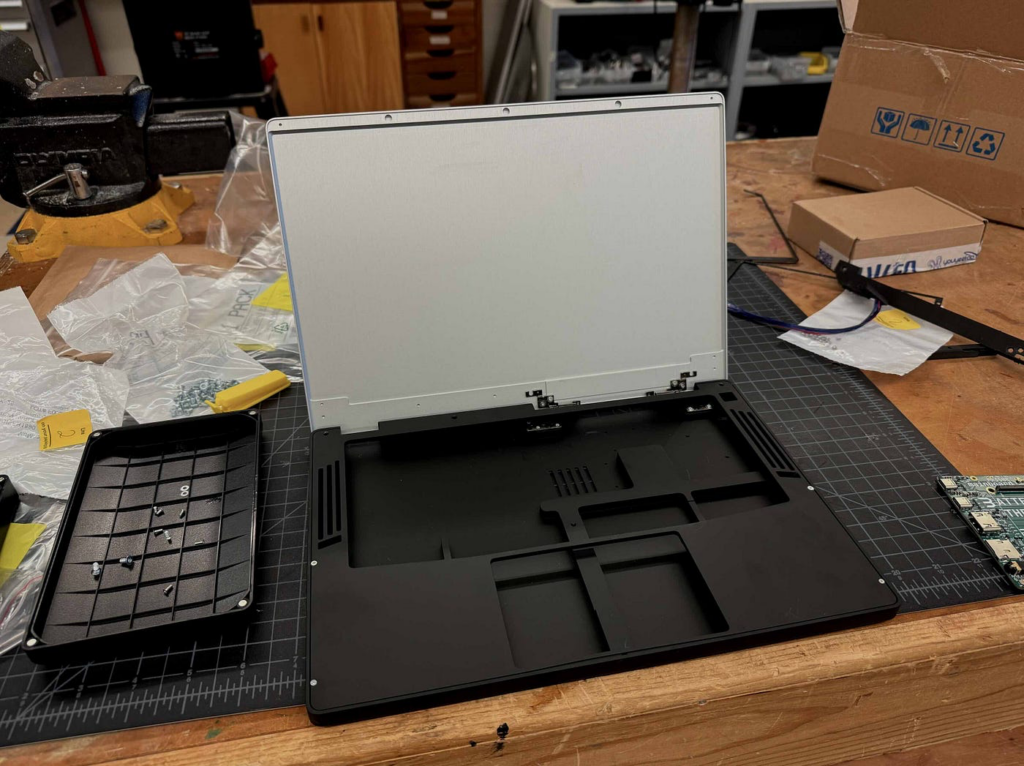
Power and structure reveal how seriously the system was conceived. The main battery is rated at 60 Wh and charges over USB-C, delivering an estimated seven hours of runtime. Huang reportedly built a custom power management approach controlled by an ESP32-S3, another sign that he treated the project as an integrated device rather than a board-in-a-box. The chassis was machined from anodized aluminum using CNC, reinforced with a copper heatsink and supplemented by 3D-printed structural parts where it made sense. That hybrid approach is how modern prototyping behaves at the edge: metal where stiffness and finish matter, printed parts where iteration is cheaper than machining.
Software is the quiet advantage that makes the hardware usable. anyon_e runs a Linux distribution and kernel optimized for Rockchip hardware, enabling the system to boot quickly and maintain broad compatibility. Huang claims the laptop boots several seconds faster than his own MacBook Pro, a provocative comparison that is less about beating Apple and more about proving the system is responsive enough to feel like a daily machine. He also describes using the laptop for 4K gaming in lightweight titles and for running heavy local AI models, which is plausible given the RK3588’s GPU capability and on-chip NPU, within the limits of thermals and Linux software stacks.
The most consequential decision was openness. Huang released design files, firmware, and detailed instructions under a permissive license, turning a one-student project into a replicable blueprint. That openness challenges the usual assumption that hardware innovation belongs only to companies with factories. It does not mean anyone can build this overnight. It still requires tools, skill, patience, and tolerance for failure. But it does show that the boundary between consumer and creator is moving, especially as compute modules, CAD tools, CNC access, and high-quality displays become more reachable.
anyon_e is not a threat to mainstream laptop makers, at least not directly. The market does not shift because one teen built a laptop. It shifts because the methods are becoming normal: modular compute, accessible fabrication, open documentation, and communities that treat hardware like software, something you can fork, improve, and redistribute. The real lesson is that the next generation of builders is learning systems integration early, at the level where electronics, mechanics, firmware, and user experience collide. That is where future product teams come from, and that is why a school project can matter beyond the classroom.
Phoenix24: clarity in the grey zone. / Phoenix24: claridad en la zona gris.