

 Phoenix 24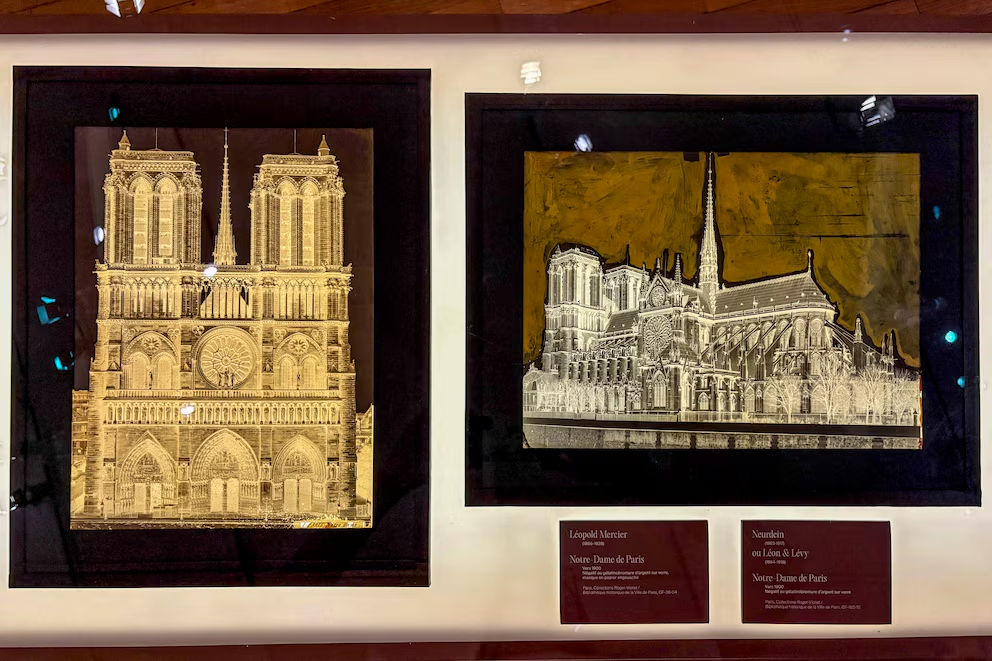
Paris explores the visual imagination behind a literary monument.
PARIS, FRANCE — July 2026. Victor Hugo’s architectural drawings have entered the public spotlight through a new exhibition examining how buildings, ruins and imagined cities shaped his literary universe. Titled Hugo and Architecture: From Stone to Pen, the exhibition is presented inside the Paris residence that now serves as the writer’s house museum. Its rooms display churches, façades, towers and mysterious structures drawn by Hugo throughout his life, revealing a private artistic practice largely unknown outside specialist circles. The collection also demonstrates that architecture was not merely a setting within his work, but a language through which he interpreted history, memory and human civilization.
The exhibition places particular emphasis on Notre-Dame de Paris, the influential novel published in 1831 and commonly known in English as The Hunchback of Notre-Dame. Hugo wrote the book during a period when the medieval cathedral was deteriorating and parts of Parisian society viewed Gothic architecture as outdated or expendable. Beyond the tragic story of Quasimodo and Esmeralda, the novel offered extensive descriptions of the cathedral and encouraged readers to recognize its historical, cultural and symbolic importance. Its success helped generate greater public awareness of Notre-Dame and contributed to the preservation movement that eventually supported its major restoration during the nineteenth century.
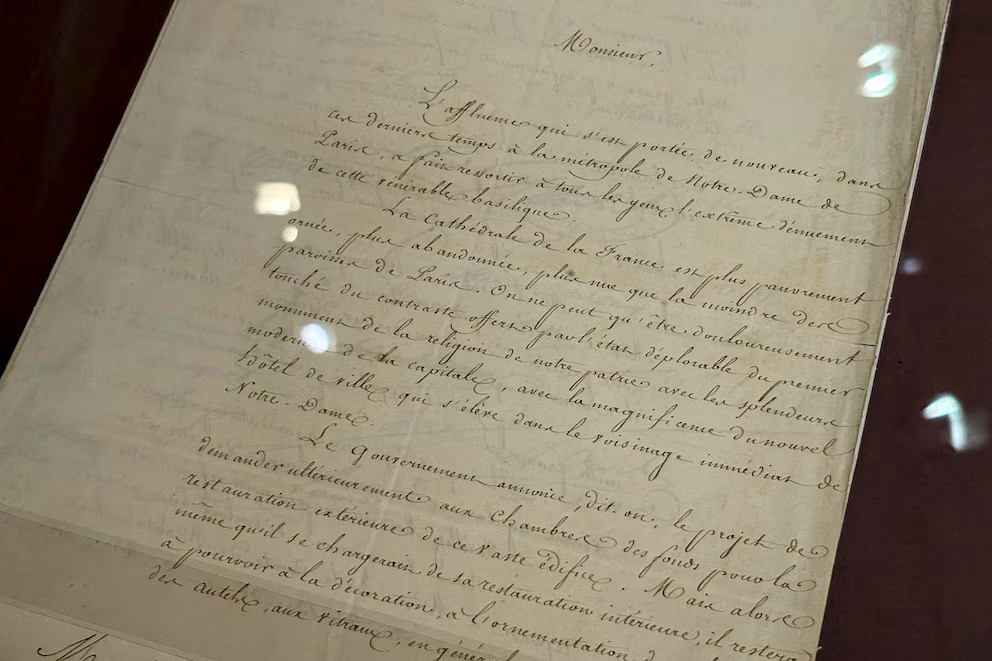
Curator Alexandrine Achille explained that architectural motifs appear constantly in Hugo’s drawings and are also visible in the physical structure of his manuscripts. The writer frequently added sketches to theatrical texts, apparently using images to organize space, movement and atmosphere while developing his scenes. This interaction between drawing and writing suggests that Hugo imagined literature visually, building his stories as though he were designing cities, rooms and monumental structures. He believed architecture, like literature, could tell the history of humanity and preserve the values, conflicts and aspirations of entire generations.
More than 100 drawings from the museum’s collection form the foundation of the exhibition, accompanied by notebooks loaned by the National Library of France. Photographs and original negatives documenting nineteenth-century Paris have also arrived from the Roger-Viollet collection and the Carnavalet Museum. Together, these materials allow visitors to compare Hugo’s visual imagination with the actual urban environment he observed during his lifetime. The exhibition transforms his drawings from isolated personal objects into evidence of a wider creative system connecting travel, literature, architecture, photography and historical preservation.
The presentation is divided into several thematic sections tracing the development of Hugo’s visual world. One area focuses on sketches produced during his travels, when he documented buildings, landscapes and architectural details that later influenced his writing. Another explores the direct relationship between literary composition and spatial design, while additional sections present invented structures and increasingly mystical or surreal creations. These imaginary buildings reveal an artist who did not simply reproduce what he saw, but combined memory, fantasy and symbolic meaning to construct places that could exist only on paper.
Among the works are three landscapes connected with Spain, a country Hugo visited during his childhood in 1812 and again in 1843 while traveling with his wife. Spanish architecture and scenery left a strong impression on him and later influenced several theatrical works. One drawing, identified as Memory of Spain, combines architectural elements he encountered while passing through territories now associated with Castilla y León. Rather than functioning as a precise record of a single location, the image blends different impressions into a personal reconstruction shaped by memory.
Hugo’s talent as a visual artist remained largely private during his lifetime. His drawings were intimate creations generally seen only by relatives, friends and members of his closest circle rather than works produced for the art market. He experimented with ink, washes, shadows and unconventional techniques, frequently creating landscapes that appear dreamlike, dramatic or psychologically charged. Their rediscovery offers a different perspective on an author traditionally celebrated almost exclusively through novels, poetry, political speeches and theatrical writing.
The exhibition also arrives during a renewed period of public attention surrounding Notre-Dame following its restoration and reopening after the devastating 2019 fire. Hugo’s nineteenth-century campaign for the cathedral’s cultural recognition now carries additional resonance as contemporary audiences reconsider the fragility of historic monuments. His work demonstrates how literature can change public attitudes toward architecture by transforming stone structures into emotional and collective symbols. The drawings reinforce that connection by revealing the cathedral and other buildings as living presences within his imagination.
Visitors will be able to explore the exhibition until November 22. The project expands understanding of Hugo beyond masterpieces such as Les Misérables, Notre-Dame de Paris and The Last Day of a Condemned Man. It presents him as an artist whose creative identity crossed the boundaries separating text, image, history and physical space. Through these rarely seen drawings, Paris is rediscovering the visual foundations of one of its most influential literary voices.
Victor Hugo wrote with words, but he also dreamed through architecture.