

 Phoenix 24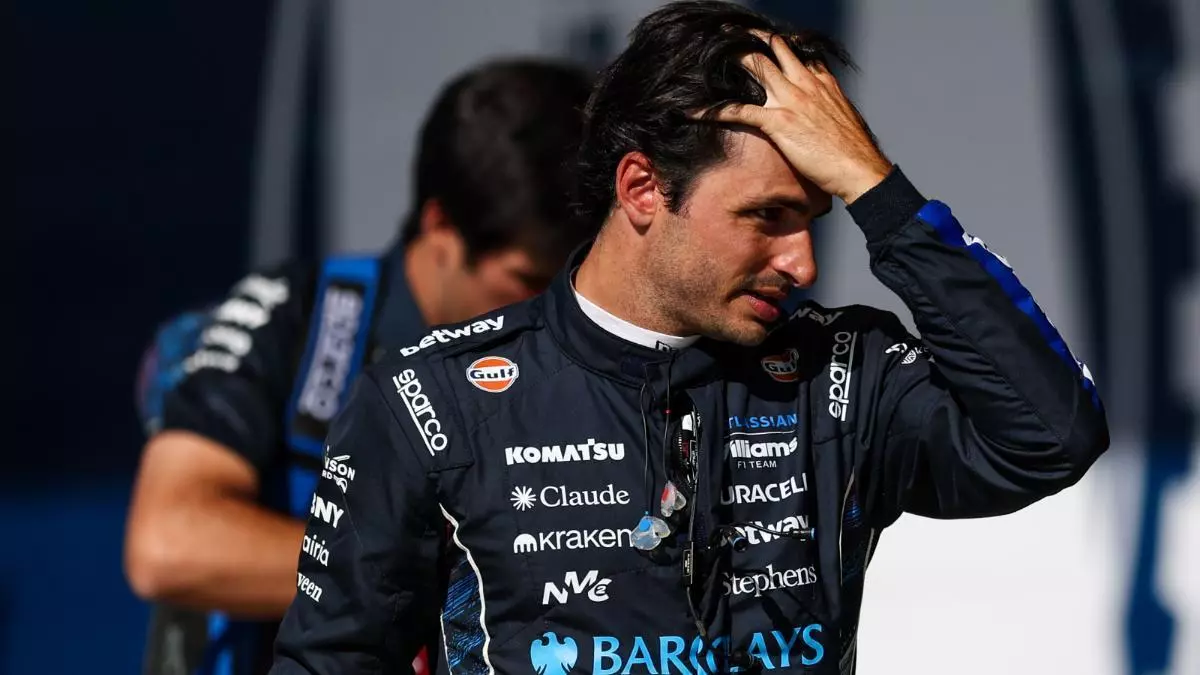
The expected recovery has not yet reached the track.
SILVERSTONE, UNITED KINGDOM — July 2026.
Carlos Sainz expressed deep frustration after qualifying 15th for the British Grand Prix at Silverstone. Williams had introduced a significant aerodynamic upgrade hoping to recover competitiveness after several difficult races. The new package included a revised nose and front wing intended to improve balance and generate additional downforce. Instead, the Spanish driver once again found himself far from the leading teams.
Sainz progressed beyond the opening qualifying segment but was unable to reach Q3. His final lap in Q2 contained several mistakes, allowing Haas driver Oliver Bearman to move ahead of him. Sainz admitted that his performance had been poor, although he emphasized that the FW48 remained extremely difficult to control. The unpredictable behavior of the car made completing a clean and competitive lap particularly challenging.
The result was especially disappointing because Silverstone represented an important test for Williams’ development program. The British team had spent recent weeks preparing the new front-wing concept and evaluating its potential in the simulator and wind tunnel. Sainz had expected the package to restore at least part of the performance lost since the beginning of the season. The improvement proved smaller than anticipated and failed to transform Williams’ competitive position.
Both Williams drivers struggled during qualifying, suggesting that the problem extended beyond an individual mistake. Alexander Albon was also eliminated in Q2 and finished immediately behind his teammate. The two cars appeared unstable through Silverstone’s demanding medium- and high-speed corners. Gusting winds added complexity, but rival teams managed the conditions more effectively.
Sainz said Williams was testing different configurations and attempting to understand how to make the new front wing operate correctly. However, he acknowledged that something within the team’s aerodynamic development process was not producing the expected results. The concern extends to the correlation between data generated in the wind tunnel and the actual behavior observed on the circuit. Without reliable correlation, upgrades can consume considerable time and resources without delivering meaningful lap-time gains.
The Spanish driver compared the current situation with Williams’ performance during the previous season. In 2025, the team occasionally finished inside the top five and secured podium results while remaining relatively close to the fastest cars. Under the new technical regulations, that gap has expanded dramatically. Williams has not developed its car at the same pace as several direct competitors.
According to Sainz, Racing Bulls was approximately seven or eight tenths of a second faster at Silverstone. Ferrari and Mercedes operated at an even higher level, approaching a two-second advantage during the decisive qualifying laps. Those margins leave Williams competing against teams near the rear of the field rather than challenging the upper midfield. The new upgrade did little to alter that reality.
The difficulty is particularly significant because the 2026 regulations changed both aerodynamic design and power-unit management. Teams have been required to understand different airflow characteristics while also adapting to greater emphasis on electrical energy deployment. Silverstone’s fast corners expose weaknesses in aerodynamic efficiency, stability and battery management more clearly than many other circuits. Williams arrived knowing that the track could reveal whether its new development direction was working.
Sainz now believes the team must reconsider some of its fundamental methods. The issue is not simply a shortage of investment, since Williams has expanded its resources and infrastructure under team principal James Vowles. The more difficult question concerns how those resources are converted into reliable technical progress. Formula One development depends on accurate simulation, efficient manufacturing and the ability to understand why a component succeeds or fails.
His frustration also reflects a difficult start to the season. Williams has frequently lacked the pace required to fight consistently for points, while reliability problems have further limited its opportunities. Sainz retired from the Austrian Grand Prix after an electrical failure only days before arriving at Silverstone. The British upgrade was therefore viewed as a possible turning point after several discouraging weekends.
At the front of the grid, Mercedes driver Kimi Antonelli secured pole position with a lap of 1:28.111. Charles Leclerc qualified second for Ferrari, while Lewis Hamilton placed third in front of his home crowd. George Russell completed the second row, confirming Mercedes’ strong position under the current regulations. Their performance highlighted the distance separating Williams from the championship’s leading technical programs.
Starting from 15th place will force Sainz to navigate traffic and rely on strategy, tire management or changing weather conditions to recover positions. Silverstone allows overtaking, but following another car through its fastest corners can produce substantial aerodynamic disruption. Williams will need stronger race pace than it displayed during qualifying to challenge for points. Reliability will also be essential after the failures experienced during recent events.
Sainz remains committed to the Williams project, but his comments reveal growing concern about the speed of its transformation. The driver is not demanding an immediate victory-capable car, yet he expects visible progress when major upgrades are introduced. At Silverstone, that evidence was difficult to find. Williams must now determine whether the new components require further optimization or whether the underlying aerodynamic concept needs a more fundamental revision.
The British Grand Prix has therefore become another diagnostic weekend rather than the competitive revival Williams expected. Sainz’s disappointment is rooted not only in 15th position, but in the absence of a clear technical response to the team’s weaknesses. The FW48 remains difficult to drive and significantly slower than the cars Williams intended to challenge. Unless development begins producing stronger results, frustration inside the garage will continue to grow.
Phoenix24 — Global news with clarity and perspective.