

 Phoenix 24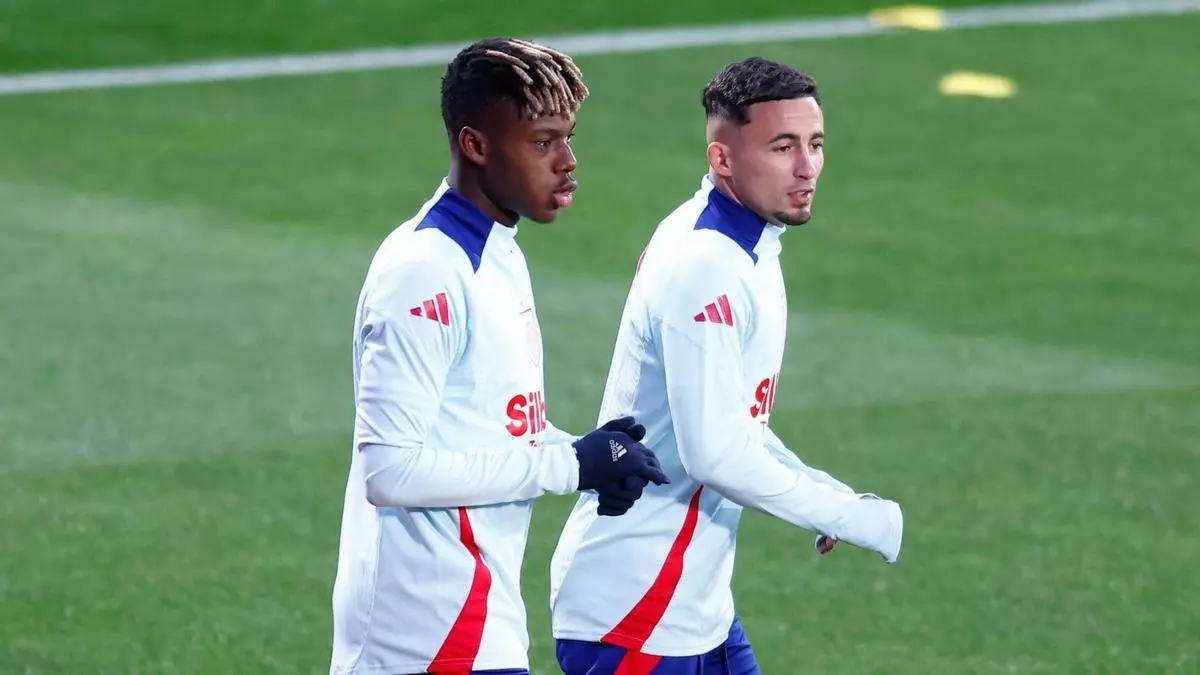
The winger follows Yeremy Pino’s recovery path.
DALLAS, UNITED STATES — July 2026.
Nico Williams has taken an important step toward returning to action with Spain after rejoining part of the team’s training work. The Athletic Club winger continues recovering from the injury suffered during the World Cup group-stage victory over Uruguay. His progress follows a similar path to that of Yeremy Pino, who returned to collective exercises sooner than initially expected. Spain’s medical staff nevertheless remains cautious and will not accelerate either player’s rehabilitation unnecessarily.
Williams suffered an injury to his right adductor following a forceful challenge from Uruguay midfielder Nicolás de la Cruz. The incident occurred shortly after the winger entered the match as a substitute, ending what was supposed to be another controlled stage of his return to competition. Medical examinations classified the problem as moderate and left his availability dependent on daily progress. The setback was particularly frustrating because Williams had already endured a season affected by recurring physical problems.
His return to group activity represents an encouraging development, but it does not automatically guarantee immediate competitive availability. Training with teammates can include limited exercises, reduced intensity and carefully monitored movements that differ significantly from the demands of a knockout match. Medical specialists must evaluate acceleration, changes of direction, contact tolerance and muscular response after each session. Spain will therefore wait before deciding whether the winger can participate in the next stage of the tournament.
Yeremy Pino has provided the clearest example of how rapidly an initially worrying injury can evolve. The Crystal Palace player suffered an acromioclavicular sprain in his left shoulder during the same physical encounter against Uruguay. Early fears suggested a possible collarbone fracture, but subsequent tests ruled out the more serious diagnosis. Pino returned to selected team exercises while wearing protection and continuing an individualized recovery program.
The similarities between the two cases are limited because their injuries affect different areas and require distinct rehabilitation processes. Pino’s shoulder problem may restrict contact and upper-body movement, while Williams must prove that his adductor can tolerate explosive running. Wingers depend heavily on repeated sprints, sudden stops and lateral changes that place considerable stress on the groin muscles. A premature return could produce another setback and potentially end Williams’ World Cup participation.
Spain has already shown that it can adapt without its full collection of natural wide players. Luis de la Fuente reorganized the attack during the victory over Austria, relying on positional flexibility and the technical qualities of players capable of operating between the lines. Lamine Yamal remained an essential source of width and creativity, while Mikel Oyarzabal, Dani Olmo, Álex Baena and Ferran Torres offered alternative structures. The result reduced immediate pressure on the medical staff to rush Williams back.
However, the potential return of Williams would significantly expand Spain’s tactical possibilities. His pace can stretch defensive lines, create space for midfielders and generate one-on-one situations near the penalty area. He also provides direct attacking transitions when opponents commit numbers forward, something that becomes increasingly valuable in elimination matches. Few players in the Spanish squad can reproduce his combination of acceleration, dribbling and physical power.
The next challenge against Portugal will require Spain to manage both possession and defensive transitions with greater precision. Portugal possesses experienced defenders, technically gifted midfielders and attackers capable of exploiting even brief positional imbalances. Williams would offer a direct threat against a defense that may otherwise feel comfortable protecting central spaces. Yet his usefulness depends on being physically capable of sustaining the intensity rather than merely appearing on the substitutes’ bench.
De la Fuente must also consider the wider tournament calendar. Spain’s objective is not simply to recover a player for one match, but to preserve his availability if the team reaches the quarterfinals and later stages. A cautious decision against Portugal could prove more valuable than exposing Williams before his rehabilitation is complete. Tournament management often requires coaches to balance immediate urgency against the possibility of deeper progression.
Williams’ emotional condition has also been part of the recovery process. He publicly expressed frustration after the challenge that caused the injury, describing it as unnecessary and particularly painful after months of physical difficulties. Teammates have supported him throughout the rehabilitation period and encouraged him to remain connected with the group. His gradual return to collective work therefore carries psychological importance as well as medical significance.
The winger’s situation illustrates the fragility of planning during a major international tournament. Spain arrived with one of the most talented attacking groups in the competition, but injuries quickly reduced the number of available specialists. Yeremy Pino, Víctor Muñoz and Williams have all required individualized management, while other players have also trained under precautionary measures. De la Fuente’s squad depth has prevented those difficulties from becoming a tactical crisis.
Nico Williams is now closer to returning, but the decisive stage of his recovery has only begun. Spain will continue monitoring his response before determining whether he can face Portugal or must wait for a possible quarterfinal appearance. Yeremy Pino’s rapid improvement offers encouragement, although each injury follows its own biological timetable. The priority remains ensuring that Williams returns as a decisive weapon rather than as another medical risk.
Phoenix24 — Global news with clarity and perspective.
o