

 Phoenix 24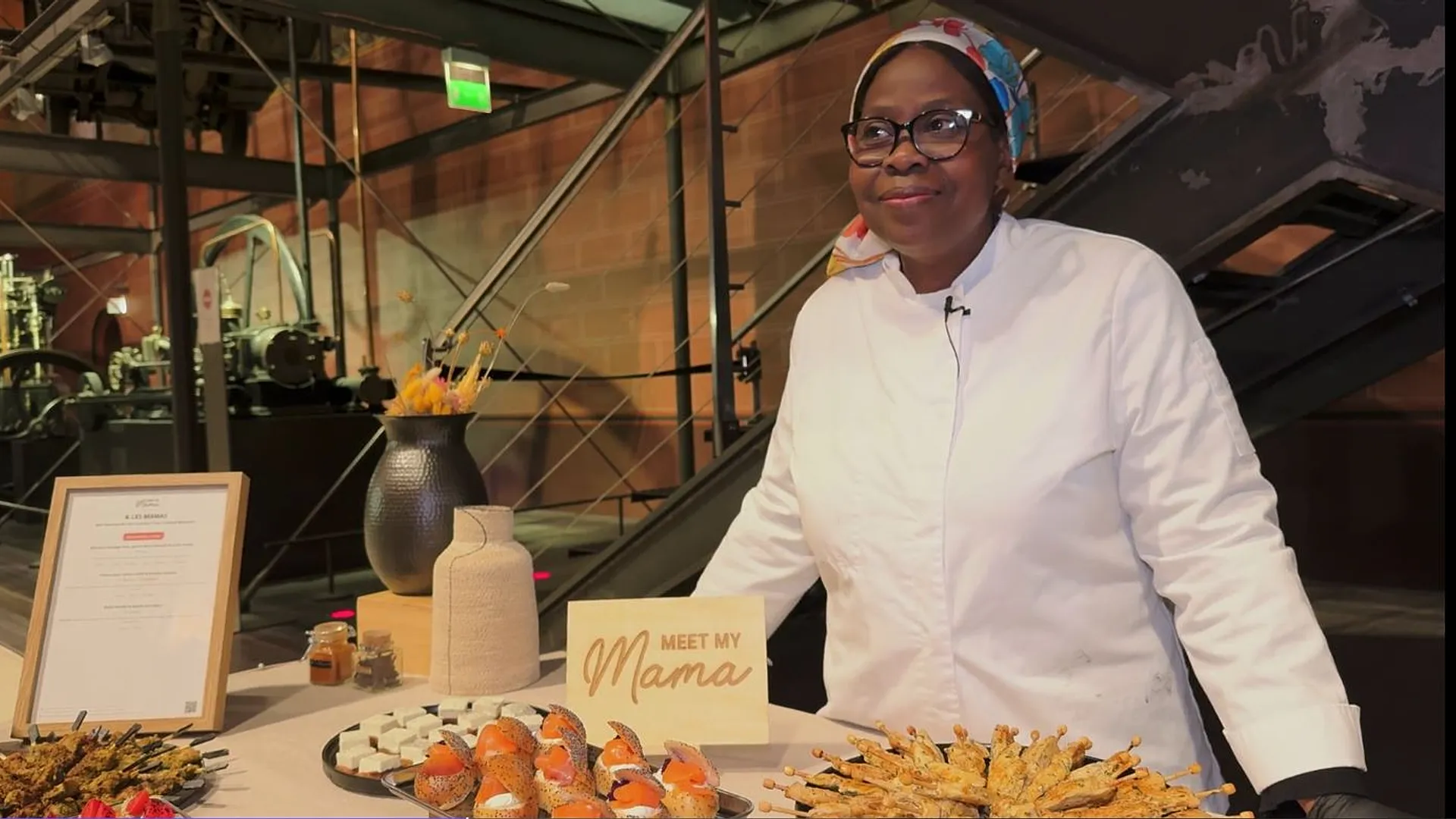
Migration, memory and entrepreneurship meet at the table.
PARIS, FRANCE — July 2026.
Inside a professional kitchen at Cité Fertile near Paris, Marie-Clarisse Bonzia prepares elegant canapés shaped by Congolese ingredients and French culinary technique. Her menu includes cassava and okra mini-quiches, chicken marinated in mafé and sweet-potato bites seasoned with Likouala pepper. For Bonzia, cooking creates a bridge between the Congo, where she was born, and France, where her professional life was rebuilt. That bridge now reaches corporate dining rooms, prestigious venues and international events through the social foodtech company Meet My Mama.
Bonzia’s transformation began far from the world of high-end catering. During conflict in the Congo, her family moved to France so that a daughter born with a rare illness could receive specialized medical treatment. Frequent hospital stays made it increasingly difficult for Bonzia to maintain a demanding administrative career. Seeking independence and flexibility, she entered culinary training, earned professional qualifications and eventually founded her own catering company, Maison Kolia.
Her story reflects the central purpose of Meet My Mama, which helps women convert domestic culinary knowledge into sustainable professional businesses. The Paris-based company provides training, mentoring, commercial opportunities and access to clients that many independent cooks could not easily reach alone. It focuses particularly on women from diverse cultural and migrant backgrounds whose skills have often remained economically invisible. By combining premium catering with social impact, the company treats culinary heritage as both cultural capital and entrepreneurial value.
Meet My Mama was founded in 2017 by Loubna Ksibi, Donia Souad Amamra and Youssef Oudahman. The idea emerged from their experience of growing up around highly capable women whose knowledge rarely translated into leadership, visibility or financial independence. Its founders argue that the professional culinary world continues to place men disproportionately in positions of authority. Their ambition was therefore not simply to include women in the industry, but to help them reach its most influential positions.
The company’s name draws inspiration from the celebrated Mères Lyonnaises, women from modest backgrounds who left domestic service and opened restaurants in Lyon. Several transformed French gastronomy during the late nineteenth and early twentieth centuries, despite entering a professional world dominated by men. Eugénie Brazier became one of their most important figures and achieved exceptional recognition from the Michelin Guide in 1933. Meet My Mama updates that tradition by placing migrant identities, global flavors and modern entrepreneurship at the center of French catering.
The network now brings together culinary traditions from Peru, Japan, Iceland, Sri Lanka, Morocco, Italy, the Congo and other countries. Each entrepreneur contributes recipes shaped by family history, migration, regional ingredients and cultural memory. The result is not a rejection of French gastronomy, but an expansion of its language through new combinations and perspectives. This approach reflects a contemporary France whose national cuisine increasingly interacts with the experiences of communities from across the world.
Milena Pecho, born in France to Peruvian parents, represents another path into the network. After working in financial auditing, she travelled to Peru for formal culinary studies and later returned to France to develop her own catering business, Wankas. Her dishes combine Indigenous traditions with Japanese, European and African influences, including refined Nikkei ceviche and black quinoa with huancaína cream. Meet My Mama helped her strengthen productivity, hygiene standards, quality control and the operational discipline required for premium clients.
Professional development continues through the Mama Academy, which offers instruction in cooking, entrepreneurship, business administration and leadership. A partnership with École Ducasse gives selected participants access to advanced training associated with one of France’s most recognized culinary institutions. Among them is Aminata Kane, founder of Au Kassimani, who seeks to elevate African cuisine through stronger technical preparation and gastronomic presentation. The model recognizes that talent alone is insufficient when entrepreneurs lack networks, credentials, managerial knowledge and access to demanding markets.
Meet My Mama has helped approximately 80 women launch catering companies, while hundreds more have received training or found work in the food sector. The company now organizes more than 600 events annually and serves clients including Google, LVMH, Chanel and AXA. Its chefs have worked at venues such as Versailles and the Eiffel Tower, as well as major international events including Expo 2020 Dubai and the Paris 2024 Paralympic Games. Thousands of aspiring chefs are reportedly waiting to join as the company considers opportunities for expansion beyond France.
Its commercial growth challenges the assumption that social impact and competitive performance must operate separately. The founders argue that greater business activity creates more opportunities for women, while stronger social results attract additional clients and partnerships. For entrepreneurs such as Bonzia, however, the deepest achievement is not only professional recognition, but the freedom to control their work and identity. Meet My Mama shows how recipes carried through migration can become instruments of autonomy, economic participation and cultural transformation.
Phoenix24 — Global news with clarity and perspective.