

 Phoenix 24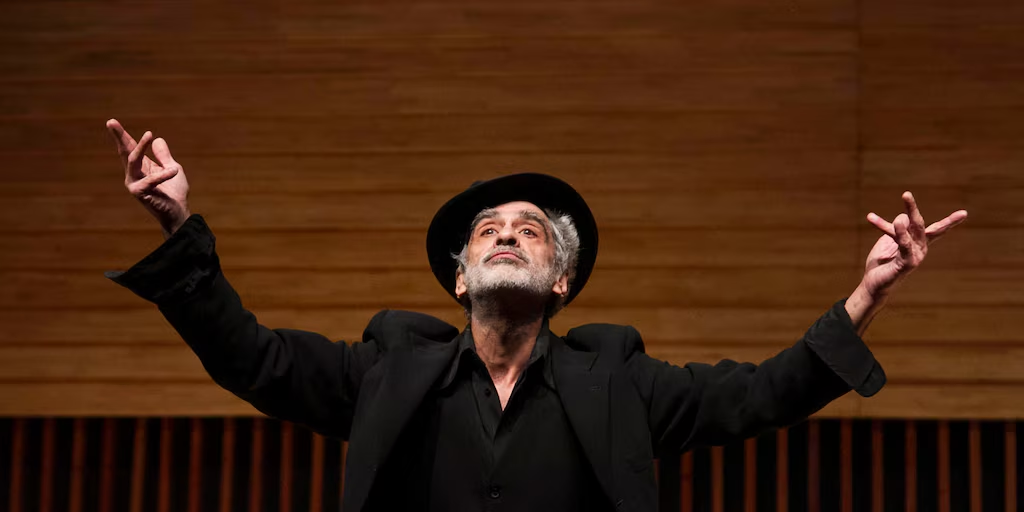
Tango, rock and theatrical darkness define his singular legacy
Buenos Aires, Argentina | June 2026
Daniel Melingo has long occupied a unique place in Argentine popular music, moving between tango, rock, underground culture and theatrical performance with a personality that resists simple classification. His career has been shaped by reinvention, excess, experimentation and a deep fascination with the darker corners of Buenos Aires sound. Rather than following a conventional artistic path, Melingo built a figure that feels almost mythological: part singer, part storyteller, part actor and part survivor of several musical eras. His work continues to represent a bridge between tradition and distortion, elegance and marginality, nostalgia and danger.
Melingo first became visible in the Argentine rock scene, participating in projects connected to the creative explosion that followed the end of the dictatorship. He was part of bands and artistic circles where experimentation, irony and urban identity became central to a new cultural language. That background helped shape his later approach to tango, which never sounded like a museum piece in his hands. Instead, he transformed tango into a theatrical, smoky and unpredictable territory where the past could speak with a rough contemporary voice.
His artistic identity is strongly linked to Buenos Aires, but not to the polished postcard version of the city. Melingo’s universe belongs to bars, alleys, faded neighborhoods, old stories, nocturnal characters and emotional ruins. His voice carries the weight of a narrator who seems to have seen too much and still chooses to sing. That quality gives his music a cinematic depth, turning each song into a scene and each performance into a small drama. In his work, Buenos Aires becomes not only a place, but a psychological landscape.
One of Melingo’s most important contributions has been his ability to renew tango without betraying its spirit. He understood that tango was never only romantic nostalgia; it was also conflict, street language, desire, loneliness, humor and social tension. By bringing elements of rock, cabaret, spoken word and theatrical interpretation into the genre, he expanded its expressive possibilities. His songs often feel like stories whispered from another time, but with a modern awareness of irony and decay.

International audiences have also recognized Melingo as one of the most distinctive Argentine artists of his generation. His work has circulated through European stages, world music festivals and specialized cultural circuits where audiences value artists capable of blending roots with experimentation. In that context, he became a kind of ambassador of an alternative tango, far removed from tourist clichés. His music offers foreign listeners a more complex, shadowed and literary version of Argentine identity.
The myth surrounding Melingo is also connected to his image and stage presence. He does not simply perform songs; he inhabits characters. His gestures, silences, phrasing and visual style contribute to the sense that the audience is watching someone who moves between reality and fiction. This theatrical dimension has made him especially powerful live, where his music becomes performance and his voice seems to summon ghosts from older Buenos Aires traditions.
At the same time, Melingo’s career reflects the resilience of artists who survive outside the center of mass commercial success. He has never depended entirely on mainstream formulas, radio-friendly structures or predictable industry strategies. His path has been more irregular and risky, but also more personal. That freedom allowed him to create a body of work that feels coherent precisely because it refuses to become comfortable.
In Argentine culture, figures like Melingo matter because they keep popular music unstable and alive. They remind audiences that tradition is not preserved by repetition alone, but by tension, reinterpretation and confrontation with the present. His music does not ask tango to behave politely; it pushes it toward the shadows where many of its original emotions were born. That is why his legacy continues to grow as younger listeners rediscover his work from different angles.
Daniel Melingo remains one of those artists who seem larger than their biography. His career crosses rock, tango, poetry, theater and urban mythology, creating a figure difficult to contain within one genre. He belongs to the lineage of musicians who do not merely sing a city, but invent a way of hearing it. In the history of Argentine popular music, Melingo stands as a rare character: dark, elegant, wounded and unforgettable.
Phoenix24 News | Information with responsibility.