

 Phoenix 24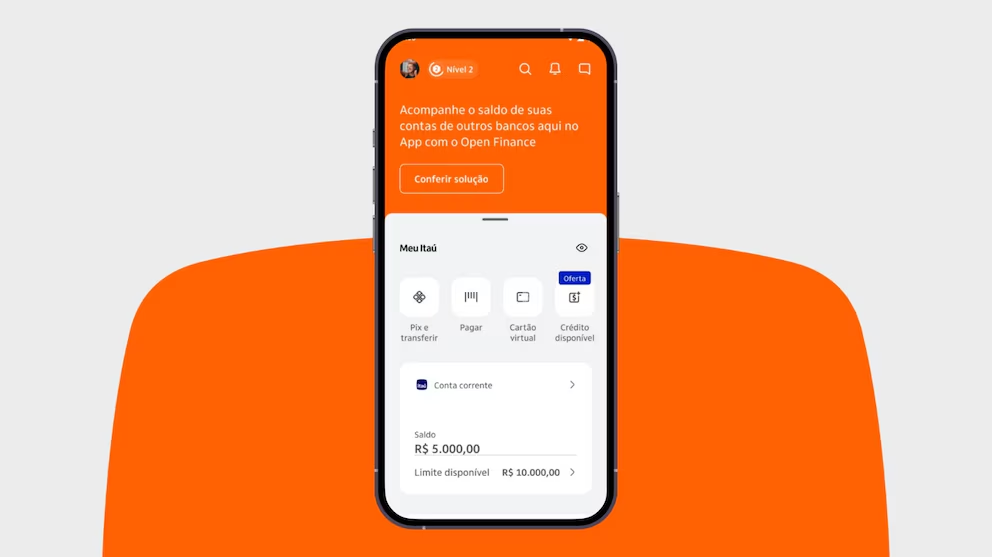
AI-assisted testing, voice interaction and clearer interfaces are helping financial institutions reduce barriers for customers with visual disabilities.
Mexico City, June 2026
Artificial intelligence is becoming an important tool in the effort to make mobile banking applications more accessible to people who are blind or have low vision. Financial institutions increasingly recognize that digital inclusion involves more than enlarging text or adding a high-contrast mode after an application has already been completed. Customers must be able to check balances, transfer money, authorize payments and resolve security alerts independently through assistive technologies. AI can support that objective by identifying accessibility failures during development and helping designers understand how an interface behaves when it is experienced through sound rather than sight.
Many banking applications remain difficult to navigate with screen readers such as VoiceOver and TalkBack because visual controls are not always described correctly in the underlying code. A button may display a recognizable icon to a sighted user while being announced only as “button” to someone relying on audio feedback. Information may also appear in an illogical order, focus may jump unpredictably between elements and dynamic notifications can interrupt the user without explaining what changed. These failures are especially serious in financial services because a misunderstood control can lead to an incorrect transfer, an abandoned transaction or the disclosure of sensitive information.
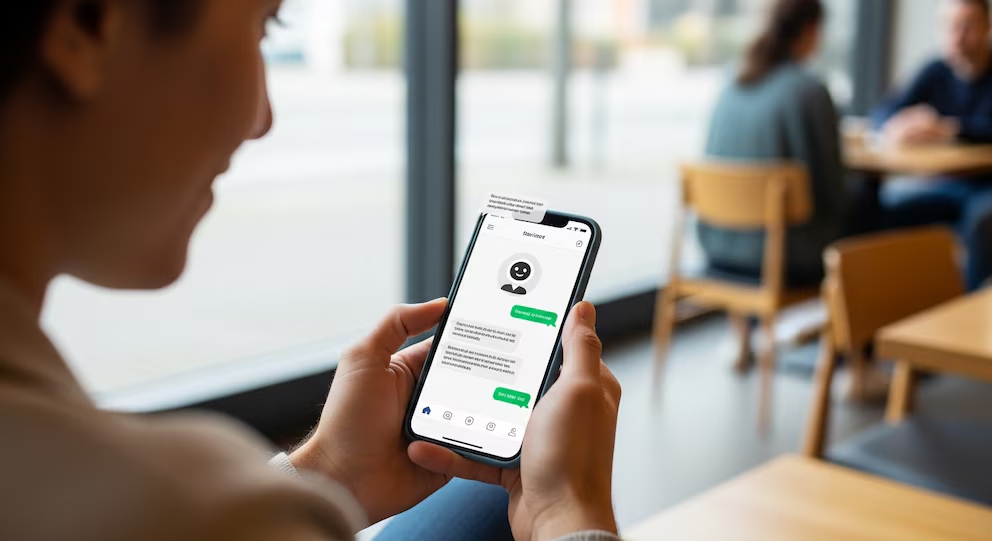
Artificial intelligence can examine screens, interface metadata and navigation sequences to detect problems that traditional automated checkers may overlook. Large language models can analyze whether labels make sense when spoken aloud, whether instructions provide enough context and whether the order of the elements reflects the sequence required to complete a transaction. They can also simulate different user journeys and identify screens where a person could become trapped or lose track of the process. This allows accessibility defects to be discovered before an application is released rather than after customers encounter them during real financial operations.
AI-assisted testing is most valuable when it complements human evaluation rather than replacing it. Automated tools can process large numbers of screens rapidly, but they do not fully understand the frustration, uncertainty or security concerns experienced by someone who uses a screen reader every day. Blind and low-vision customers can reveal problems that appear technically compliant while remaining difficult or exhausting in practice. Their participation during research, prototyping and final testing helps ensure that accessibility is treated as part of the product’s architecture instead of as a corrective feature added near the end.
Voice-based navigation is another area in which artificial intelligence can improve banking accessibility. A customer could ask an application to read recent transactions, explain an unfamiliar charge or guide them through a transfer using natural language. Instead of moving sequentially through every button and menu, the user may be able to state the intended action and receive a concise verbal summary of the relevant information. This conversational model can reduce cognitive effort, although financial institutions must design it carefully to prevent ambiguous commands or accidental transactions.
The greatest benefits may appear in tasks that combine visual information with complex decision-making. AI can describe charts, summarize account activity, explain spending categories and convert visually dense dashboards into structured audio narratives. It can also help interpret scanned documents, payment receipts and identification materials that would otherwise require assistance from another person. By presenting information in a form adapted to the user’s needs, the technology can increase autonomy without changing the financial service itself.

Security remains inseparable from accessibility because banking applications depend on authentication procedures that frequently assume the customer can see the screen. One-time codes, visual puzzles, countdown timers and poorly labeled biometric prompts can become major obstacles for people using assistive technology. When those systems fail, customers may be forced to ask another person for help, exposing passwords, account details or transaction information. AI-supported design can identify these conflicts and help create authentication flows that remain secure without requiring visual interpretation.
Biometric authentication can reduce some of those barriers when it is integrated correctly. Fingerprint recognition, facial verification and device-based credentials can allow a person to confirm identity without manually entering information under time pressure. Voice guidance can explain each step, confirm whether the action succeeded and provide a clear alternative when the biometric method fails. The process must still protect privacy and prevent unauthorized access, but accessibility and security do not have to be treated as opposing objectives.
Artificial intelligence can also personalize the interface according to the user’s interaction patterns and declared preferences. An application might simplify frequently used operations, adjust the amount of spoken detail or present essential information before secondary content. Someone with low vision may prefer larger controls and stronger contrast, while a blind customer may need highly structured labels and predictable screen-reader focus. Personalization can reduce friction, but it should remain transparent and controllable so that the system does not make unexplained decisions on behalf of the customer.
Banks must also prevent AI-generated descriptions from becoming a new source of risk. A system that summarizes a balance incorrectly, confuses an incoming payment with an outgoing charge or omits an important warning could cause financial harm. Critical information should therefore be drawn from verified transaction data and presented through carefully tested templates rather than improvised freely by a language model. High-risk actions must include explicit confirmation, clear amounts, named recipients and an accessible method for canceling the operation.

Privacy represents another central concern because conversational assistants may process highly sensitive financial information. Institutions must explain what data is collected, where it is processed and whether interactions are stored or used to improve future models. Voice commands can also be overheard in public spaces, making headphones, discreet notifications and alternative input methods essential. An accessible service should increase independence without requiring customers to sacrifice confidentiality.
The development of inclusive banking applications also depends on semantic design standards that work reliably with existing assistive technologies. Buttons need accurate labels, headings must reflect the structure of the page and form fields should announce both their purpose and any errors that occur. Color cannot be the only method used to communicate whether a payment was approved, rejected or pending. AI can help detect violations, but developers must still build the application with clean code and predictable navigation.
Accessibility improvements often benefit customers beyond the group for which they were initially designed. Clearer instructions can help older adults, people with temporary injuries, users operating a phone in bright sunlight and anyone experiencing stress during an urgent transaction. Voice interaction can also assist people whose hands are occupied or who have difficulty reading small screens. Inclusive design therefore expands usability across the customer base rather than serving a narrow or isolated market.
Financial institutions have strong commercial and ethical reasons to invest in this transformation. Mobile banking has become the main point of contact for many customers, and an inaccessible application can effectively exclude a person from managing their own money. The consequences extend beyond inconvenience because dependence on family members or employees can reduce privacy and personal control. Making digital services independently usable is therefore an essential component of financial inclusion.

The most effective approach begins by involving people with visual disabilities before the interface is defined. Their experiences can guide decisions about navigation, terminology, confirmations, error messages and the amount of information spoken at each stage. AI can then accelerate testing, identify recurring weaknesses and help developers refine alternative interaction methods. The technology becomes most useful when it operates within a design process led by accessibility knowledge and direct user participation.
Artificial intelligence will not automatically make every banking application inclusive, and poorly implemented automation may reproduce or deepen existing barriers. Its value lies in helping teams discover inaccessible patterns earlier, generate clearer descriptions and create interfaces that respond to different ways of perceiving information. Banks must combine those capabilities with rigorous security, human oversight and continuous testing by people who depend on assistive technology. The goal is not simply to create an application that technically functions, but one that allows every customer to manage financial decisions safely, privately and confidently.
La verdadera innovación financiera comienza cuando la tecnología permite que cada persona controle su dinero con independencia. / True financial innovation begins when technology allows every person to control their money independently.