

 Phoenix 24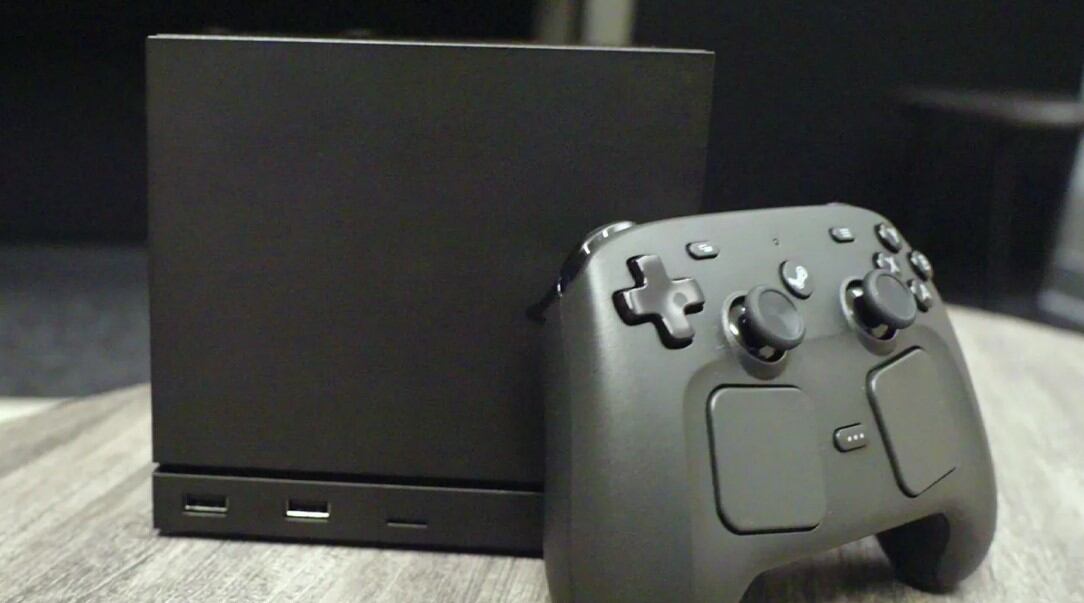
The living-room PC challenges consoles without matching their affordability.
BELLEVUE, United States | June 2026
Valve has confirmed the price and release date of its new Steam Machine, marking the company’s most ambitious attempt yet to bring the flexibility of PC gaming into the living room. The compact device will launch on June 30 with prices starting at $1,049 for the version equipped with 512 GB of storage. A higher-capacity 2 TB model will cost $1,349. Those figures place the machine well above the price of most traditional consoles.
Reservations will remain available until June 25, giving interested buyers only a short period to secure the first units. Valve will also sell configurations bundled with its new Steam Controller. The 512 GB package with the controller will cost $1,128, while the 2 TB version will rise to $1,428. The larger model will additionally include interchangeable front plates with different finishes.
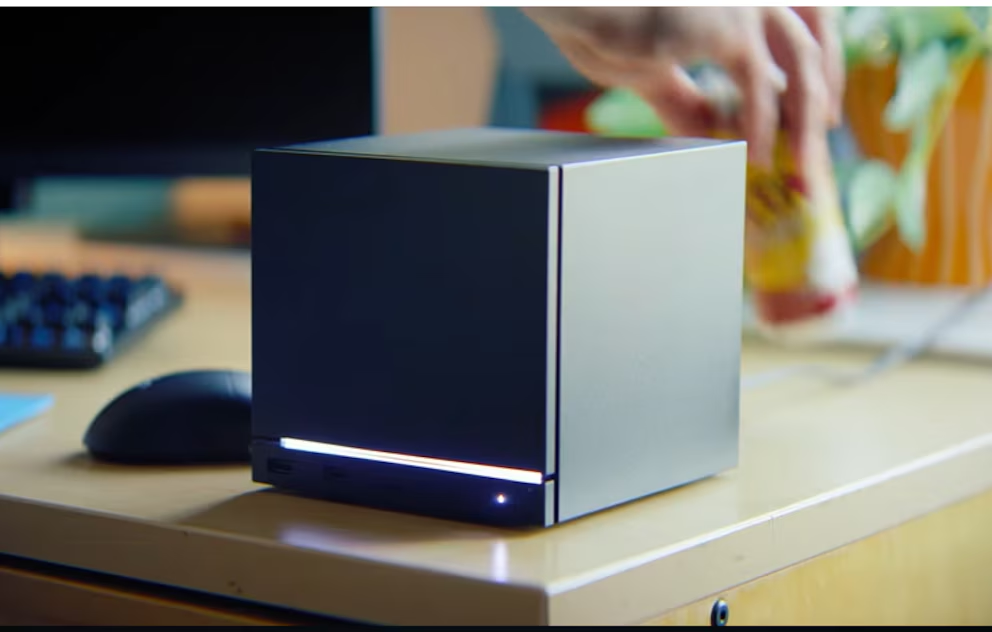
The Steam Machine is designed as a compact gaming computer that connects directly to a television and provides a console-style experience. Unlike a conventional console, however, it gives users access to the enormous Steam library and many of the functions associated with PC gaming. Valve wants players to turn on the device, select a game with a controller and begin playing without managing a traditional desktop environment. SteamOS 3 provides the interface supporting that approach.
Inside the cube-shaped system is a customized AMD processor based on the Zen 4 architecture. It includes six CPU cores and 12 processing threads, accompanied by RDNA 3 graphics with 28 computing units. The device also features 16 GB of DDR5 system memory and 8 GB of GDDR6 video memory. These specifications place it closer to a mid-to-high-range compact PC than to an inexpensive mass-market console.
Storage is provided through an NVMe solid-state drive in either 512 GB or 2 TB capacity. A microSD card slot offers an additional expansion option, although modern high-budget games can occupy more than 100 GB each. The lower-capacity model could therefore fill quickly for users maintaining several large installations. The 2 TB edition provides greater convenience, but its price moves the product into a particularly competitive segment.
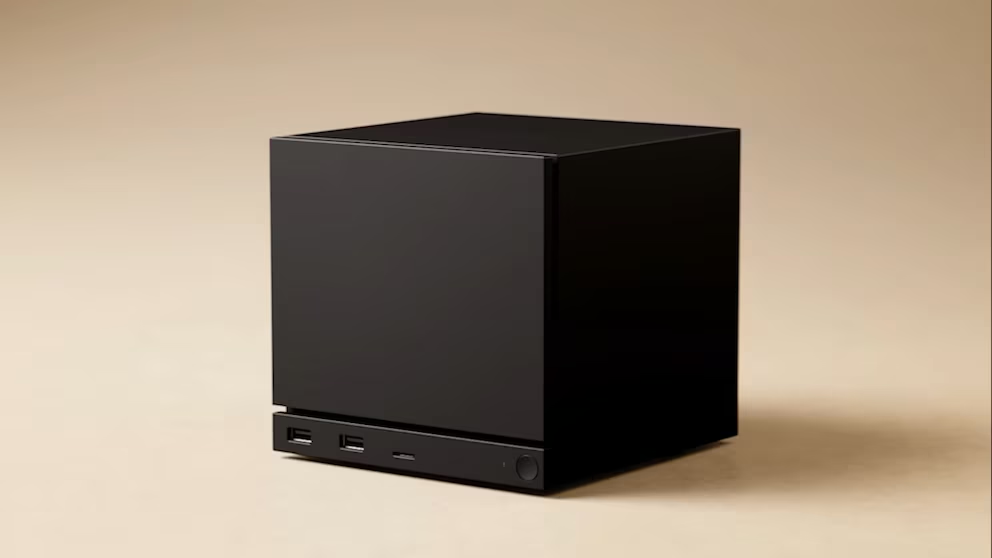
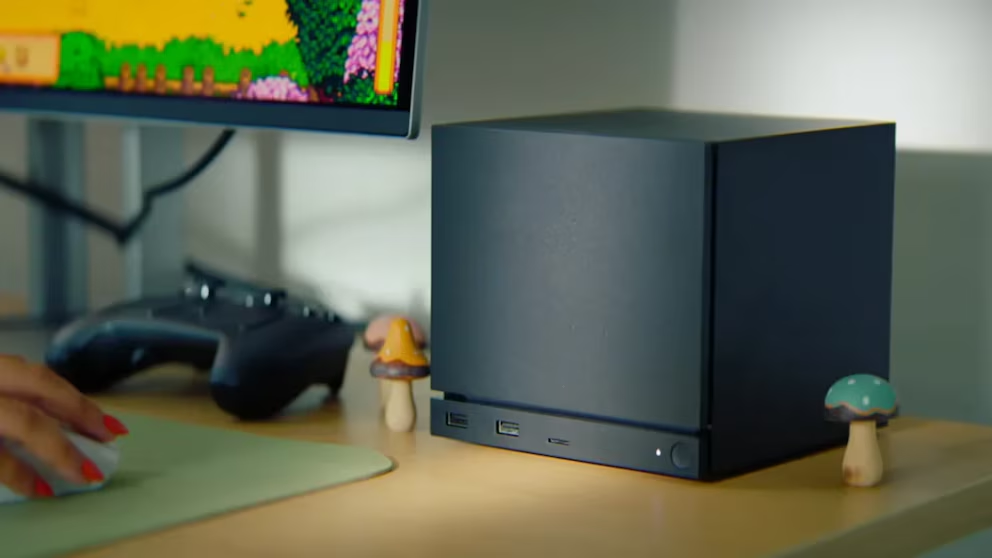
Connectivity includes Wi-Fi 6E, Bluetooth 5.3 and Gigabit Ethernet. Valve has also incorporated a dedicated wireless adapter for the Steam Controller, helping reduce latency and simplify pairing. The combination allows the machine to support wireless accessories while maintaining a stable wired connection for online gaming. Its compact design is intended to fit alongside televisions and entertainment systems rather than on a conventional computer desk.
The company describes the Steam Machine as substantially more powerful than its Steam Deck handheld. That difference is expected because the desktop device does not face the same battery and portability restrictions. The system targets television gaming and is expected to use modern image-scaling technologies to deliver higher resolutions. Its actual performance will still vary according to the optimization and technical requirements of each game.
Price has immediately become the central concern. A PlayStation 5, Xbox console or Nintendo device can generally be purchased for considerably less, while often including a controller as standard equipment. Valve’s entry-level configuration exceeds $1,000 before taxes or import costs. Consumers must therefore decide whether access to their existing Steam libraries and the flexibility of PC gaming justify the premium.
The comparison with a custom-built computer is equally important. Experienced users may be able to assemble a similarly powerful or more easily upgradeable PC within the same price range. A conventional computer can also support Windows applications, productivity software and a wider selection of hardware configurations. Valve is betting that convenience, compact size and the optimized SteamOS experience will compensate for reduced customization.
SteamOS has evolved considerably since Valve’s original Steam Machine experiment more than a decade ago. The earlier generation depended on multiple hardware manufacturers, inconsistent specifications and a Linux gaming ecosystem that was not yet mature. Many Windows titles were unavailable or performed poorly. The project eventually disappeared without becoming a serious competitor to established consoles.
The success of Steam Deck changed that environment. Valve’s Proton compatibility technology now allows a large number of Windows games to operate through SteamOS. The company has also established a verification system that tells users whether games are fully supported, playable with adjustments or incompatible. That experience gives the new Steam Machine a stronger software foundation than its predecessor possessed.
Valve is extending the Verified program to cover both the Steam Machine and its upcoming Steam Frame headset. Developers will be able to optimize and classify titles across the company’s hardware family. A unified system could reduce uncertainty for consumers who do not want to adjust graphical settings manually. Ease of use will be essential if Valve expects the device to compete inside the living room rather than among dedicated PC enthusiasts.
The high cost has been linked to component prices, supply-chain pressures and strong demand for memory and storage from artificial intelligence companies. Manufacturers across the technology industry are competing for semiconductors, advanced memory and production capacity. These pressures have raised the cost of computers and other electronic devices. Valve delayed the launch while addressing supply availability and final production expenses.
Distribution may also limit the machine’s reach. Valve is not expected to provide official availability throughout much of Latin America during the initial launch. Buyers in unsupported countries may need to use importers or international shipping services. Taxes, transportation and reseller margins could push the final price substantially beyond the amounts announced in the United States.
The Steam Machine is unlikely to appeal primarily to owners of powerful gaming computers already connected to televisions. Its strongest audience may be players with large Steam libraries who want a smaller and simpler secondary system. It could also attract console users interested in PC game pricing, modifications and a broader range of independent titles. Whether that audience is large enough at more than $1,000 remains uncertain.
Valve is not simply introducing another console. It is attempting to define a category between a closed entertainment device and a conventional gaming computer. The machine offers standardized hardware and a controlled interface while preserving much of Steam’s open software ecosystem. That hybrid identity is its greatest advantage and its most difficult marketing challenge.
The June 30 launch will reveal whether consumers view the Steam Machine as a premium console, a compact PC or an unnecessary compromise between both. Its hardware appears capable, and SteamOS is more mature than ever. Yet strong technology does not eliminate the importance of value. Valve’s return to the living room now depends on convincing players that convenience and ecosystem access are worth a distinctly premium price.
Innovation becomes competitive only when performance justifies the price. / La innovación se vuelve competitiva únicamente cuando el rendimiento justifica el precio.