

 Phoenix 24
Offshore platforms could ease pressure on land-based infrastructure.
PORTLAND, United States | June 2026
A new generation of floating data centers is being designed to generate electricity from ocean waves while processing artificial-intelligence workloads directly at sea. The American technology company Panthalassa is developing autonomous offshore platforms that combine wave-energy generation, onboard computing and natural seawater cooling. The company recently secured $140 million in Series B financing to expand production and prepare pilot deployments in the North Pacific. Its model seeks to reduce the growing strain that conventional data centers place on electricity grids, freshwater supplies and surrounding communities.
The project is based on the idea that the open ocean can serve simultaneously as an energy source, an industrial location and a cooling environment. Panthalassa’s platforms are designed as mass-produced floating systems built from rolled steel at coastal factories. Once deployed in deep water, they convert the kinetic movement of waves into a continuous supply of electricity. That power is then used immediately by computing hardware installed aboard the platform.
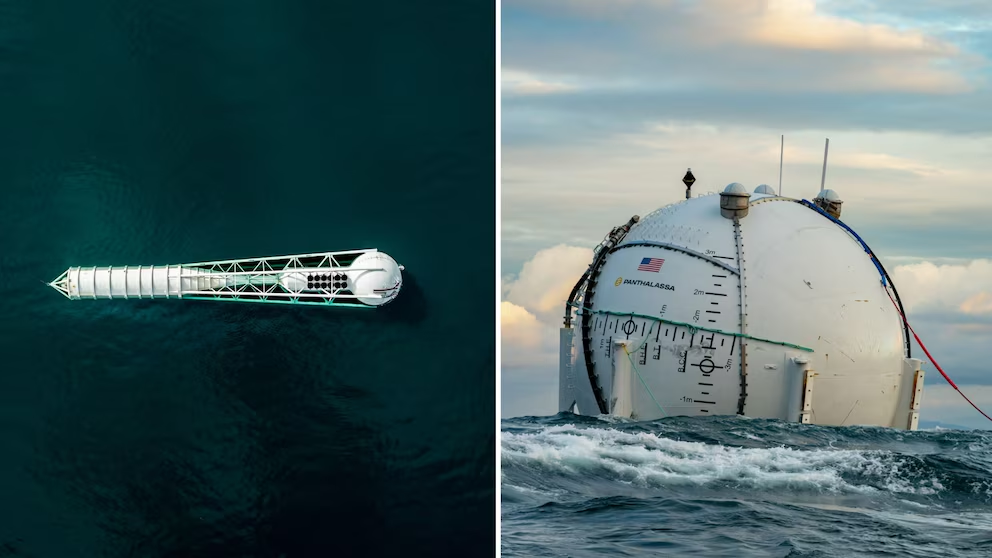
Unlike offshore energy projects that transmit electricity back to land, these systems consume the generated power at the place where it is produced. Specialized processors perform high-performance computing and artificial-intelligence tasks without depending on terrestrial substations or long electrical connections. Instructions are sent from land through low-Earth-orbit satellite networks, and completed results are transmitted back to customers. This approach moves the computation to the energy source instead of moving electricity toward distant computing facilities.
The ocean also provides a permanent thermal sink for the equipment. Conventional data centers use large quantities of electricity and water to control the heat produced by dense concentrations of processors. Panthalassa’s design uses the surrounding marine environment to remove heat more efficiently while reducing dependence on municipal freshwater. Lower operating temperatures could also reduce component degradation and extend the useful life of expensive hardware.
The company argues that traditional data-center development is encountering increasingly serious obstacles on land. Grid connections may take years to approve, particularly in regions where electricity demand is already rising rapidly. New facilities can also face resistance because of noise, land use, water consumption and pressure on local energy supplies. Offshore platforms could avoid some of those conflicts by operating far from urban areas and existing infrastructure bottlenecks.
Wave energy offers a different operating profile from solar and wind power. Sunlight disappears every night, while wind generation changes according to atmospheric conditions. Ocean waves can remain active across long periods because they are created by distant weather systems and continue traveling after local winds decline. Panthalassa believes that placing platforms in regions with consistently strong waves could provide a more stable renewable supply for continuous computing.
The concept has been under development for approximately a decade. Panthalassa previously tested prototypes known as Ocean-1, Ocean-2 and Wavehopper during ocean trials conducted in 2021 and 2024. Those experiments evaluated electricity production, platform behavior and the stability of the autonomous navigation software. The next pilot series, called Ocean-3, is intended to process real commercial workloads rather than only demonstrate individual technical functions.
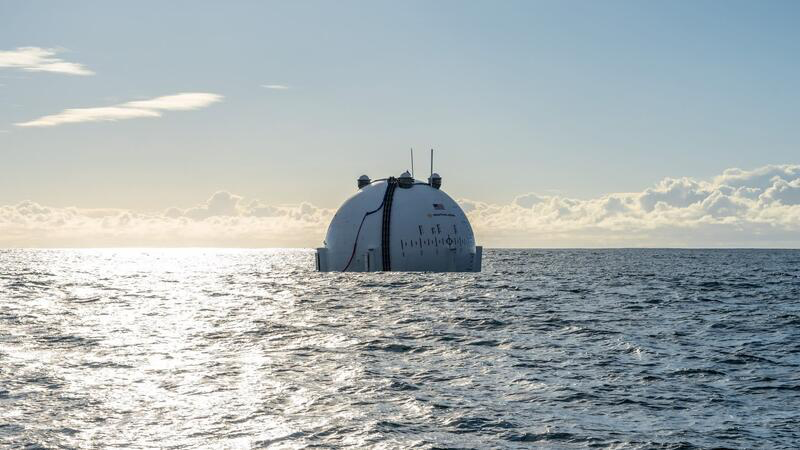
The North Pacific deployment planned for this year will represent an important transition from research toward industrial operation. Engineers will need to confirm that the platforms can survive severe weather, saltwater corrosion and repeated mechanical stress while maintaining reliable computing performance. The pilot will also test satellite communications and remote-control systems under real offshore conditions. Any interruption in power, cooling or data transmission could compromise the commercial viability of the project.
The new financing will support the completion of an assembly plant near Portland, Oregon. Standardized factory production is central to the company’s strategy because individually constructed offshore systems would be too expensive to deploy at scale. Panthalassa wants to manufacture platforms in a repeatable way and launch fleets rather than isolated units. Commercial expansion is planned for 2027 if the pilot program achieves its technical objectives.
Supporters see the model as a possible response to the rapidly increasing energy demand created by artificial intelligence. Training and operating advanced AI systems require large numbers of processors working continuously, often inside facilities consuming as much electricity as small cities. Technology companies are searching for new sources of power that can be added faster than conventional generation and transmission projects. Floating computing nodes could provide capacity without waiting for major land-based grid expansions.
The approach also creates a different relationship between digital infrastructure and geography. Data centers have traditionally been concentrated near fiber-optic networks, abundant electricity and major urban markets. Satellite connectivity allows some workloads to operate farther from customers, particularly when rapid millisecond-level responses are not essential. Tasks such as model training, scientific computation and large-scale data analysis may be suitable for remote processing at sea.
However, offshore computing also presents substantial environmental and operational questions. Large fleets could affect marine habitats, navigation routes and fisheries if they are poorly located or managed. Underwater noise, anchoring systems and maintenance traffic would require careful assessment. The company will also need reliable plans for recovering damaged platforms and preventing fuel, batteries or electronic materials from contaminating the ocean.
Extreme weather remains another challenge. Platforms operating in wave-rich regions must survive the same forces they are designed to harvest. Storms can produce waves far beyond normal operating conditions and place enormous stress on structural connections. Autonomous systems must be capable of adjusting their position or shutting down safely when environmental conditions exceed technical limits.
Cybersecurity will be equally important because the platforms depend on remote operation and satellite communications. A successful intrusion could interrupt workloads, alter navigation or compromise customer information. Data transmitted between land and sea must remain encrypted and authenticated at every stage. Operating far offshore reduces physical access but also makes emergency intervention more difficult.
The project remains at the pilot stage, and its commercial economics have not yet been proven. Building, deploying and maintaining offshore platforms could be expensive even if the energy itself is renewable. Panthalassa must demonstrate that the value of the electricity and computing capacity exceeds the costs of marine engineering, satellite connectivity and specialized maintenance. Its $140 million investment round provides resources for that test but does not guarantee success.
Floating data centers nevertheless represent an ambitious attempt to redesign the physical foundation of the digital economy. Instead of consuming scarce land, freshwater and grid capacity, they would use the movement and cooling power of the open ocean. The North Pacific pilot will determine whether that vision can operate reliably outside controlled experiments. If successful, future computing infrastructure may expand not only across continents, but across fleets positioned far beyond the coastline.
Innovation changes scale when infrastructure finds new terrain. / La innovación cambia de escala cuando la infraestructura encuentra un nuevo territorio.