

 Phoenix 24
Mobility, influence and organized crime increasingly overlap.
MIAMI, United States | June 2026
Russia’s presence in Latin America is evolving through methods that differ sharply from the ideological alliances associated with the Cold War. Rather than attempting to reproduce the Soviet model, Moscow is seeking influence through economic dependence, information operations, informal networks and access to regional vulnerabilities. One of the most sensitive concerns involves the post-2022 movement of Russian citizens into Latin American countries. Analysts warn that legitimate migration flows may also provide cover for intelligence operatives and members of organized crime.
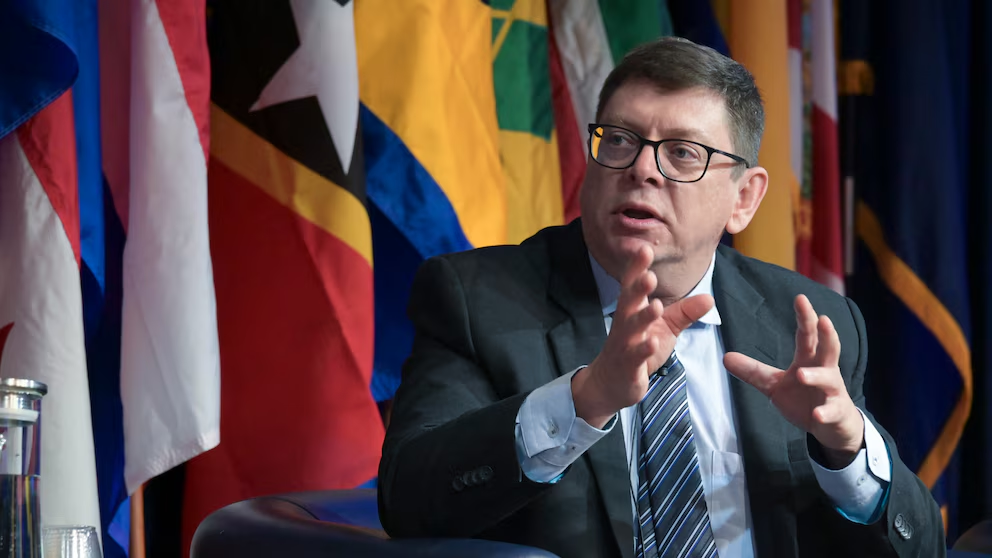
Vladimir Rouvinski, director of the Politics and International Relations Laboratory at ICESI University in Colombia, argues that Russia views Latin America through a logic of strategic symmetry. Moscow considers Ukraine, Belarus and the Caucasus part of its natural sphere of influence and resists Western involvement there. It therefore seeks a presence in what it perceives as the United States’ own near abroad. The objective is not necessarily territorial control, but the ability to generate pressure, uncertainty and political costs close to Washington.
This approach differs from China’s regional strategy. Chinese companies pursue commercial gains while concentrating investment in infrastructure, telecommunications, energy and other strategic sectors. Russia has fewer financial resources and therefore targets specific dependencies that can produce disproportionate influence. Fertilizers are one of the clearest examples because several Latin American agricultural economies rely heavily on Russian supplies.
Brazil is particularly exposed because its large agricultural sector requires imported fertilizers to maintain production. Affordable Russian supplies have helped create a commercial relationship that cannot be replaced immediately without economic consequences. A sudden interruption could affect costs, harvests and food exports. That dependence gives Moscow leverage even when it is not accompanied by formal political conditions.
Russian activity also operates in what security specialists describe as grey zones between legal commerce and criminal economies. These spaces involve transactions, intermediaries and networks that are not always clearly controlled by a government but may still serve its strategic interests. Rouvinski does not claim that Moscow directly commands Latin American drug trafficking or arms smuggling. He argues instead that Russian institutions may understand these networks well enough to exploit them selectively.
The war in Ukraine has added another layer to the relationship. Thousands of Colombian citizens have reportedly joined Ukrainian forces, attracted by military experience, financial incentives or opposition to Russia’s invasion. According to figures cited in the analysis, more than 8,000 Colombians have fought in Ukraine and around 1,000 have died. Participation on the Russian side is described as less transparent and more closely connected to prison recruitment, private military structures and criminal intermediaries.
The eventual return of combatants could produce security consequences across the region. Individuals with battlefield experience may return with advanced knowledge of drones, explosives, communications and urban warfare. Most veterans will not become criminals, but weak monitoring systems can allow dangerous skills to move into illicit markets. The same concern applies to weapons, contacts and financial relationships developed during the conflict.

Drug trafficking represents another area of opacity. Russia has maintained bilateral arrangements with some Latin American governments outside the most transparent multilateral frameworks. Colombia has extradited suspected traffickers to Russia, but the subsequent legal handling of those cases is not always publicly clear. That lack of visibility creates opportunities for intelligence collection, bargaining and informal influence.
Information operations remain one of Moscow’s most effective tools in the region. Russian outlets and aligned networks often present themselves as alternative voices defending pluralism against Western media dominance. Their messages frequently rely on real events but interpret them through a consistent narrative that democratic institutions are corrupt, ineffective or fundamentally hypocritical. This method is often described as sharp power because it penetrates open societies by exploiting their freedoms rather than openly promoting an authoritarian model.
Latin America provides fertile ground for this strategy because public trust in political institutions is already fragile in many countries. Economic inequality, corruption, insecurity and repeated government failures create audiences receptive to messages that reject democratic legitimacy. Russian narratives do not need to persuade citizens to support Moscow directly. Creating cynicism, polarization and confusion can be strategically sufficient.
Migration has become one of the least examined components of this wider presence. After Russia invaded Ukraine in February 2022, thousands of Russians left their country to avoid forced recruitment, repression or economic isolation. Those migrants have a legitimate right to seek safety and should not be treated automatically as security threats. The concern is that intelligence personnel or organized-crime figures may move within the same flows.
Russian passport holders can enter Argentina, Colombia and many other Latin American countries without obtaining a visa in advance. This facilitates tourism, business and humanitarian mobility, but it also creates broad freedom of movement across states with uneven border controls. Once admitted legally into one country, individuals may establish residence, companies or financial relationships that make their activities more difficult to monitor. Fragmented regional databases increase that vulnerability.
The central policy challenge is separating legitimate migration from covert activity without criminalizing an entire nationality. Broad suspicion would violate rights and discourage cooperation from Russians who genuinely oppose the Kremlin. Effective screening requires evidence, intelligence sharing and targeted investigation rather than ethnic or national profiling. Democratic governments must protect migrants while identifying behavior that presents a genuine security risk.
Regional coordination is therefore essential. If one country identifies suspicious financial activity, intelligence connections or criminal links, that information should be available to neighboring migration and security agencies. Political disagreements between governments often obstruct this exchange. Yet transnational networks benefit precisely from those institutional divisions.
Latin American states also need stronger oversight of shell companies, property purchases, cryptocurrency transfers and unusual residency patterns. None of these activities is inherently criminal, but together they can reveal networks designed to conceal ownership or movement. Intelligence agencies must cooperate with financial regulators, customs authorities and organized-crime investigators. The problem cannot be addressed by border police alone.
Russia’s influence in the region is unlikely to resemble the military alliances and ideological blocs of the twentieth century. It is more adaptable, less visible and often embedded inside legitimate economic or social activity. Fertilizer dependency, information operations, migration and criminal intermediaries may appear unrelated when examined separately. Together, they form a flexible architecture of influence.
The risk is not that every Russian migrant represents an operative or that every commercial agreement conceals a geopolitical plan. The real danger lies in institutional weakness that prevents governments from distinguishing ordinary activity from coordinated manipulation. Latin America’s response must preserve openness while improving awareness, verification and cooperation. In the current security environment, infiltration succeeds less through invasion than through the spaces democratic systems fail to monitor.
Influence grows where institutions stop looking. / La influencia crece donde las instituciones dejan de mirar.