

 Phoenix 24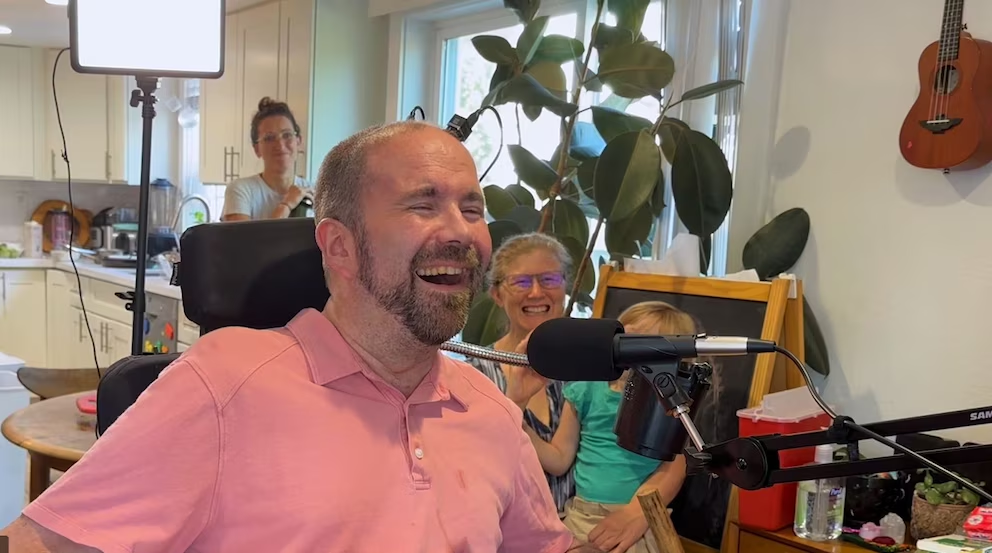
The system converts neural activity into fluent speech without daily technical assistance
CALIFORNIA, UNITED STATES | JUNE 2026. A man with amyotrophic lateral sclerosis has regained the ability to communicate fluently and independently through an experimental brain-computer interface. Casey Harrell, 48, uses the implanted system from his home to translate neural activity associated with attempted speech into text and synthetic voice. Three years after surgery, he can hold conversations, operate a computer and communicate at an average rate of approximately 56 words per minute.
Harrell was diagnosed with ALS several years ago as the neurodegenerative disease progressively weakened the muscles responsible for movement and speech. Damage to the connections between his motor cortex and the muscles controlling his tongue, lips and larynx made his words increasingly difficult to understand. Although his ability to formulate language remained intact, his body could no longer express it clearly.
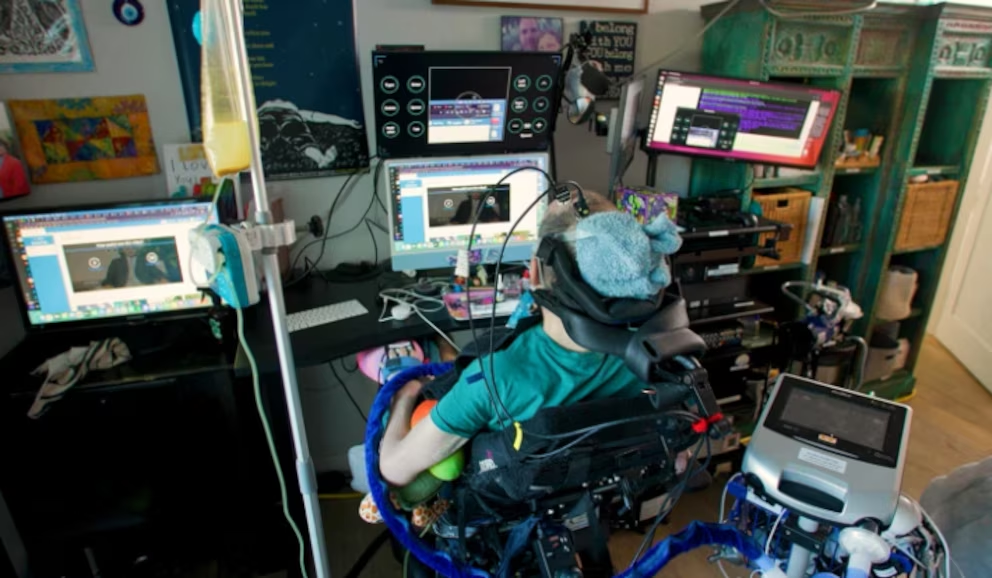
The experimental interface was developed by researchers from the University of California, Davis, Brown University and Utrecht University. Surgeons placed arrays containing hundreds of microscopic electrodes in areas of Harrell’s motor cortex associated with speech production. These sensors record the electrical patterns generated when he attempts to pronounce words, even when his muscles cannot execute those movements effectively.
Artificial-intelligence algorithms analyze the signals and estimate the words he intends to say. The decoded language appears as text on a computer screen and can also be reproduced through a synthesized voice modeled on recordings made before ALS severely affected his speech. This personalized output allows the technology to restore not only information, but part of the vocal identity the disease had taken from him.
Earlier brain-computer interfaces often worked only during supervised laboratory sessions and required researchers to recalibrate them frequently. Harrell’s system represents an important advance because it can operate at home without daily technical assistance. Its autonomous design continuously adjusts to changes in recorded neural signals, allowing him to connect to the equipment and begin communicating with minimal intervention.
That stability is essential for practical use. Brain activity recorded by implanted electrodes can change over time because of biological processes, minor electrode movements and variations in concentration or fatigue. A system that performs accurately during a controlled experiment but deteriorates outside the laboratory has limited value for patients who need reliable communication throughout the day.
Harrell has used the interface for ordinary and professionally meaningful activities. He can send messages and emails, control his computer, participate in meetings and continue working in environmental advocacy. He can also speak with family members through a synthetic version of his former voice, restoring interactions that had become increasingly difficult as ALS progressed.
The emotional importance of the technology became especially clear in his relationship with his young daughter. As his natural speech deteriorated, she had little memory of hearing his original voice clearly. The system allowed him to communicate familiar expressions in a voice resembling the one he had before the disease, including words of affection that had become physically impossible to pronounce.
Traditional assistive communication systems can provide vital support to people with severe paralysis, but they often depend on eye tracking, residual facial movements or switches activated by limited muscle control. These methods may be slow and exhausting, particularly as ALS progresses. A direct neural interface bypasses much of the damaged motor pathway by decoding the intended movement before it reaches weakened muscles.
The system is also multimodal. Harrell can use attempted speech for rapid communication while controlling other computer functions through the interface. This expands the technology from a specialized speech tool into a broader platform for digital independence, potentially allowing users to manage personal communication, entertainment, employment and essential services.
Despite the promising results, the development remains experimental. The findings come primarily from one participant in a clinical trial, making it impossible to assume that every person with ALS would achieve the same accuracy, speed or long-term stability. Larger studies will be required to determine safety, durability and effectiveness across patients with different disease stages and patterns of neural degeneration.
The implant also requires neurosurgery, which carries risks including infection, bleeding, seizures and damage to brain tissue. Harrell experienced a difficult recovery after the procedure, underscoring that the technology is not a simple consumer device. Researchers must demonstrate that its potential benefits justify the medical risks before it can move toward broader clinical use.
Cost and accessibility represent additional obstacles. Experimental surgery, specialized computers, clinical monitoring and long-term personal care can be extremely expensive. A breakthrough that works technically but remains available only to a small number of wealthy patients would have limited public-health impact. Health systems, insurers and regulators will eventually need to determine how such technologies could be funded and distributed fairly.
Neural data also raises serious privacy questions. Brain signals are among the most intimate forms of personal information, and future systems may reveal more than the commands users intentionally provide. Strong safeguards will be necessary to control who owns the data, how it is stored and whether companies may use it to improve commercial algorithms.
Researchers must also ensure that users retain control over activation and output. A communication implant should decode intentional speech rather than private thoughts or internal monologue. Clear consent procedures, security protections and reliable mechanisms for deactivating the system will be as important as improvements in decoding accuracy.
The implant does not treat ALS or reverse the biological damage caused by the disease. Its achievement lies elsewhere: it restores a channel between an intact mind and the outside world. For people whose cognitive abilities remain preserved while muscular control disappears, that distinction can mean the difference between isolation and participation.
Harrell’s experience demonstrates that brain-computer interfaces are moving beyond short laboratory demonstrations toward sustained use in everyday life. The technology remains far from routine medical availability, but its autonomous operation addresses one of the most important barriers to practical adoption. A communication system becomes transformative only when the patient can depend on it without a team of engineers constantly present.
The advance does not restore the body that ALS progressively weakens, but it returns something equally fundamental: the capacity to express decisions, emotions and identity. For Harrell and his family, the implant has turned neural signals into conversation and dependence into a measure of autonomy.
Technology becomes truly human when it restores the voice that illness tried to silence.