

 Samira El-Khalil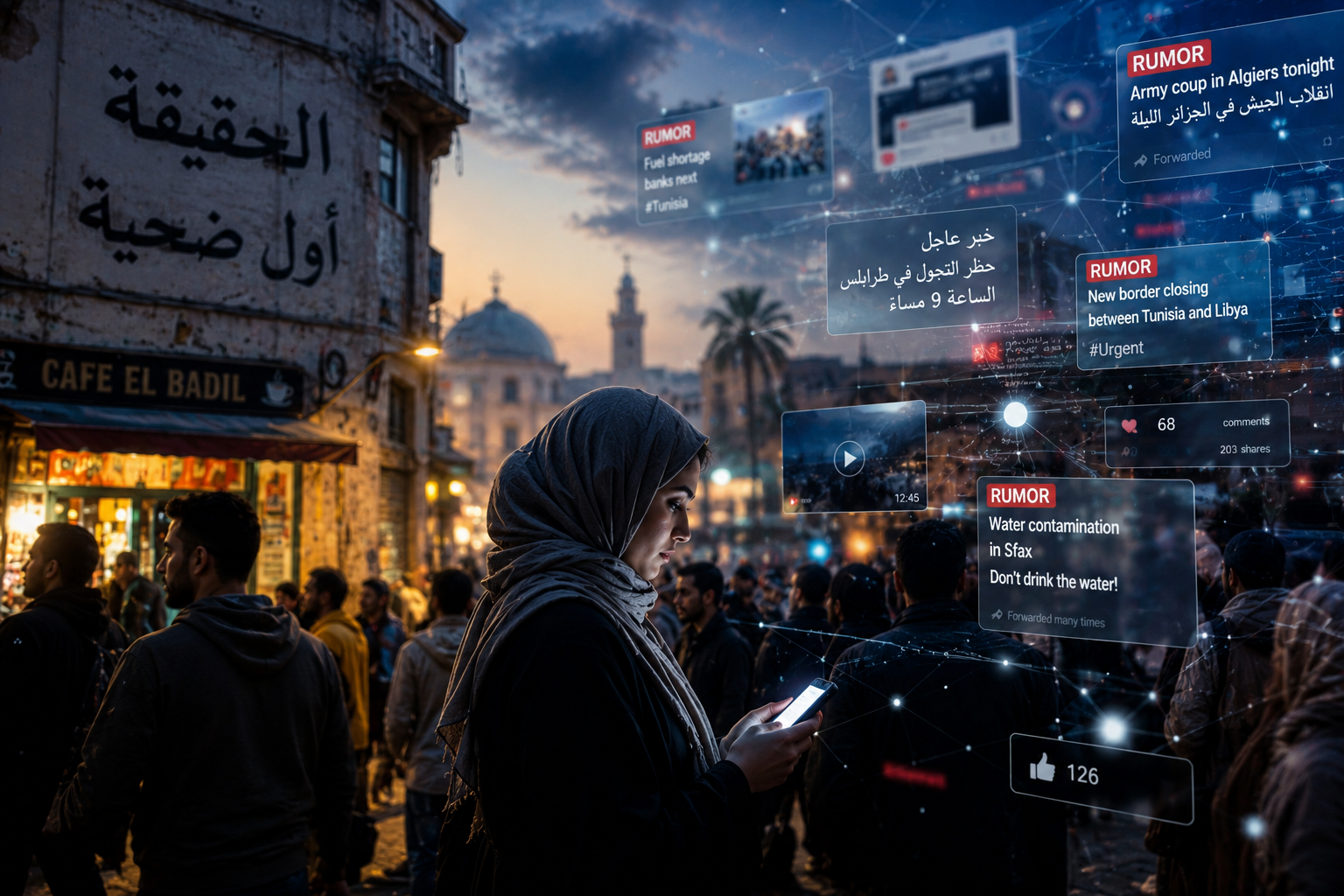
When institutions lose credibility, rumors stop being noise and start becoming power.
Tunis, Tunisia | June 2026
There is a moment in the life of every fragile political system when citizens stop asking whether a government is telling the truth and begin assuming that nobody is. The transition rarely arrives through a dramatic event. More often, it accumulates quietly across years of contradictions, disappointments, unfinished reforms, and competing versions of reality. By the time the shift becomes visible, trust has already become one of the most valuable and endangered resources in public life.
Across North Africa, this transformation is unfolding in ways that extend far beyond electoral politics or institutional performance. It can be heard in conversations between taxi drivers in Tunis, in family WhatsApp groups in Algiers, in cafés overlooking the Mediterranean, and in communities scattered across the vast territories linking Libya to the Sahel. The details differ from one country to another, yet the underlying pattern remains remarkably consistent. Official statements are increasingly received with skepticism. Alternative explanations circulate with unusual speed. Rumors are no longer treated merely as possibilities. They are often consumed as parallel forms of authority.
Entire generations across the region carry memories of official narratives that later proved incomplete, manipulated, or detached from lived experience. Distrust rarely emerges overnight. It accumulates gradually until skepticism becomes a cultural reflex. People learn to read between the lines. They search for hidden motives behind public announcements. They develop alternative systems of interpretation that exist alongside formal institutions. In societies shaped by political turbulence, skepticism often functions first as a survival mechanism and only later as a political position.
The digital age has amplified this dynamic in ways that previous generations could scarcely have imagined. Rumors have always existed. They moved through markets, mosques, schools, and neighborhoods long before social media platforms connected entire regions in real time. What has changed is their velocity and their capacity to travel across social, national, and linguistic boundaries almost instantly. A rumor heard in a café in Tunis can pass through encrypted messaging groups, circulate among diaspora communities in Europe, reach Tripoli, and return days later carrying the appearance of established fact. Along the way, it gathers details, interpretations, emotional weight, and the illusion of credibility simply through repetition.
In many parts of North Africa today, people no longer argue primarily about what should be done. They argue about what actually happened. The distinction may appear subtle, but it reveals a profound shift in the nature of public life. Political disagreements are difficult enough when citizens share a common understanding of reality. They become far more destabilizing when reality itself becomes fragmented.
Libya offers perhaps the clearest example. More than a decade after the fall of Muammar Gaddafi, competing political authorities, armed groups, foreign actors, media networks, and digital communities continue to generate rival narratives about the country’s present and future. Events are contested almost as quickly as they occur. Facts are challenged before they can be verified. Competing versions of reality circulate simultaneously, each reinforced by its own ecosystem of supporters, grievances, and interests. Under such conditions, legitimacy becomes difficult to establish because different audiences are often responding to entirely different interpretations of the same event.
Elsewhere, the patterns vary but the consequences remain familiar. In Tunisia, public frustration with political institutions has created fertile ground for speculation, conspiracy narratives, and competing interpretations of national events. In Algeria, official historical narratives increasingly coexist with alternative memories circulating through digital communities. Across parts of the Sahel, rumors regarding foreign military involvement, security operations, and political alliances frequently travel faster than official communication. By the time governments respond, public perception has often moved elsewhere, guided less by evidence than by the speed and emotional force of competing stories.
The deeper issue is not the existence of false information. Societies have always contained rumors, myths, exaggerations, and propaganda. The more significant challenge is the gradual erosion of shared reality. Democracies, transitional systems, and even authoritarian states depend upon some minimum level of agreement regarding facts. Citizens may disagree on policies, ideologies, or leadership, but public life becomes increasingly fragile when competing groups no longer recognize the same informational foundations. The crisis emerges not because everyone believes falsehoods, but because fewer people believe anyone possesses sufficient credibility to establish what is true.
This environment creates opportunities that external actors understand well. Modern influence campaigns rarely seek to convince entire populations of a single narrative. Such ambitions belong to an earlier era of information warfare. Contemporary influence operations often pursue something more subtle and, in many ways, more effective. Confusion can be as strategically valuable as persuasion. If trust becomes sufficiently fragmented, societies begin to police themselves through uncertainty. Institutions lose authority. Public debate splinters into isolated communities. Citizens spend more energy questioning sources than evaluating evidence.
Russia has experimented with this approach. Regional powers have explored it. Private influence networks have refined it. Artificial intelligence may soon accelerate it. Yet the greatest danger is not the creation of increasingly convincing falsehoods. The greater danger lies in the weakening of confidence surrounding authentic information. When citizens become convinced that everything can be manipulated, truth itself begins to lose political value. The result is not necessarily widespread belief in a single lie. It is widespread uncertainty regarding every version of reality.
Political psychology offers important insight into why this process becomes so difficult to reverse. Human beings do not interpret information through reason alone. Memory matters. Identity matters. Fear matters. Communities shaped by unresolved trauma often understand new events through experiences accumulated over decades. Populations that have repeatedly witnessed corruption, repression, broken promises, or foreign interference naturally develop suspicion toward official narratives. Under such conditions, rumors become persuasive not because they are demonstrably accurate, but because they feel emotionally consistent with what people already believe about power.
This is what makes the current crisis so difficult to address. The temptation is to treat disinformation primarily as a technological problem requiring technological solutions. Better detection systems, stronger moderation policies, and more sophisticated algorithms may help limit some forms of manipulation. Yet such measures address symptoms more effectively than causes. A society does not become vulnerable to rumors simply because false information exists. It becomes vulnerable when large numbers of citizens cease to regard institutions as reliable sources of truth. Trust cannot be automated. It cannot be manufactured through public relations campaigns. It develops slowly, often over generations, and can disappear with surprising speed.
Across North Africa, the struggle over information has therefore become inseparable from the struggle over legitimacy itself. Governments seek credibility. Citizens seek accountability. Journalists seek verification. Foreign actors seek influence. All operate within an environment where trust has become both the prize and the battlefield. The republic of rumors does not emerge when falsehood defeats truth. It emerges when uncertainty becomes more persuasive than certainty and when citizens begin searching elsewhere for explanations because institutions no longer appear capable of providing them.
North Africa may simply be confronting this reality earlier than others. The forces reshaping the region are not uniquely North African. Variations of the same dynamic are visible across democracies, hybrid regimes, and fragile states throughout the world. The technologies differ. The histories differ. The political contexts differ. Yet the underlying question remains remarkably similar. What happens to a society when trust becomes harder to believe than the rumor itself?
Samira El-Khalil
Senior Political Analyst and International Correspondent | Phoenix24
Samira El-Khalil writes on information warfare, political psychology, transitional justice, and the hidden architectures of power across North Africa and the Sahel for Phoenix24.