

 Phoenix 24
The city is learning to locate itself.
Seoul, April 2026. The use of Wi-Fi signals as a navigation layer marks a quiet but decisive shift in how cities understand movement. A system developed through KAIST research proposes using existing wireless networks to locate people, vehicles and robots in places where GPS becomes weak or unreliable. The promise is not futuristic spectacle, but operational precision inside tunnels, basements, dense urban corridors and buildings where satellite signals often fail.
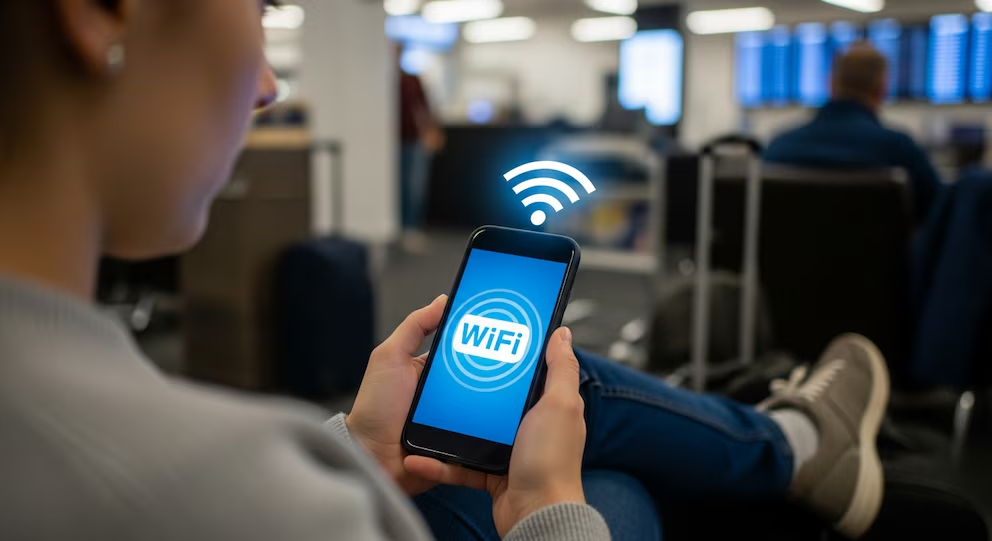
The logic is simple, but its implications are extensive. Routers already produce invisible maps of signal behavior across urban space, and artificial intelligence can interpret those patterns to estimate position with greater continuity. Instead of depending exclusively on satellites orbiting thousands of kilometers above Earth, navigation begins to draw intelligence from the city’s own digital infrastructure. What was once background connectivity now becomes spatial intelligence.
This matters because urban mobility is no longer limited to drivers and pedestrians. Autonomous vehicles, delivery robots, emergency responders, logistics operators and smart buildings all require positioning systems that do not collapse when GPS disappears. A hospital basement, a subway station or a high-rise district can become a blind zone for traditional navigation. Wi-Fi-based localization reduces that blindness by turning ordinary connectivity into a distributed sensing network.

The strategic layer is harder to ignore. When cities use wireless signals to navigate, they also expand the amount of location data circulating through public and private systems. Precision brings efficiency, but also questions over governance, privacy and control. The same infrastructure that helps a robot move through a building could help institutions map patterns of human movement with unprecedented granularity.
The future of navigation may not arrive through a new satellite constellation, but through the routers already embedded in daily life. If this model scales, the smart city will not simply connect devices; it will interpret space. That makes Wi-Fi more than a communication tool. It becomes an urban compass, and perhaps one of the next foundations of automated life.
Más allá de la noticia, el patrón. / Beyond the news, the pattern.