

 Phoenix 24
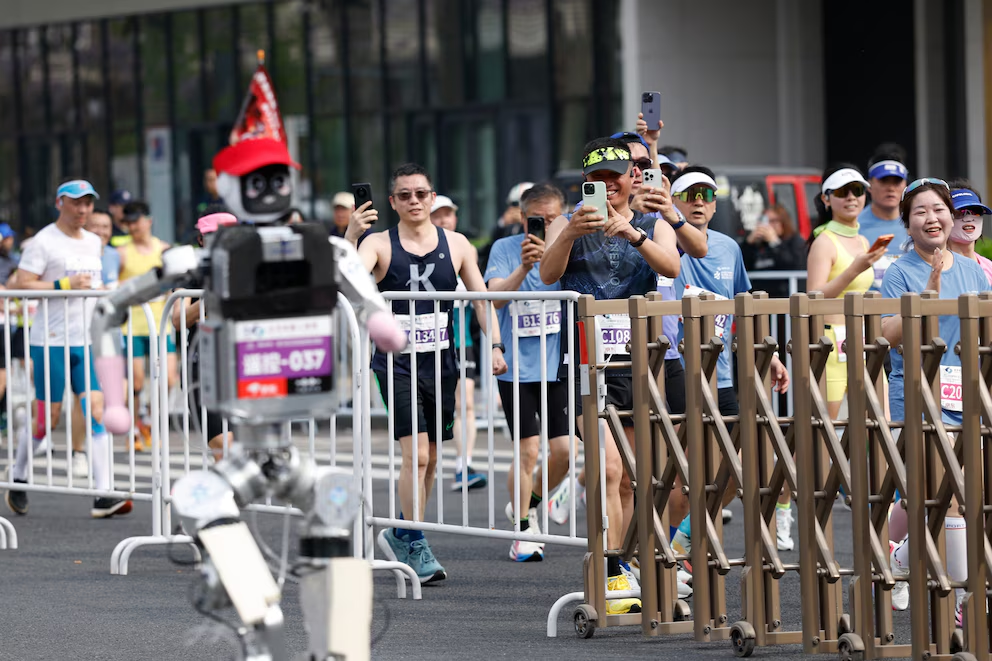
The machine is no longer staying in the lab.
Beijing, April 2026. The latest humanoid robot race in Beijing has become more than a technological curiosity after autonomous machines posted times that outpaced the human world record for the half marathon distance. The winning robot completed the 21 kilometer course in 50 minutes and 26 seconds, a figure that pushed the event instantly into global headlines and transformed what might have been dismissed as spectacle into a statement about velocity, balance, and machine endurance. What matters most is not only that robots ran fast. It is that they did so in a public setting designed to dramatize progress under real world conditions rather than inside a closed demonstration environment.
That distinction changes the meaning of the event. Robotics has long depended on carefully controlled showcases in which machines perform impressive tasks under managed circumstances. A half marathon imposes a different test. It demands sustained motion, rhythm, stability, energy management, and enough environmental adaptability to survive the unpredictability of a long course. Once humanoid robots begin handling that kind of challenge at this level, the conversation shifts. The question is no longer whether they can produce isolated moments of brilliance, but whether they are beginning to acquire a more operational form of physical competence.
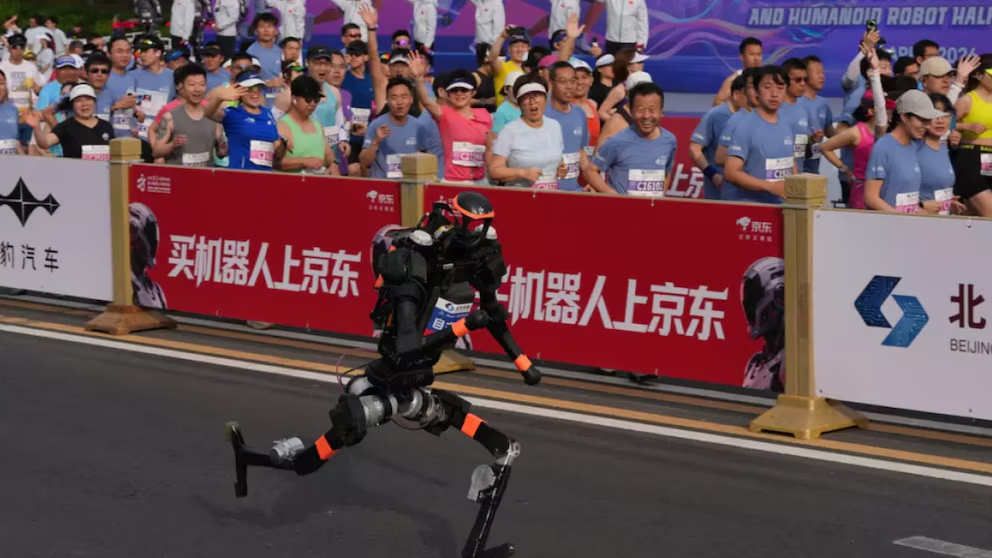
The Beijing race also matters because it condensed two narratives into a single image. One is the rapid acceleration of humanoid robotics, especially in China, where industrial policy, national prestige, and technological development are increasingly intertwined. The other is the symbolic crossing of a threshold once reserved for human athletic superiority. When a machine posts a time below the human world record for the same distance, even under conditions that are not perfectly identical, the symbolic effect is enormous. It forces the public to confront a future in which machines are no longer merely tools surrounding performance, but actors entering performance itself.
Still, the real story is more complex than the headline suggests. These robots did not suddenly become athletes in the human sense, nor does a controlled race mean they are ready to replace people across broader physical environments. Their success depends on specialized engineering, optimized conditions, and design priorities aimed at a very specific type of movement. What the event demonstrates is not generalized superiority over humans, but a remarkable compression of the gap between robotic motion and human locomotion in a domain once thought difficult to imitate. That is significant enough on its own without needing mythologized exaggeration.

The engineering implications are substantial. To sustain this kind of run, a humanoid robot must coordinate gait mechanics, shock absorption, thermal regulation, energy use, and real time adaptation with a degree of reliability that was still elusive not long ago. In previous years, many machines in similar events struggled simply to finish. The leap in performance now suggests that developers are solving not just speed problems, but systems integration problems. In advanced robotics, that is where the true barrier usually lies. Power is not enough. Balance is not enough. Intelligence is not enough. The challenge is getting all of them to function together under stress.
That is why this race should be read as a strategic signal rather than a novelty clip. Public demonstrations like this help normalize the idea that humanoid robots are moving from experimental prototypes toward broader social and industrial legitimacy. A machine that can run long distances with visible control and endurance becomes easier to imagine in other demanding environments, from logistics and manufacturing to hazardous operations and emergency response. The marathon is not the final application. It is the proof of concept that makes wider applications feel less speculative.
There is also a geopolitical reading that should not be ignored. China increasingly understands that technological leadership is not built only through patents, production capacity, or research papers. It is also built through dramatic public moments that shape global perception. A humanoid robot outrunning human benchmarks in Beijing functions as a narrative weapon as much as a scientific achievement. It tells domestic audiences that the future is being built at home, and it tells international audiences that the race for embodied artificial intelligence is accelerating in visible, unsettling ways.

The deeper significance, then, is cultural as much as technical. Human beings have long treated running as one of the purest expressions of organic performance, a direct measure of endurance, will, and bodily capacity. When humanoid robots begin to trespass into that symbolic territory, they do more than impress engineers. They disturb assumptions about where human distinctiveness begins to narrow. Beijing’s robot race was not just about speed. It was about the public staging of a new threshold, one in which the machine appears less like an instrument and more like a competitor entering the frame.
Detrás de cada dato, hay una intención. Detrás de cada silencio, una estructura.
Behind every datum, there is an intention. Behind every silence, a structure.