

 Phoenix 24
Sobriety changed her inner vocabulary.
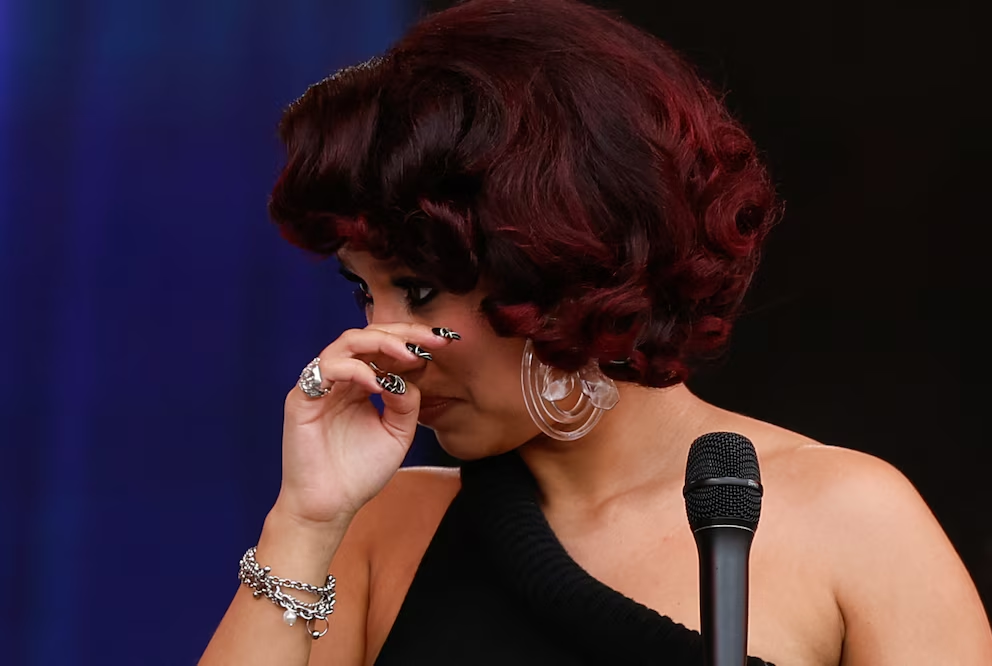
London, April 2026. RAYE has begun describing a different kind of recovery, one that reaches beyond the abandonment of drugs and alcohol and into the way she now structures attention, meaning, and emotional survival. In recent remarks, the British singer suggested that social media has lost the centrality it once had in her daily life, while the Bible has taken on a more intimate role in her process of healing. The shift is not minor in symbolic terms. It suggests that recovery, for some public figures, is no longer being narrated only as abstinence, but as a deeper reorganization of what fills the silence once occupied by compulsion.

That matters because addiction recovery in celebrity culture is often framed in simplified ways, as though the decisive moment were merely the rejection of substances. In reality, dependency tends to leave behind more than a biochemical void. It also disrupts routines, emotional regulation, identity, and the daily rituals through which a person interprets themselves. What RAYE appears to be describing is not just sobriety as restraint, but sobriety as replacement, where one source of constant stimulation gives way to another form of inward structure.
The role of social media in that equation is especially revealing. Platforms built around visibility, comparison, performance, and endless scrolling can become emotionally destabilizing even for ordinary users, but for artists they often function as both promotional machinery and psychological pressure chamber. Stepping back from that cycle does not simply mean spending less time online. It can also mean refusing a system that rewards fragmentation, self-surveillance, and a constant negotiation with public appetite. In that context, replacing digital noise with scripture becomes more than a personal habit. It becomes a form of resistance against a culture of permanent exposure.

RAYE’s story carries additional force because her public identity has already been shaped by emotional candor. Her music has repeatedly engaged pain, trauma, excess, and the aftermath of self-destructive coping, which means her comments about addiction do not arrive as an isolated confession detached from her artistic language. They extend a narrative her audience already recognizes, but they move it into a different register. The woman who once turned turmoil into song is now describing a phase in which healing seems to require less performance and more discipline. That distinction matters because it changes the emotional architecture of her public image.
There is also a spiritual layer here that contemporary pop culture often struggles to process without reducing it to branding, sentimentality, or moral reinvention. When a major artist says the Bible replaced social media in part of her life, the statement can sound surprising precisely because faith now occupies an unstable place in celebrity discourse. It is often tolerated as symbolism, but treated with caution when it appears as actual practice. Yet for many people in recovery, belief functions not as ornament but as structure, offering language, rhythm, repetition, and submission to something beyond the self. In that sense, faith can serve not as image management, but as cognitive scaffolding.

What makes this episode more interesting is that it does not read as a triumphalist redemption narrative. RAYE is not presenting herself as untouched by the darkness behind her, nor as someone who solved pain through a single dramatic conversion. The tone, instead, suggests a more fragile and ongoing recalibration, where discipline is chosen because collapse remains imaginable. That nuance is important. Recovery is often strongest when it is described not as total victory, but as sustained vigilance against old forms of escape.
The cultural resonance of her words extends beyond music. More public figures are beginning to speak openly about mental strain, addiction, overstimulation, and the emotional distortions produced by digital life. What distinguishes RAYE’s framing is the conjunction of those themes. She is not only talking about substances. She is also pointing toward the economy of attention itself, implying that endless online consumption can function as another kind of escape, even if it is socially normalized. When social media and intoxication are both understood as technologies of numbing, the act of turning toward faith takes on a more radical coherence.
For the entertainment industry, there is an additional implication. Pop culture depends heavily on artists who can remain visible, emotionally available, and perpetually narratable without disappearing into private reconstruction. That creates a contradiction for anyone trying to heal while still being marketable. RAYE’s comments suggest an attempt to negotiate that contradiction by reducing one kind of visibility and deepening another kind of interiority. Whether that balance is sustainable remains to be seen, but the gesture itself signals fatigue with the old model in which vulnerability had to remain permanently performative.

What emerges, then, is not simply a story about a singer who found religion after addiction. It is a story about substitution, attention, and the search for forms of survival that do not depend on digital overstimulation or chemical escape. RAYE seems to be describing a life in which the battle is no longer only against substances, but against whatever conditions make self-erasure feel necessary in the first place. In that sense, the Bible is not just replacing an app. It is replacing a mechanism of drift with a discipline of presence.
Information that anticipates futures.
Información que anticipa futuros.