

 Phoenix 24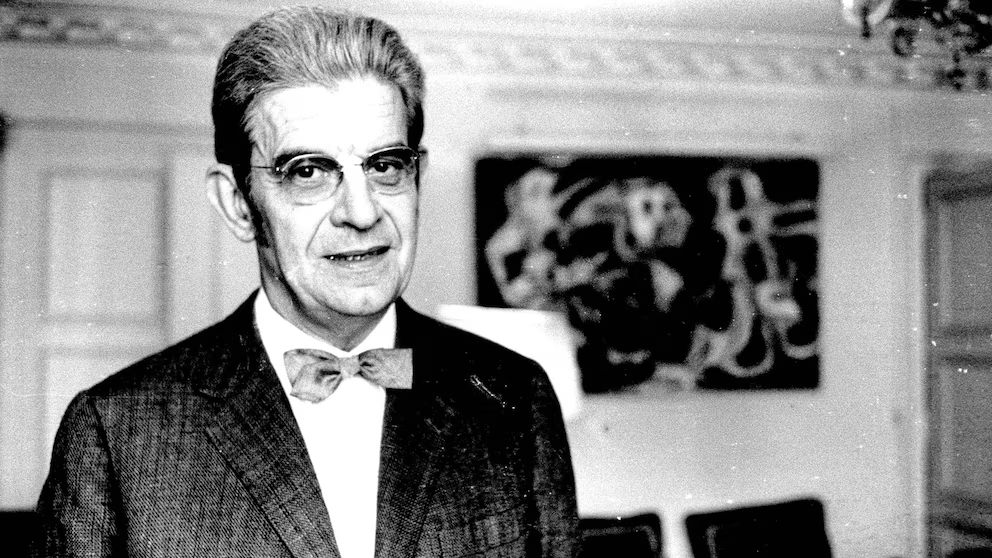
The subject was no longer self-transparent.
Paris, March 2026
Jacques Lacan transformed psychoanalysis by arguing that the human subject is shaped not only by instinct, biography or conscious intention, but by language itself. That shift reoriented Freud’s legacy and helped turn psychoanalysis into a wider intellectual field, one capable of speaking not only to the clinic, but also to philosophy, literature and the modern debate over identity.
What made Lacan so disruptive was not a rejection of Freud, but a reinterpretation. He presented himself as returning to Freud while insisting that the unconscious should not be treated as a hidden container of meanings waiting to be recovered through simple psychological explanation. Instead, he emphasized structure, signification and the way speech reveals more than the speaker intends. In his framework, the unconscious does not merely use language. It is structured through it.
That move had major consequences for how identity could be understood. Lacan challenged the idea of a stable, transparent and self-contained individual. In its place, he proposed a divided subject, one formed through lack, desire and symbolic mediation. In practical terms, the person is never fully identical to what he or she thinks, says or imagines. Identity emerges through language, through the gaze of others and through structures that exist before personal choice.
His thought also changed the vocabulary of psychoanalysis. The distinction between the Imaginary, the Symbolic and the Real gave Lacan a way to describe how the self is shaped by images, by language and by what resists symbolization altogether. These concepts became central not only to psychoanalytic theory, but to wider intellectual debates about representation, conflict and the instability of meaning in modern life.
Language occupies the decisive place in that architecture. Lacan argued that the subject enters the social world through speech and through systems of meaning already in place. As a result, the self is never purely natural or self-originating. It is produced within a symbolic order that grants recognition, imposes limits and organizes desire. That is one reason Lacan continues to matter in contemporary culture: he offers a way of thinking about identity not as possession, but as something formed through tension, displacement and interpretation.
His influence moved well beyond psychoanalytic institutions. Literary theory, film studies, feminism, philosophy and political thought all absorbed Lacanian concepts in different ways, sometimes productively and sometimes critically. His work acquired a long afterlife because it treated the subject as unstable and language as constitutive, two ideas that became central to late twentieth-century thought and remain relevant in current debates over identity and modernity.
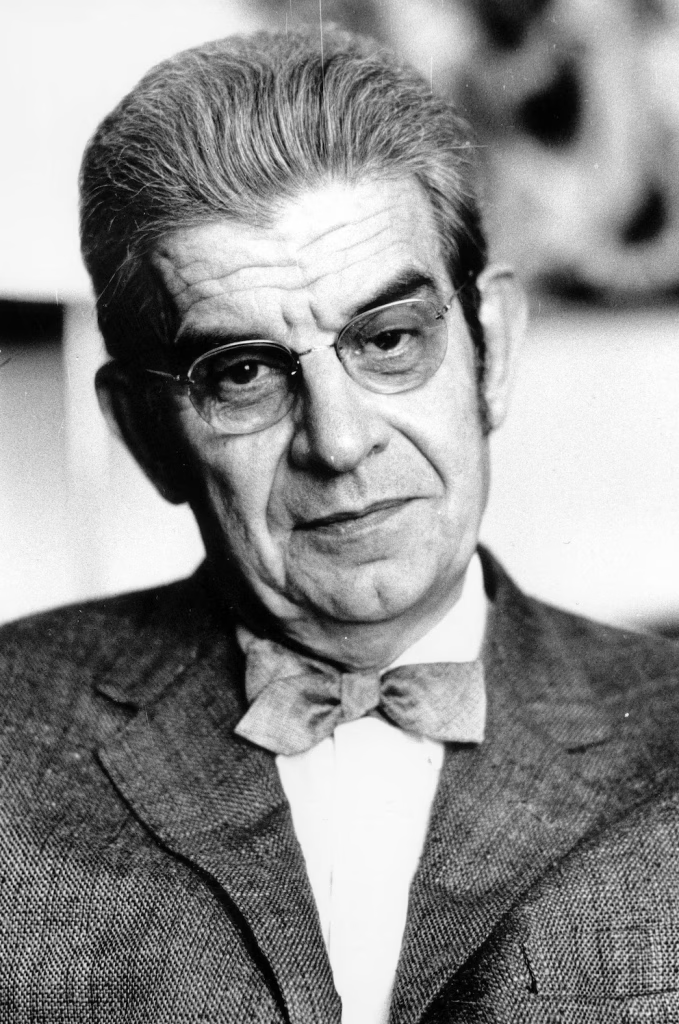
At the same time, Lacan remains controversial. His writing is famously difficult, his seminars have often been described as opaque, and many of his concepts have generated debate over their clarity and clinical usefulness. Yet that difficulty is also part of his enduring force. Lacan did not offer a comforting psychology of self-knowledge. He offered a theory in which the subject is split, desire is mediated and language never says only what it appears to say.
For that reason, Lacan’s refoundation of psychoanalysis still matters. He did not simply update Freud for a new generation. He reoriented the field around the idea that identity is inseparable from language, and that the modern subject is shaped as much by what cannot be fully mastered as by what can be consciously affirmed.
Phoenix24: clarity in the grey zone. / Phoenix24: clarity in the grey zone.