

 Phoenix 24
Creativity is being priced like surplus.
Paris, February 2026.
UNESCO is putting a hard number on a fear that has been circulating in creative circles for months: generative AI is not only changing how culture is produced, it may change who gets paid for it. In the organization’s latest assessment of the cultural economy, UNESCO projects that by 2028 the expansion of AI generated outputs could translate into global revenue losses of up to 24 percent for music creators and 21 percent for audiovisual creators. The warning is not framed as a distant ethical debate. It is framed as a near term economic squeeze, driven by scale, distribution mechanics, and the fact that digital markets have become the main artery through which creators earn.
The first structural point is that digital income is no longer a side stream. UNESCO notes that digital revenues account for about 35 percent of creators’ income, up from 17 percent in 2018. That shift matters because it concentrates risk. When the economic center of gravity is streaming, platform discovery, and on demand consumption, any technology that can mass produce content inside those channels is capable of compressing human earnings quickly. The shock does not require a world where AI “replaces” artists in a dramatic sense. It only requires a world where the supply of acceptable, algorithm friendly content becomes so abundant that human work is forced to compete on price and attention against a category whose marginal production cost is close to zero.
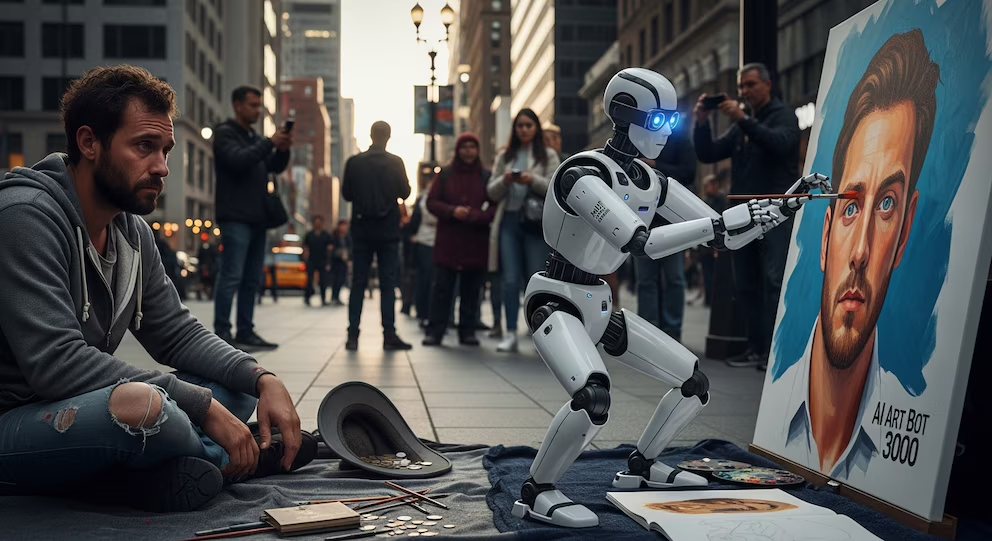
The mechanism is brutally simple. Generative systems can produce songs, instrumentals, loops, background scores, voice like performances, and short audiovisual pieces at industrial volume. In marketplaces dominated by recommendation feeds, playlists, and automated curation, attention is the scarce resource, not content. When content becomes abundant, discovery becomes more valuable than creation, and whoever controls discovery controls income distribution. UNESCO’s framing points toward market concentration and opaque curation as force multipliers: a small number of platforms act as gatekeepers while creators face an environment where rules of visibility are not fully transparent and can change without negotiation.
This is why the warning lands hardest on the middle of the creative economy, not only on celebrities. The top tier has brand power, touring leverage, and cross platform monetization that can buffer shocks. The bottom tier often operates outside monetized channels or treats income as incidental. The middle tier, working professionals whose livelihoods depend on licensing, streaming, commissions, and steady output, is the most exposed. If AI generated content takes a meaningful slice of low friction use cases, mood music, ambient tracks, background video, short form fillers, then the middle gets squeezed first. Their work becomes interchangeable inside the same discovery pipes, while their costs remain human.
UNESCO adds a second layer that is easy to overlook: inequality will widen if adaptation capacity is uneven. The report highlights a digital skills gap, with essential digital skills held by 67 percent of people in developed countries and 28 percent in developing countries. In practice, that gap translates into bargaining power. Creators who can navigate metadata, platform optimization, rights management, and audience building will defend their income better than creators who cannot. When AI enters the market, those skills become even more decisive because the fight shifts from creating to positioning, authentication, and negotiating terms for data use.
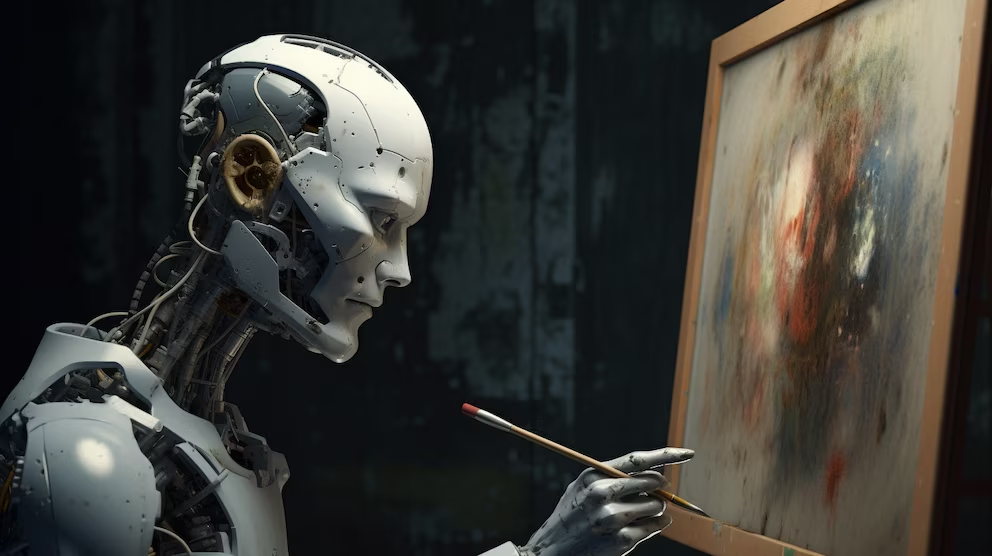
The third layer is legal and institutional. AI systems are trained on vast corpora of human made work, and the policy question is whether that training is treated as a permissible input, a licensable use, or something in between. UNESCO’s position, consistent with its broader cultural policy agenda, is that governance is lagging behind transformation. That lag matters because in the absence of enforceable rules, value tends to concentrate where leverage sits: in platforms, model providers, aggregators, and large rightsholders with legal capacity. Individual creators, especially those without representation, face a familiar pattern: the market moves first, and compensation debates arrive later.
The tension is not that AI has no place in creativity. Many creators already use AI as an assistive tool for ideation, editing, sound design, workflow acceleration, and accessibility. The tension is distributive. If AI increases productivity but the economic gains are captured primarily by distribution platforms and technology vendors, then creators experience AI as wage pressure, not empowerment. UNESCO’s numbers are a warning about that distributional outcome. Even if overall consumption rises, the share flowing to human creators can fall if the catalog becomes flooded with cheaper substitutes optimized for engagement.
There is also a perception risk that becomes economic. If audiences cannot reliably distinguish between human made and machine made content, trust in the cultural marketplace erodes. That erosion can drive platforms to introduce labeling and provenance tools, but labels only matter if they are enforced and visible. Otherwise, the market drifts toward a cheapest viable equilibrium, where the content that wins is content that performs, not content that is authored. In music and audiovisual work, where recommendation systems shape most listening and viewing, performance metrics can outvote authorship unless policy or design intervenes.
UNESCO’s warning is therefore less a prophecy than a stress test. It describes what happens if current trajectories remain mostly unchanged: AI output expands rapidly, platform concentration persists, transparency remains limited, and rights frameworks adapt slowly. The alternative trajectory is not a ban. It is a governance stack: clearer licensing paths, enforceable transparency on training data and synthetic labeling, stronger collective bargaining for creators, and platform accountability for how synthetic content is promoted. Without those mechanisms, the market will treat creativity as an abundant input, and abundance almost always pushes prices down.
The simplest way to read the 24 percent figure is this: the risk is not only that AI can create, it is that AI can compete at scale inside the same distribution systems that creators already depend on. If those systems remain opaque and concentrated, the economic result is predictable. Culture grows, but creators earn less from it.
La narrativa también es poder. / Narrative is power too.