

 Phoenix 24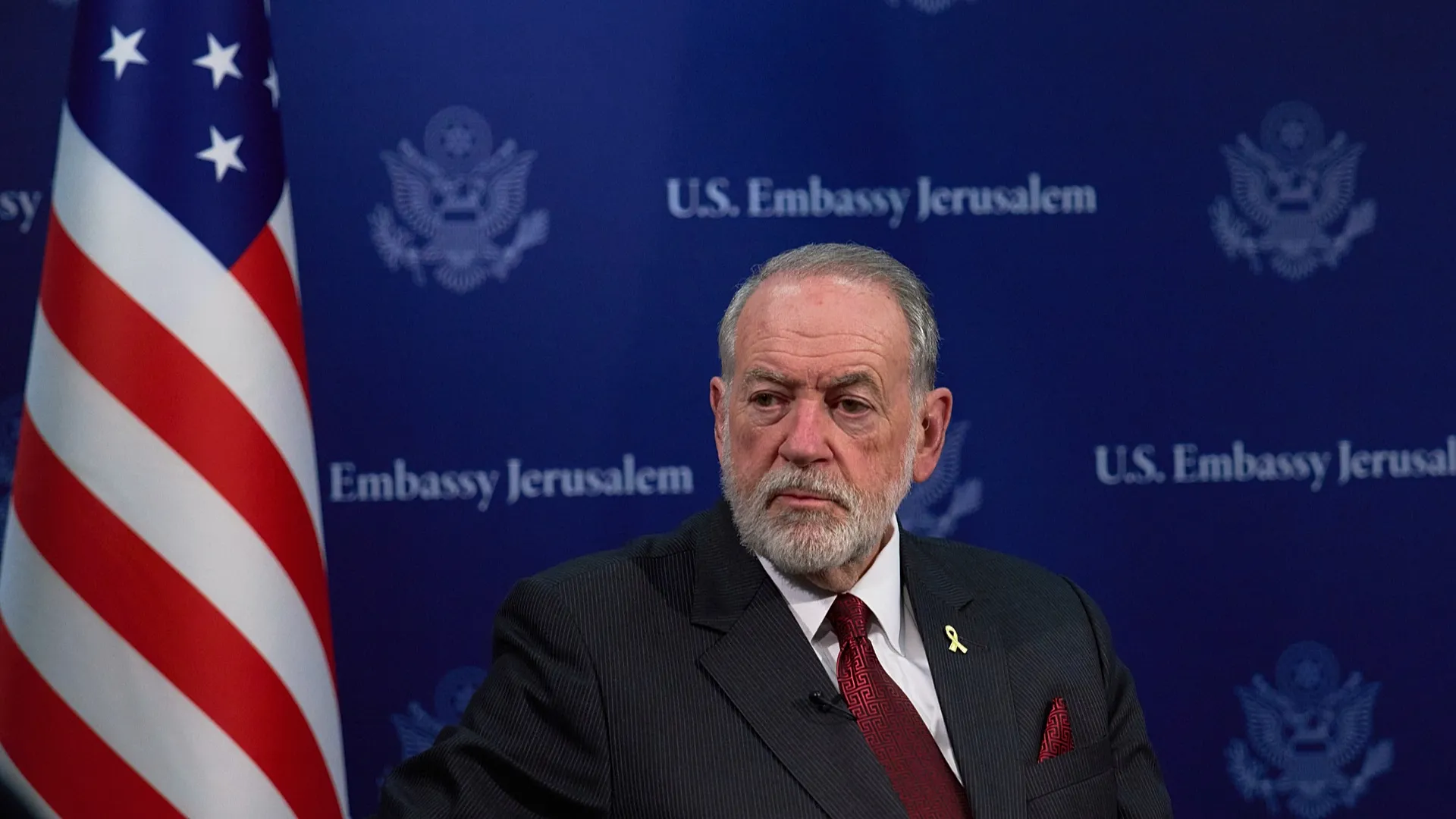
Words can move borders before armies do.
Jerusalem, February 2026.
A diplomatic storm broke not over a troop movement or a formal treaty shift, but over an interview in which the U.S. ambassador to Israel, Mike Huckabee, spoke in language that many governments heard as permission to expand territory. The remarks invoked a biblical frame for Israeli claims, including the idea that it would be “fine” if Israel took land stretching from the Nile to the Euphrates, a phrase that carries a long and volatile afterlife in regional politics. In the Middle East, where rhetorical signals often precede policy hardening, a sentence can function like a stress test for the entire system.
The response was swift and deliberately multilateral. A joint condemnation emerged from Arab and Muslim states and from regional bodies, including the Arab League, the Gulf Cooperation Council, and the Organization of Islamic Cooperation, describing the comments as dangerous, inflammatory, and inconsistent with international law. Reuters reported that the statement included countries such as Jordan, Saudi Arabia, Egypt, Turkey, the United Arab Emirates, Indonesia, Pakistan, and Palestinian authorities, a list that matters because it spans different blocs and rivalries. When actors that frequently disagree adopt a single line, the goal is not moral performance. The goal is to raise the diplomatic cost of treating the comment as casual opinion.
The language of the protest anchored itself in law to suffocate ambiguity. The joint statement leaned on the United Nations Charter framework and on the principle that Israel has no recognized sovereignty over occupied Palestinian territories, a way of closing the door on any narrative that normalizes annexation. Several governments framed the remarks as a threat to regional stability and a direct challenge to the idea that borders cannot be rewritten by ideology. This is not merely a legal argument, it is a survival mechanism for states whose legitimacy depends on the predictability of territorial norms. Once a senior U.S. official legitimizes maximalist imagery, even rhetorically, it energizes actors who profit from turning negotiation into permanent confrontation.
Washington’s containment response followed a familiar pattern: partial distancing without a dramatic public rupture. The U.S. embassy in Jerusalem said the comments were taken out of context and insisted there was no shift in official policy, a formulation echoed in reporting by the Associated Press. That phrasing does two things at once. It aims to calm allies who fear policy drift while avoiding a headline that reads like the U.S. is reprimanding its own envoy. Yet in this region, the difference between policy and messaging is thinner than diplomats prefer, because messaging is treated as policy rehearsal.
The controversy also exposes a structural vulnerability inside U.S. foreign policy when domestic political language leaks into strategic theaters. Huckabee is not a neutral technocrat; he is widely known for evangelical positions and for skepticism toward Palestinian statehood, which means his rhetorical register is read as ideological by default. The Guardian and Al Jazeera both emphasized how his interview framed territorial questions through a religious promise narrative rather than through negotiated borders. That matters because religious framing is not a normal diplomatic instrument, it is an accelerant. It shifts the discourse from bargaining to destiny, and destiny is not negotiable.
The core of the backlash is not only the headline phrase about the Nile and the Euphrates, but what it signals about normalization. If an ambassador treats maximalist boundaries as thinkable, it becomes easier for hardline actors to argue that international objections are theater and that facts on the ground will eventually be rewarded. This is how rhetoric becomes operational. It does not order a bulldozer or a battalion forward, but it can lubricate the political environment that makes expansion easier to justify. In conflict systems, legitimacy is a resource, and perceived U.S. blessing is one of the most valuable forms of it.
The timing compounds the sensitivity. The region is already carrying overlapping pressures, including Gaza’s aftershocks, tensions in the West Bank, and the broader confrontation geometry involving Iran and Israel. When the strategic environment is saturated, every new provocation increases the probability of miscalculation, not necessarily by governments, but by armed networks and political entrepreneurs who interpret ambiguity as opportunity. A single statement can become recruitment material, propaganda fuel, or a pretext for escalatory acts that no capital explicitly ordered. This is why governments reacted so quickly, because delay allows the narrative to harden.
There is also a hierarchy-of-costs problem for Arab states managing domestic audiences. Many governments maintain relationships with Washington for security and economic reasons, yet they cannot appear passive when Palestinian sovereignty language is challenged. A collective condemnation lets them signal red lines without triggering an immediate rupture with the United States. It is a calibrated move: firm enough to deter, structured enough to look official, broad enough to appear inevitable. In that sense, the protest is less about persuading Huckabee and more about disciplining the interpretive space.
The episode illustrates a deeper rule of modern diplomacy: symbolism is now a battlefield layer. A state can lose strategic ground even while its troops never move, if language shifts the perceived baseline of what is acceptable. For Washington, the immediate risk is reputational, the impression that its diplomatic line is drifting toward annexation tolerance. For regional actors, the risk is contagion, the fear that one official’s rhetoric will be echoed by others, turning a fringe claim into an informal policy current. For Israel, silence can be tactically useful in the short term, but the broader discourse can still reshape expectations and harden opposition.
In the coming days, the crucial variable will not be outrage itself, which is predictable, but clarification. Diplomacy in this domain runs on explicit anchors, not on after-the-fact reinterpretations. If Washington wants to contain the damage, it will need to restate, in plain terms, where it stands on territorial acquisition and on the legal status of occupied lands, and it will need to do so in a way that allies can cite without embarrassment. Otherwise the system will do what it always does in uncertainty: fill the void with the most extreme interpretation available.
La narrativa también es poder. / Narrative is power too.