

 Phoenix 24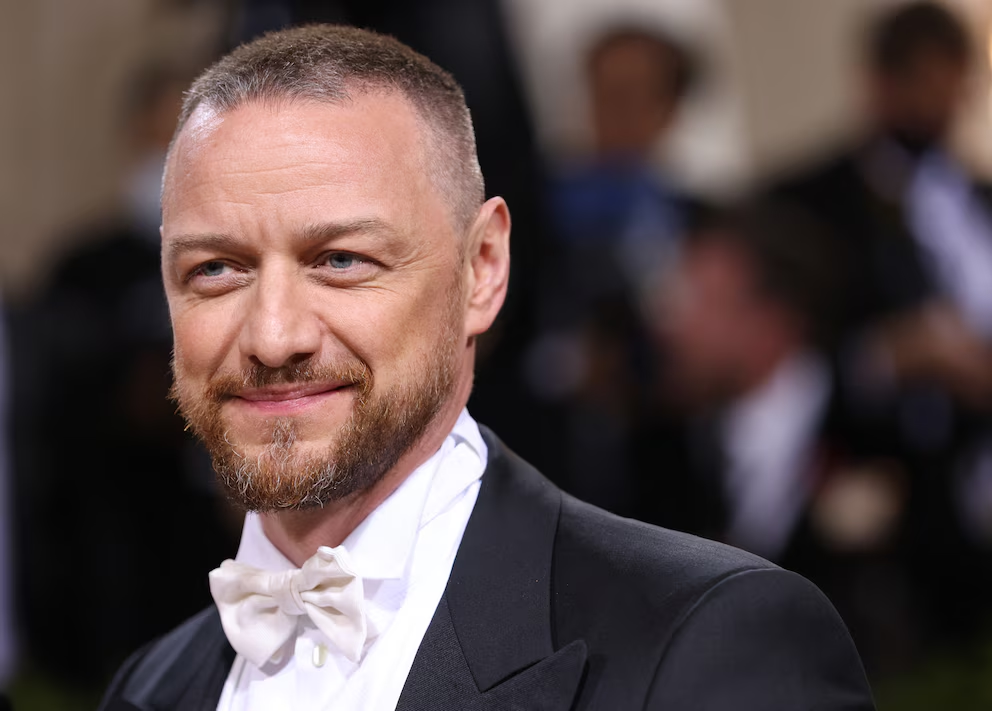
He waited until the equation became visible.
Glasgow, February 2026.
James McAvoy is stepping into a kind of responsibility that acting can sometimes postpone. After roughly three decades in front of the camera, he is making his directorial debut with California Schemin’, a film scheduled to close the 2026 edition of the Glasgow Film Festival. That placement matters because a closing night is built for collective judgment, not for polite experimentation. If the film lands, it will do so in the most public way possible, as an event designed to send an audience home energized.
McAvoy’s explanation for why it took him so long is unusually technical for a celebrity narrative. He has described directing as an “equation” he could not clearly understand, even while watching admired filmmakers solve it in real time. The hesitation was not simply fear of failing, but fear of misunderstanding the job and confusing proximity to excellence with actual mastery. Many actors think directing is acting plus authority, until they realize it is acting plus systems engineering.
That difference begins with what directing forces you to notice. An actor can focus on character logic, timing, and emotional truth inside a protected channel, while others absorb the surrounding chaos. A director must hold the entire chain together, from script clarity to visual continuity to practical constraints that do not care about inspiration. When something breaks, it breaks everywhere at once, and the director is the person expected to rebuild coherence in motion.
The choice of project is a signal about how McAvoy wants to frame his first attempt. California Schemin’ is inspired by the improbable story of two young Scottish rappers who presented themselves as Americans in order to break into the music industry. At surface level it is entertainment built on audacity, confidence, and social improvisation. Underneath, it is a story about credibility, accent, and the gatekeeping reflex that decides who sounds “real” before anyone checks the facts.
That theme connects to a quiet power structure that creative industries rarely admit openly. Accent and class cues often operate as proxy measures of legitimacy, shaping casting, funding, and media attention while remaining socially acceptable to mock or correct. McAvoy has spoken about being urged to soften his Scottish voice in professional settings, a small instruction that carries a big message about who is allowed to sound authoritative. A film about performance and passing becomes, in that context, less a novelty and more a controlled way to stage the problem without turning it into a lecture.
Festival strategy amplifies the stakes. A closing gala is expected to deliver pace, payoff, and emotional lift, not just competence or mood. That expectation creates a narrow corridor for a debut director: the film must be accessible enough to satisfy a crowd and disciplined enough to convince critics that the craft is real. It is a difficult slot for a first feature because it compresses judgment into a single communal moment, where audiences respond viscerally and the industry reads the room.
McAvoy’s reported emphasis on script is another tell about what he thinks directing is for. He has criticized how often productions proceed with writing that lacks a true core, a credible beginning, and an earned ending, even when everything else looks polished. That critique is common, but it becomes risky the moment you direct, because it turns into a standard you must meet rather than an opinion you can voice. A debut framed as “story first” becomes a credibility test: if structure wobbles, the film does not just fail, the argument fails.
The practical reality of directing, as he has described it, strips away romance quickly. He has talked about being pulled out of acting focus by logistical questions that arrive at the worst possible moment, about schedules, facilities, and availability for scenes not yet shot. That detail matters because it captures the real nature of the role: directing is not a single creative act but a continuous arbitration between competing urgencies. If he finally “saw the equation,” it may be because he accepted that the equation is not glamorous, it is simply unavoidable.
The public ecosystem around a debut also changes when you become the person in charge. Directors carry the narrative of a project, and that narrative attracts attention that can be generous, dismissive, or simply chaotic. During the film’s festival life, coverage included an incident in which McAvoy was reportedly struck by an intoxicated stranger after a screening, a reminder that visibility has its own risks and distractions. None of that changes whether the film works, but it changes the conditions under which it is judged.
McAvoy has kept his future intentions open, acknowledging that he may return fully to acting or feel pulled to direct again. That ambivalence reads as credible because directing is not an upgrade, it is a different cost structure that not every artist wants to pay twice. What is clear is that he did not direct to check a box. He directed because he believes he can now hold the system together, and because the story he chose lets him test that belief in public, where the equation either resolves or it does not.
La verdad es estructura, no ruido. / Truth is structure, not noise.