

 Phoenix 24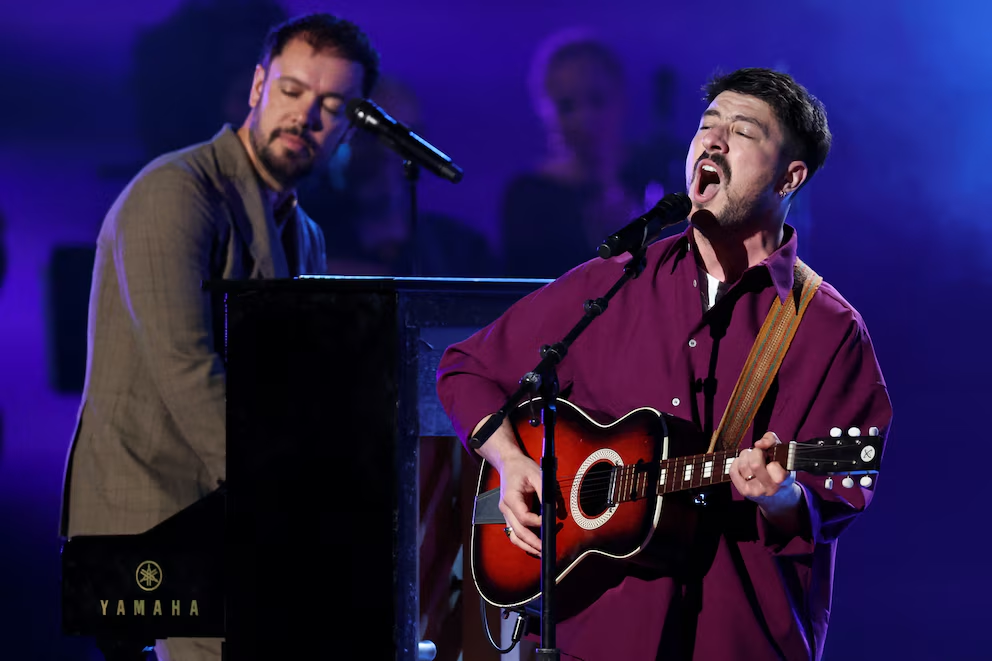
Folk is being rebuilt as a global language.
London, February 2026.
The new Mumford and Sons album, Prizefighter, arrives with a premise that would have sounded like overreach a decade ago: that a band once defined by a specific stomp and a specific era can treat collaboration as composition, not decoration, and still sound like itself. The record is framed as a return to core instincts, yet it does not behave like nostalgia. It behaves like an argument about what folk means once genre is no longer a border but a routing system. In the 21st century, the folk label survives less as instrumentation and more as emotional posture, and this album leans into that shift.
Prizefighter is built around a tight internal identity and an unusually wide external cast. Aaron Dessner is central as co-producer and co-writer, bringing a disciplined sense of texture and negative space that modern indie listeners recognize instantly. The band, now a trio fronted by Marcus Mumford alongside Ted Dwane and Ben Lovett, uses guests not as cameos but as pressure points that force the songs into new shapes. Chris Stapleton’s presence pulls the record toward American roots realism, while Hozier brings a different kind of intensity, closer to gospel heat than pub-chorus uplift. Gigi Perez and Gracie Abrams nudge the songwriting into a contemporary pop-adjacent intimacy that changes how the choruses land.
That guest list matters because it reflects where power sits in music now. Streaming era attention rewards adjacency, not purity, and collaboration is one of the few mechanisms that reliably bridges audiences without demanding a full aesthetic makeover. The album treats that reality with unusual candor, folding multiple fan communities into a single track list rather than releasing isolated feature singles that feel transactional. The effect is a folk record that behaves like a coalition, with each voice negotiating space rather than competing for it. This is not folk as a fixed tradition, but folk as a flexible social contract.
The record’s structure reinforces that logic. Fourteen tracks is enough room for range, and the sequencing alternates between kinetic, crowd-facing momentum and quieter, interior writing that feels closer to confession than performance. The familiar Mumford propulsion still appears, but it is less dominant and less predictable than on their early work. When the songs lean big, they do it with sharper arrangement discipline, and when they lean soft, they avoid drifting into mere mood. The album’s center of gravity is not volume; it is intent.
Some of the most revealing moments occur where collaborators change the band’s default emotional register. A duet can force a lyric to become dialogue instead of monologue, and that shift is one of the album’s quiet innovations. Abrams’ contribution, for example, is not simply vocal color, it introduces a different psychological lens, turning a song into a two-person narrative rather than a solitary declaration. Stapleton’s vocal authority, by contrast, brings a kind of grounded inevitability that can make a line feel final rather than searching. Hozier’s involvement adds a spiritual weight that complicates the band’s traditional earnestness, making it feel less clean and more lived-in.
The credits behind the scenes also signal a deliberate widening of the songwriting room. Names like Brandi Carlile, Finneas, Jon Bellion, Kevin Garrett, and Justin Vernon imply a workshop mentality where craft is shared across stylistic camps. That is not a small cultural detail; it is the modern version of the folk process itself, except the campfire has become a studio network. Folk historically evolved through communal revision, with songs reshaped by whoever carried them next. Prizefighter updates that mechanism for a world where artists carry audiences as well as melodies.
There is also a narrative subtext that the band does not need to announce loudly because listeners already know it. The group has lived through reinvention, public controversy, and lineup change, and the absence of Winston Marshall remains part of how the band is heard, whether they want it or not. In that context, a feature-heavy record can read as insecurity, but here it reads more like renewed confidence in curation. Choosing guests is an editorial act, and the album suggests the band is more interested in building a sound world than in proving self-sufficiency. The ambition is not to dominate the room alone, but to control the architecture of the room.
The album’s strongest claim, then, is not that folk can survive modernity, but that folk can absorb modernity and still feel human. Folk in the 21st century competes with hyper-polished pop and algorithmic sameness, and the easiest way to stand out is often exaggeration. Prizefighter takes a different route, betting that sincerity can be sophisticated, that texture can carry drama, and that emotional clarity can coexist with production complexity. It is a record that understands the audience’s fatigue with artificial grandeur, while also understanding that plainness without craft no longer holds attention.
If there is a risk, it is the same risk that shadows many contemporary albums built on cohesion rather than shock. Some tracks inevitably blur at the edges, and the record’s atmosphere can feel so consistently curated that a few songs pass by without leaving a hard outline. Yet even that speaks to the album’s central thesis: this is folk as continuity, not folk as novelty. The goal is not to invent a new genre, but to expand the operating range of an old one without breaking the emotional contract that made people care in the first place.
La narrativa también es poder. / Narrative is power too.